Clear Sky Science · en
Changes in postural control in older adults: a five-year longitudinal study
Why Standing Still Gets Harder With Age
Most of us take standing upright for granted—until a stumble, dizzy spell, or fall reminds us how much work our bodies do just to keep us balanced. As people live longer, understanding how balance changes with age is crucial for staying independent and preventing injury. This study followed a group of healthy, active older adults for five years to see how their ability to stand still changed over time, and whether those changes meant decline, adaptation, or a bit of both.
Who Was Studied and How
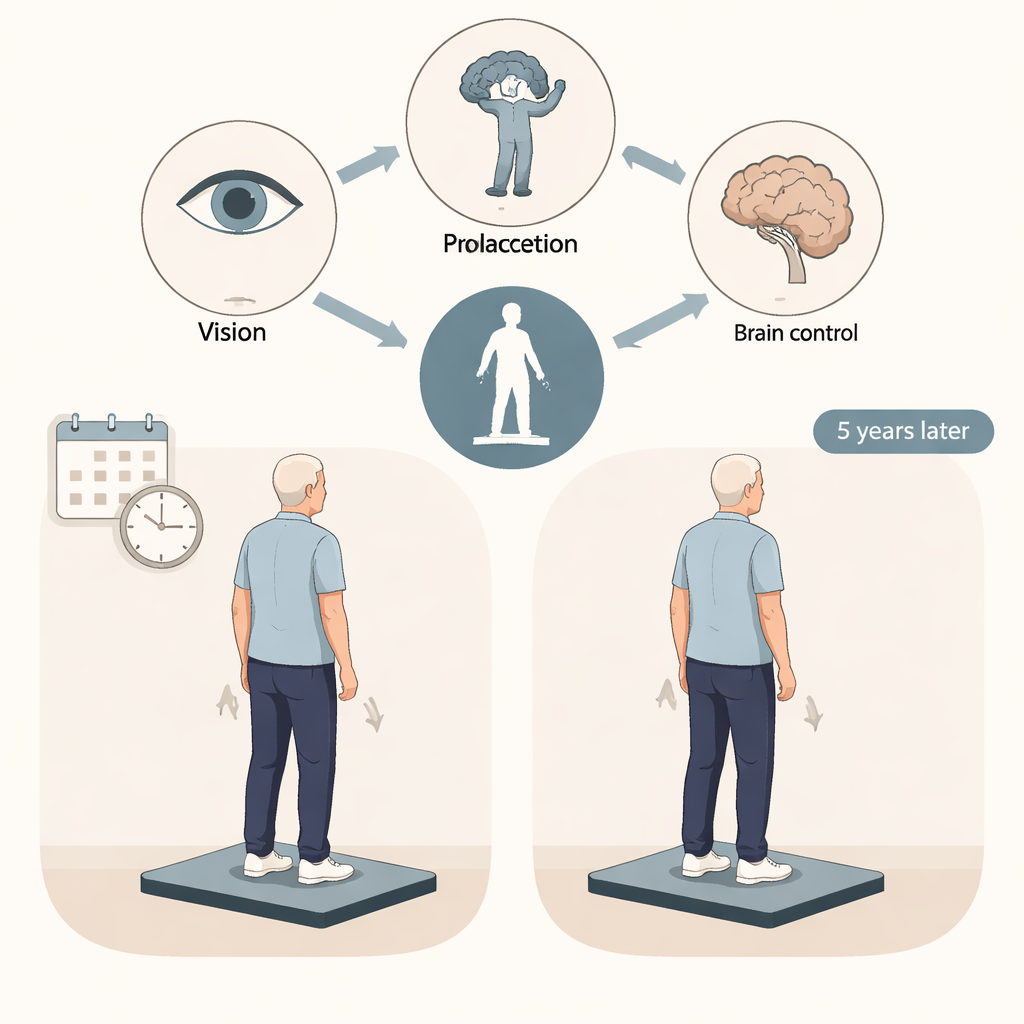
The researchers tracked 23 older adults in their early to mid‑60s at the start of the study, all of whom were living independently, free of major neurological or balance‑related illnesses, and able to move without walking aids. Each person was tested twice—once at the beginning and again five years later. The team used a confidence questionnaire about everyday balance, a standard clinical balance test, and a sensitive lab setup that measured tiny shifts in weight under the feet while people stood quietly in place. Participants stood either on a hard floor or on a foam pad, with their eyes open or closed, to mimic easier and harder balance situations.
Measuring the Invisible Sway
Even when people think they are standing perfectly still, their bodies are constantly making tiny corrections to keep the center of mass over the feet. The study captured this “sway” using force platforms, which record how the center of pressure moves side‑to‑side and front‑to‑back. The scientists looked at basic measures such as how fast this point moved, and also at more subtle features of the motion over time using mathematical tools that describe how regular or irregular the sway pattern is. In simple terms, faster sway can signal that the body is working harder to stay upright, while more irregular patterns can reflect either loss of control or flexible adaptation, depending on the context.
What Changed Over Five Years
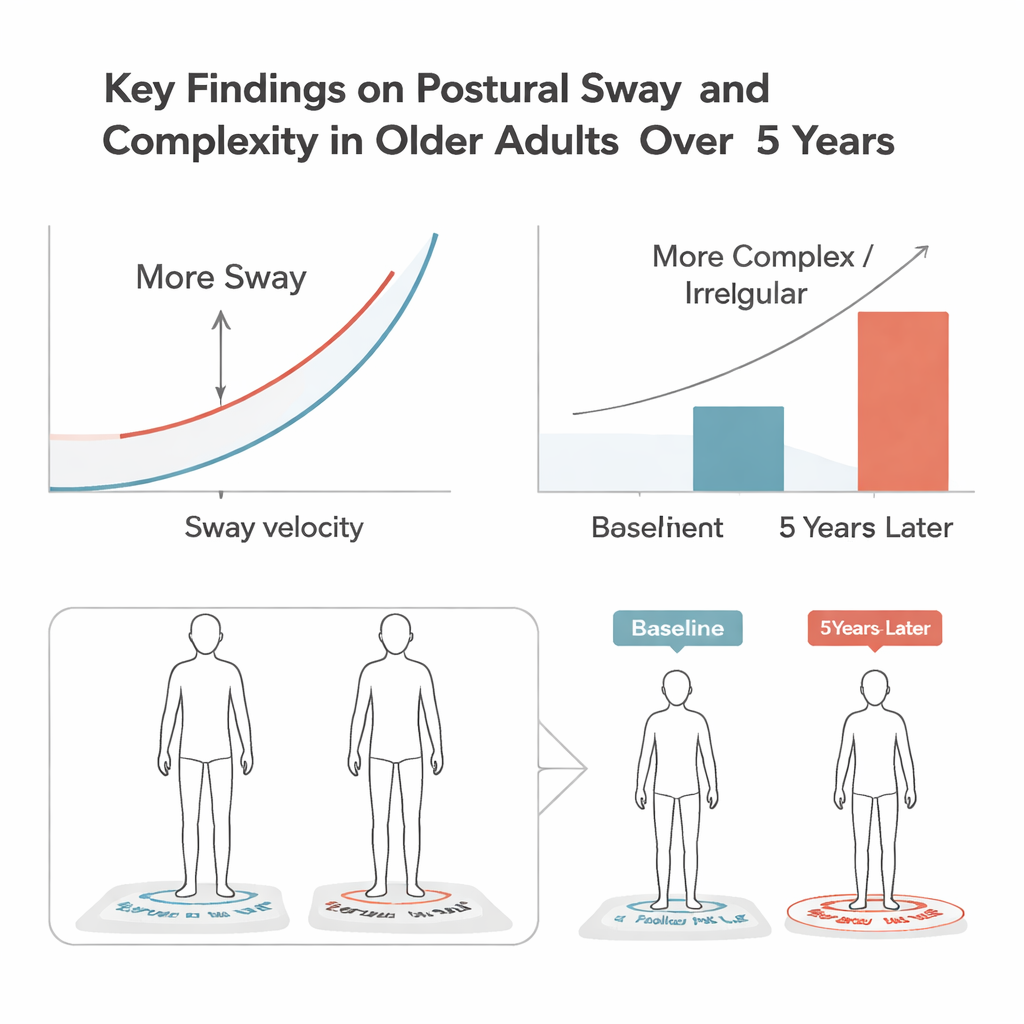
Over the five‑year period, these healthy older adults showed clear changes in how they stood. Their sway became faster in many situations, especially when they stood with eyes open on either a firm floor or a foam surface. On foam—where the surface is unstable and the feet receive less reliable information—the increases in sway speed and size were most pronounced. At the same time, the mathematical measures of irregularity and “complexity” of sway generally increased, particularly when vision was available. This means the motion of their bodies became less predictable and more varied across different time scales, suggesting the nervous system was engaging more actively to keep balance.
Confidence Without Clear Clinical Decline
Interestingly, while their sway patterns changed, the participants’ self‑reported confidence in their ability to stay balanced actually went up, and their scores on a standard clinic‑style balance test remained high and unchanged. In other words, simple tests and personal impressions did not detect a worsening of balance, even though laboratory measurements showed that the body was working differently. The authors interpret this as a sign that these high‑functioning older adults were adapting their balance strategies—making more frequent, flexible corrections—rather than sliding steadily toward frailty. However, the changes were modest, and the small, unusually healthy sample means the results may not apply to more vulnerable older people.
What It Means for Healthy Aging
For a lay reader, the main message is reassuring but nuanced. Even in healthy, active older adults, the quiet act of standing still becomes more demanding with age: the body sways more and the brain seems to get more involved in keeping posture steady, especially when vision and surface conditions resemble everyday life. Yet these shifts do not necessarily signal looming disability. Instead, they may reflect the body’s ability to reorganize its control systems and find new ways to stay upright. The study suggests that healthy aging is not simply a slow, unavoidable march toward poor balance, but a process in which the body adapts, at least for a time, by using more complex and flexible strategies to prevent falls.
Citation: Nohelova, D., Vuillerme, N., Bizovska, L. et al. Changes in postural control in older adults: a five-year longitudinal study. Sci Rep 16, 7610 (2026). https://doi.org/10.1038/s41598-026-36592-1
Keywords: balance in older adults, postural control, falls and aging, standing stability, healthy aging