Clear Sky Science · en
Sex differences in foraging ecology of the chick rearing Brünnich’s Guillemots (Uria lomvia) breeding in a High Arctic colony
Why Arctic seabirds share the load differently
On sheer cliffs in the High Arctic, thousands of Brünnich’s guillemots raise a single chick in a place that never gets dark in summer. At first glance, males and females look identical, but this study reveals that they divide the hard work of feeding and protecting their young in surprisingly different ways, using distinct parts of the surrounding ocean to get the job done.
Life on a narrow ledge
Brünnich’s guillemots, also called thick-billed murres, nest shoulder to shoulder on rocky ledges in Spitsbergen, Svalbard. Each pair raises only one chick a year, and one parent must stay to guard it from predators almost constantly. Earlier work showed that both parents incubate the egg and feed the chick, but that females tend to bring more food once the chick is a couple of weeks old, while males spend more time defending the nest and later escort the flightless fledgling out to sea alone. The question this study tackles is how two birds that look so similar manage these very different parental roles at sea without getting in each other’s way.
Following parents with space-age tags
To uncover these hidden routines, the researchers captured 15 adult guillemots at a large colony in the Hornsund fjord and equipped them with tiny GPS loggers that weighed less than 2% of the birds’ body mass. DNA tests on a few feathers were used to determine each bird’s sex. Over several weeks in July, the devices recorded the birds’ positions every 15 minutes whenever they were at sea. The team then combined the tracks with satellite measurements of sea surface temperature, chlorophyll (a proxy for productivity), and detailed maps of sea depth and seabed slope. By focusing on slow, stationary locations, they identified where the birds were most likely diving and feeding.
Similar trips, different hunting grounds
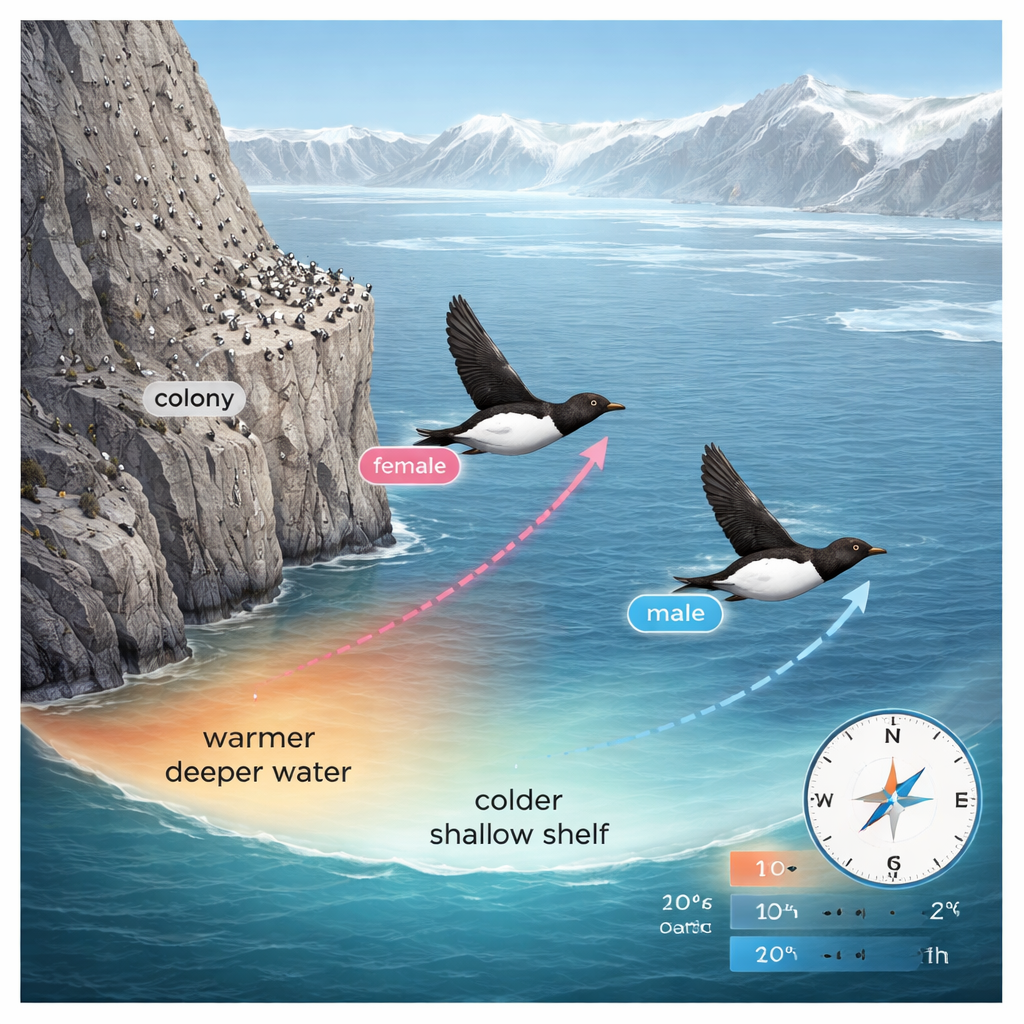
On the surface, males and females behaved much alike. They took a similar number of foraging trips per day, spent comparable amounts of time at the colony, and covered roughly the same distances during each trip. Yet when the researchers looked more closely at where those trips led, a clear pattern emerged. Males tended to forage closer to the colony, over the shallow continental shelf, where waters were colder and conditions were most favorable for the guillemots’ preferred Arctic prey such as polar cod. Females, in contrast, pushed farther offshore into deeper, warmer waters that are considered less optimal. As the chick-rearing season progressed and food near the colony was gradually depleted by many hungry mouths, both sexes extended their reach and dived more often, but females did so more rapidly and over a wider range of ocean conditions.
Balancing risk, energy, and chick care
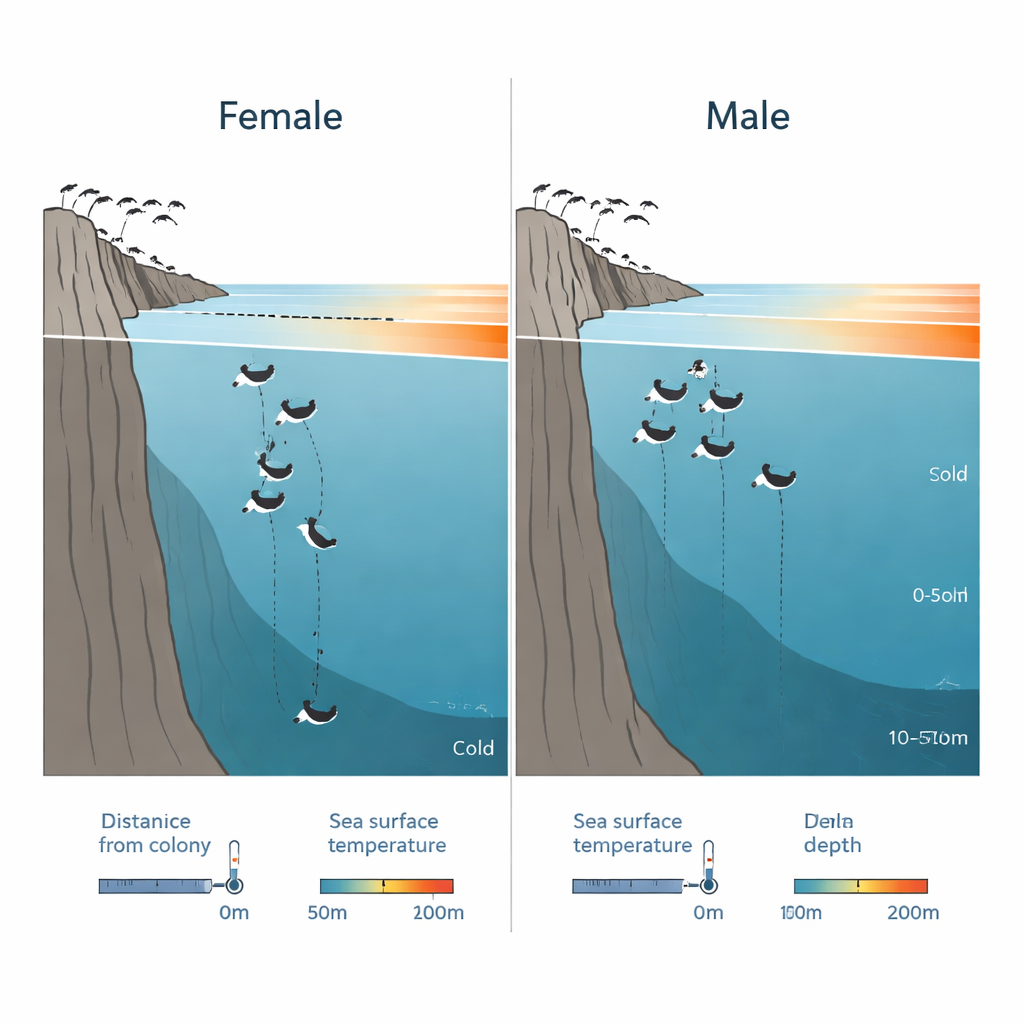
By measuring the range of temperatures, depths, and distances each sex used, the authors showed that females occupied a broader “foraging niche” than males, meaning they tapped into a more diverse set of marine habitats. This fits with the idea of risk-sharing between parents. Males, who later shoulder sole responsibility for the fledgling at sea, appear to adopt a safer, more predictable strategy: they stay closer to the colony and focus on reliable, if somewhat less energy-rich, prey. Females, freed from post-fledging duties, can afford to range farther into riskier, less predictable waters in search of higher energy food that boosts chick growth and helps rebuild their own reserves before their parental work ends.
What this means for Arctic wildlife
For a layperson, the take-home message is that even in species where males and females look nearly identical, they can use the environment in very different ways to raise a single chick successfully. In these High Arctic guillemots, males act as cautious providers and bodyguards, feeding closer to home, while females behave more like long-range hunters, exploring a broader and less forgiving seascape. As warming waters and shifting currents continue to reshape Arctic seas, understanding these subtle divisions of labor will be crucial for predicting how seabird families cope with change and for protecting the key feeding areas each sex depends on.
Citation: Cieślińska, K., Kidawa, D., Iliszko, L.M. et al. Sex differences in foraging ecology of the chick rearing Brünnich’s Guillemots (Uria lomvia) breeding in a High Arctic colony. Sci Rep 16, 5854 (2026). https://doi.org/10.1038/s41598-026-36586-z
Keywords: Arctic seabirds, parental care, foraging behavior, marine ecology, sexual differences