Clear Sky Science · en
Research on abnormal pressure of dark shale in the Tiemulike formation of the Yining Sag, Ili basin
Hidden Pressure Beneath an Asian Valley
Deep under a broad valley on the border between China and Kazakhstan, layers of dark, organic‑rich rock quietly store oil and gas—and something less obvious: unusually high fluid pressures. This study investigates those hidden pressures in the Tiemulike Formation beneath the Yining Sag of the Ili Basin. Understanding how and where such pressures form is crucial, because they help drive oil and gas out of source rocks and into potential reservoirs, while also affecting drilling safety and costs.
A Basin Shaped Like a Gentle Bowl
The Yining Sag is a large, bowl‑shaped depression framed by mountains and filled with sedimentary rocks laid down in ancient lakes and rivers. Among these rocks, the Tiemulike Formation stands out as a thick package of dark shale rich in organic matter—the remains of long‑dead plants and plankton. Only a few deep wells have reached this formation, but they reveal several hundred meters to more than a kilometer of dark shale, mudstone, and thin beds of limestone and sandstone. These shales are considered high‑quality “source rocks,” with enough organic carbon to generate substantial oil and gas under the right temperature and pressure conditions. 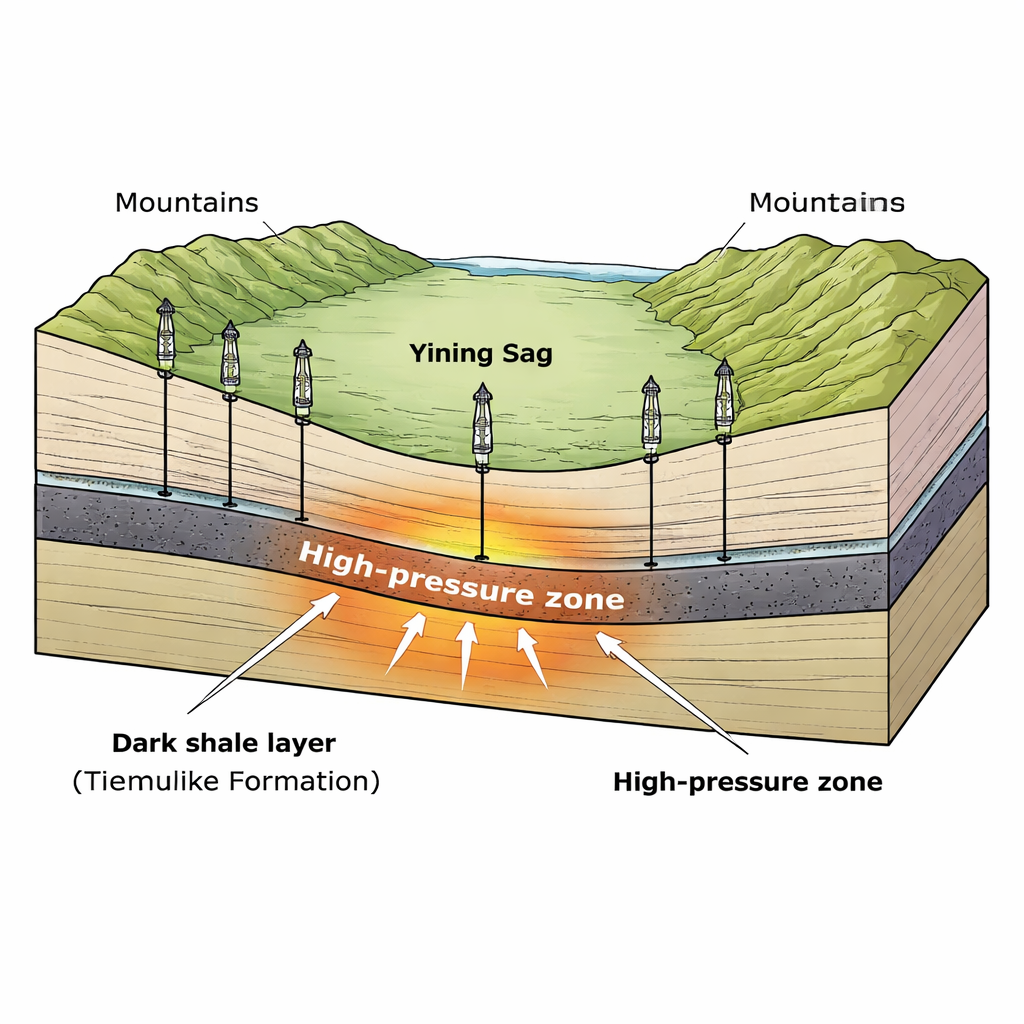
Listening to Rocks with Sound Waves
To probe pressures so far underground, the researchers turned to acoustic data recorded in four deep wells. As sediments are buried, their pores tend to squeeze shut, changing how fast sound waves travel through them. If fluid pressure inside the pores becomes unusually high, this natural compaction slows or even stalls, and the rock’s acoustic response deviates from the normal trend. The team first built a reference curve showing how shale in the region should compact and change its acoustic “travel time” with depth under ordinary conditions. They then applied a well‑known technique called the equilibrium depth method, which compares actual measurements to this ideal curve to estimate the true pore pressure, the “excess” pressure above normal water pressure, and a pressure coefficient that classifies how abnormal a given layer is.
Pockets of Overpressure in the Dark Shale
The calculations show that the dark shale of the Tiemulike Formation contains widespread abnormal pressures. Pressure coefficients mostly range from about 1.2 to nearly 2.0—values that correspond to moderately high up to ultrahigh pressures. In individual wells, excess pressure in the Tiemulike shales is typically 5–10 megapascals higher than in the overlying rock layers. With depth, pressure builds steadily, and in each key well the researchers identified three distinct “spikes” where pressures jump sharply over short vertical intervals. When they compared wells along a cross‑section through the central low‑lying zone of the sag, these high‑pressure spikes lined up laterally, revealing laterally continuous high‑pressure compartments that can reach about 29 MPa of excess pressure. Such compartments can strongly influence how hydrocarbons move and accumulate.
How Heat, Organic Matter, and Clays Pump Up the Pressure
Why is the shale so overpressured? Geological reconstructions show that since the Permian period, the Yining Sag has gone through rapid burial, episodes of uplift and erosion, and renewed subsidence, with the Tiemulike shales spending long periods at temperatures between roughly 80 °C and 150 °C. At these conditions, their organic matter converted into oil and gas, expanding by several percent—enough to exceed the shale’s limited pore space. At the same time, clay minerals within the shale underwent a transformation from montmorillonite to illite, releasing tightly held water into the rock’s tiny pores. Both processes add extra fluid volume in a rock that cannot easily leak, so pressure rises. Logging signatures, organic carbon measurements, and maturity indicators (such as vitrinite reflectance) all support this picture of strong hydrocarbon generation and clay alteration as the main drivers of overpressure. 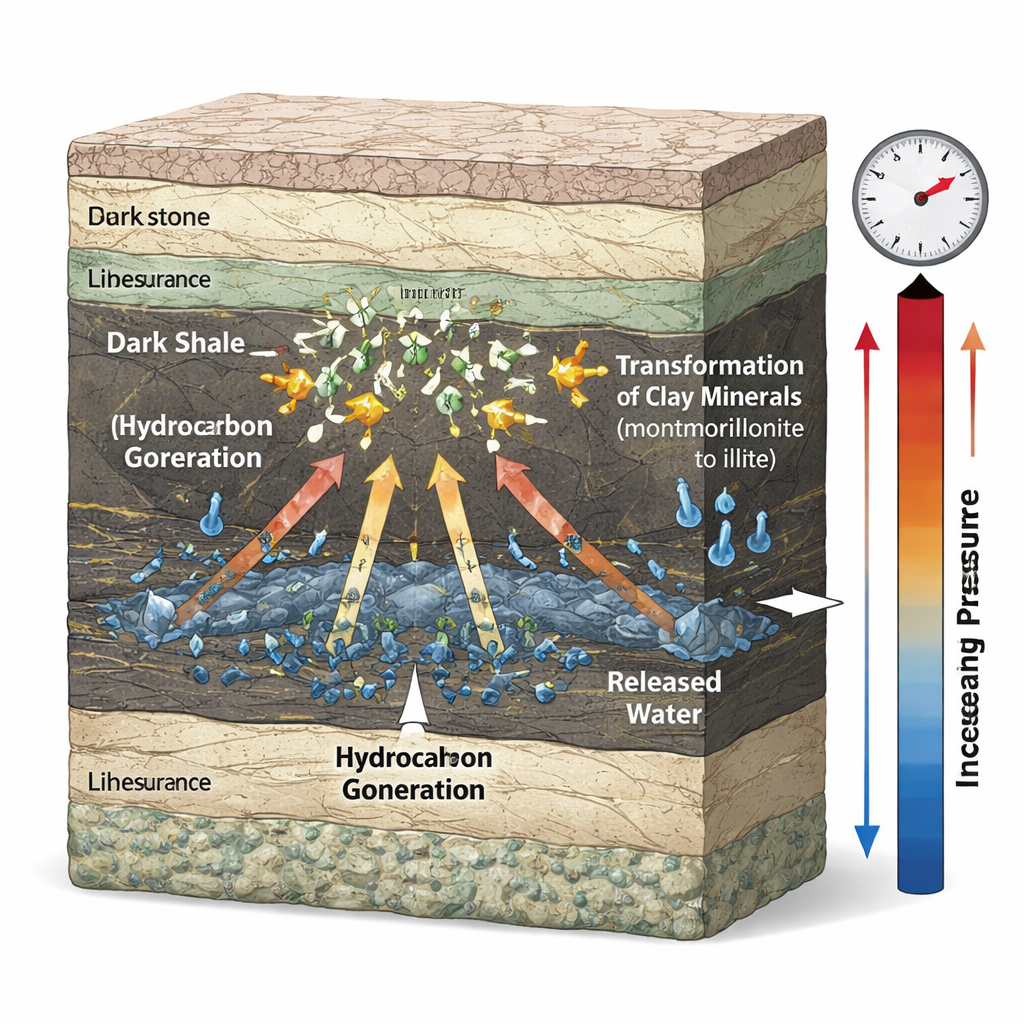
What This Means for Future Energy Exploration
In everyday terms, the study shows that the dark shale beneath the Yining Sag behaves like a sealed pressure cooker: as buried organic matter cooks into oil and gas, and as clays release additional water, fluids have nowhere to go and pressure climbs. These overpressured zones appear in stacked, laterally extensive compartments in the central part of the basin, providing both the energy to push hydrocarbons out of the shale and a warning for drillers who must manage high pressures safely. Although no well has yet fully penetrated the Tiemulike Formation, the results point to promising shale oil and gas potential, while underscoring the need to understand subsurface pressure systems before tapping these deep resources.
Citation: Yang, W., Ren, Y. & Igorevich, M.I. Research on abnormal pressure of dark shale in the Tiemulike formation of the Yining Sag, Ili basin. Sci Rep 16, 6516 (2026). https://doi.org/10.1038/s41598-026-36584-1
Keywords: shale overpressure, Ili Basin, Yining Sag, Tiemulike Formation, shale gas