Clear Sky Science · en
Efficacy of ambulance air purifiers with different photocatalytic oxidation components in the removal of Bacillus subtilis spores
Why Clean Air in Ambulances Matters
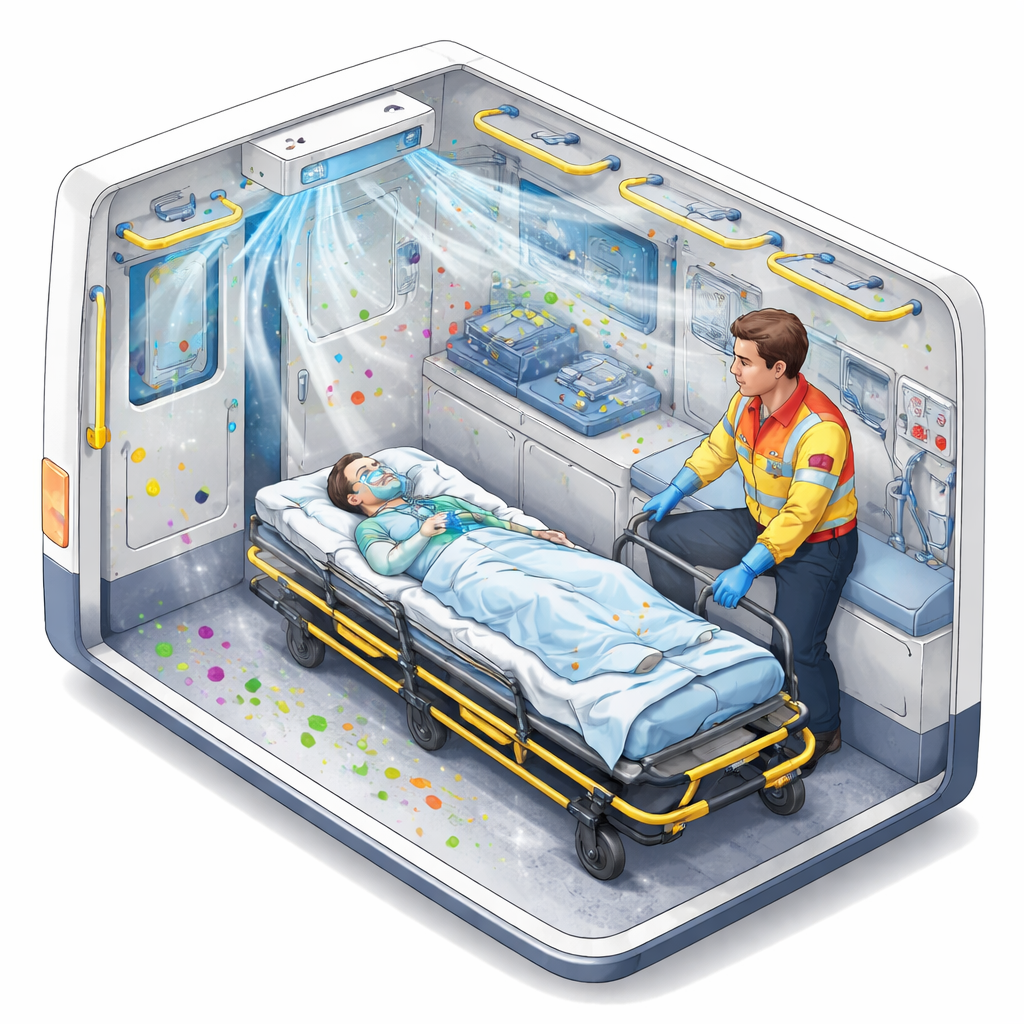
Ambulances are often the first place where very sick patients meet medical staff, yet the air and surfaces inside these vehicles are rarely thought about by the public. In reality, ambulances are small, tightly sealed rooms on wheels where coughs and sneezes can fill the air with germs that settle on floors, stretchers, and equipment. This study asks a simple but important question: can we build compact air purifiers that quietly scrub an ambulance’s air of hardy microbes, without adding new risks for patients and paramedics?
Germs in a Moving Room
The authors begin by outlining why ambulances are such risky spaces for infection. Patients with illnesses like COVID-19, tuberculosis, or other serious respiratory infections release tiny droplets packed with germs when they cough, talk, or breathe. In a cramped vehicle with poor ventilation, these droplets can linger in the air and coat nearby surfaces, from oxygen tanks to door handles. Studies have found drug-resistant bacteria such as MRSA and VRE on ambulance interiors, yet current cleaning practices—like briefly airing out the vehicle and wiping down surfaces—are often inconsistent and may not keep up with busy emergency services.
A New Kind of Air Cleaner
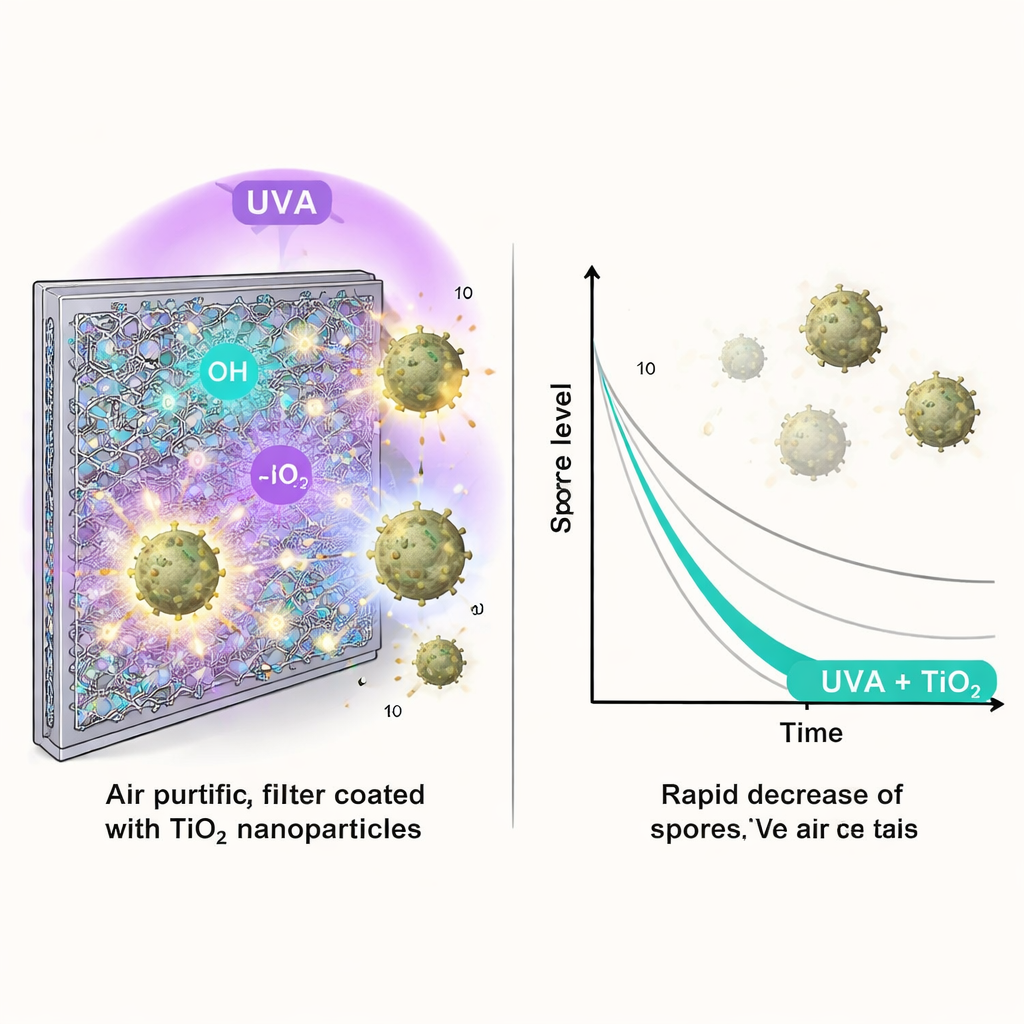
To tackle this problem, the researchers tested an advanced type of air purifier based on photocatalytic oxidation. In simple terms, this technology shines ultraviolet light onto a special coating on a filter. When the light hits the coating, it creates short-lived, highly reactive molecules that can damage and kill germs that touch the filter. The team built a modular prototype that could be run in four different ways: using a titanium dioxide (TiO₂) coating with UVA light, the same system plus added ozone gas, a zinc oxide (ZnO) coating with UVC light, and that same ZnO system combined with ozone. They installed this device in a test chamber built to match the size and airflow of a real ambulance and then filled the space with spores of Bacillus subtilis—a tough, harmless stand-in for more dangerous pathogens.
Putting the Systems to the Test
Inside the chamber, the spores were sprayed into the air and allowed to mix evenly before the air purifiers were switched on. The scientists then repeatedly sampled both the air and key surfaces over two and a half hours. In the air, two systems stood out: the TiO₂ filter with UVA light alone, and the same combination with added ozone. Both cut airborne spores by more than 80% within just 15 minutes. The ozone-free UVA+TiO₂ system completely cleared spores from the air within 90 minutes and kept them down, while the ozone-assisted and ZnO-based systems were either slightly weaker or less stable over time. On surfaces, the UVA+TiO₂ setup again performed best, cutting contamination by about 97% after two hours. Systems that relied on ozone or ZnO either removed fewer spores or showed signs that some spores were recovering.
Why One Design Works Best
The researchers traced the success of the UVA+TiO₂ purifier to how its materials and light source work together. Titanium dioxide in a particular crystal form responds efficiently to the gentler UVA light used here, producing a steady stream of reactive molecules without quickly wearing out the coating. In contrast, the harsher UVC light and the presence of ozone can damage the filter material over time, reducing performance. Ozone itself is also a lung irritant, making it a poor choice in a cramped space where patients, paramedics, and family members are breathing the same air. Importantly, the study shows that as airborne spores are removed, fewer land on surfaces, so cleaning the air has a double benefit.
What This Means for Real Ambulances
For a layperson, the bottom line is straightforward: a compact air purifier that combines a TiO₂-coated filter with mild UVA light can, under realistic test conditions, strip the air of even very hardy microbial spores and greatly reduce surface contamination—without adding harmful gases. While the experiments were done in a controlled mock-up rather than in operating ambulances, the results suggest that this ozone-free design could make ambulances safer for everyone inside by quietly reducing invisible germs during and between trips. Future work in real vehicles and against real drug-resistant pathogens will be needed, but this technology offers a promising, practical new tool for infection control on the front lines of emergency care.
Citation: Poohpajit, A., Khiewkhern, S., Thunyasirinon, C. et al. Efficacy of ambulance air purifiers with different photocatalytic oxidation components in the removal of Bacillus subtilis spores. Sci Rep 16, 5615 (2026). https://doi.org/10.1038/s41598-026-36581-4
Keywords: ambulance air quality, infection control, photocatalytic air purifier, UVA TiO2, airborne pathogens