Clear Sky Science · en
Occupational polycyclic aromatic hydrocarbons (PAHs) exposure is associated with accelerated aging trajectories in Chinese coke oven workers
Why factory air can matter for how fast we age
Most of us think of aging as a simple matter of birthdays. But scientists now know that our "biological age"—how worn out our bodies really are—can run ahead of or behind the calendar. This study looks at Chinese coke oven workers who regularly breathe in a class of air pollutants called polycyclic aromatic hydrocarbons (PAHs). The researchers asked a simple but important question: does long‑term exposure to these industrial fumes make workers age faster on the inside, and if so, by how much?
Dirty smoke and invisible chemicals
PAHs are a family of chemicals formed whenever coal, oil, wood, or other organic material burns without enough oxygen. They are a major component of industrial smoke and city air pollution, and previous work has linked them to heart disease, cancer, cognitive problems, and even wrinkles. Coke oven workers stand very close to one of the strongest sources of PAHs, because they handle coal as it is heated to make coke for steel production. That makes them an ideal group for studying how everyday job exposures might quietly influence the pace of aging.
Measuring age beyond birthdays
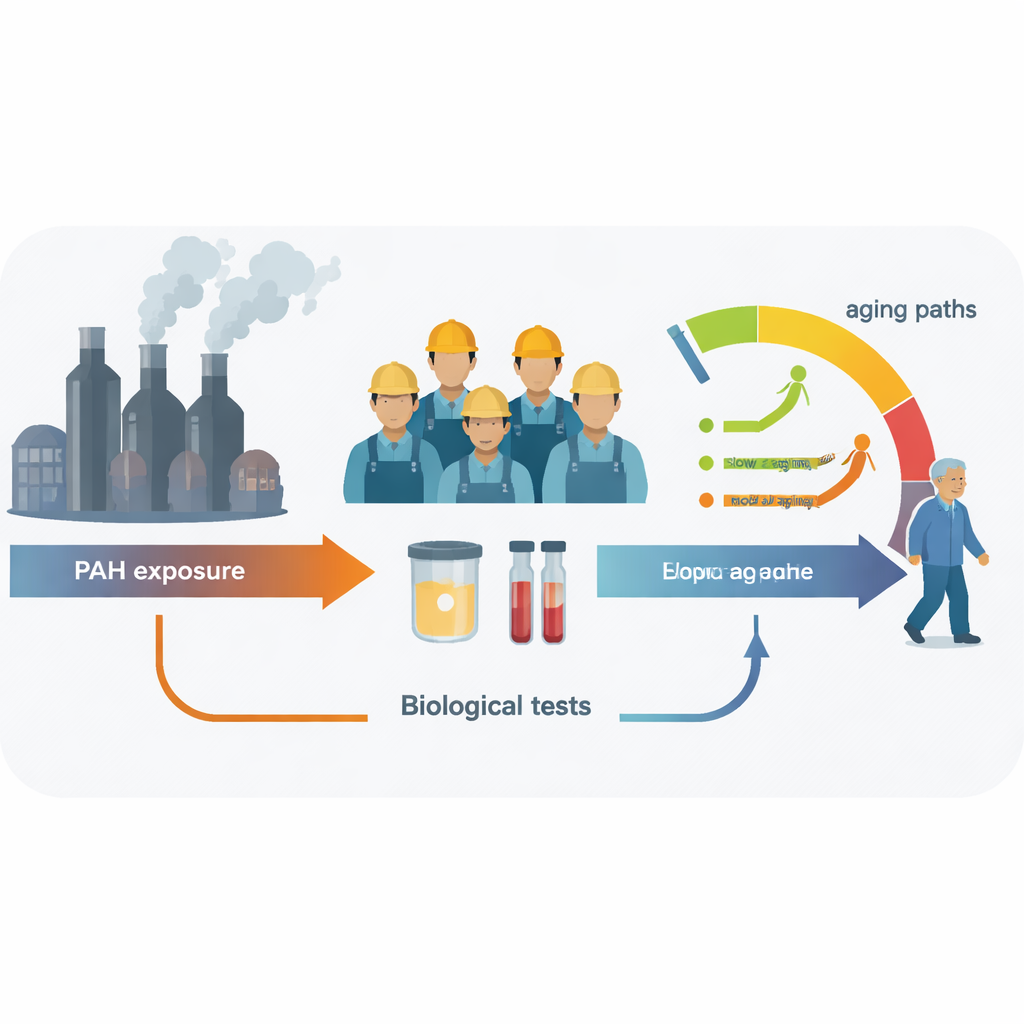
Instead of just counting years, the team estimated each person’s biological age using 12 routine health measurements from blood pressure, liver and kidney function, blood fats, and blood cells. Using a method developed by statisticians Klemera and Doubal, they combined these readings into a single "biological age" score and then calculated how far each worker was aging faster or slower than expected for their actual age. This "aging acceleration" was tracked at five different time points between 2019 and 2023, allowing the scientists to see how aging paths unfolded over several years rather than at a single checkup.
Following workers over time
The study followed 610 coke oven workers and 454 comparison workers from a water treatment plant in Shanxi Province, China. Everyone filled out detailed questionnaires and provided blood and urine samples. The urine was tested for 11 breakdown products of PAHs, which serve as fingerprints of recent exposure. Using a statistical approach called group‑based trajectory modeling, the researchers sorted 673 workers with complete data into three aging patterns: a "slow aging" group whose bodies stayed younger than their calendar age; a "moderately accelerated" group, which included most workers; and a "highly accelerated" group whose biological age pulled ahead of their actual age year after year.
Smoky jobs and faster aging paths
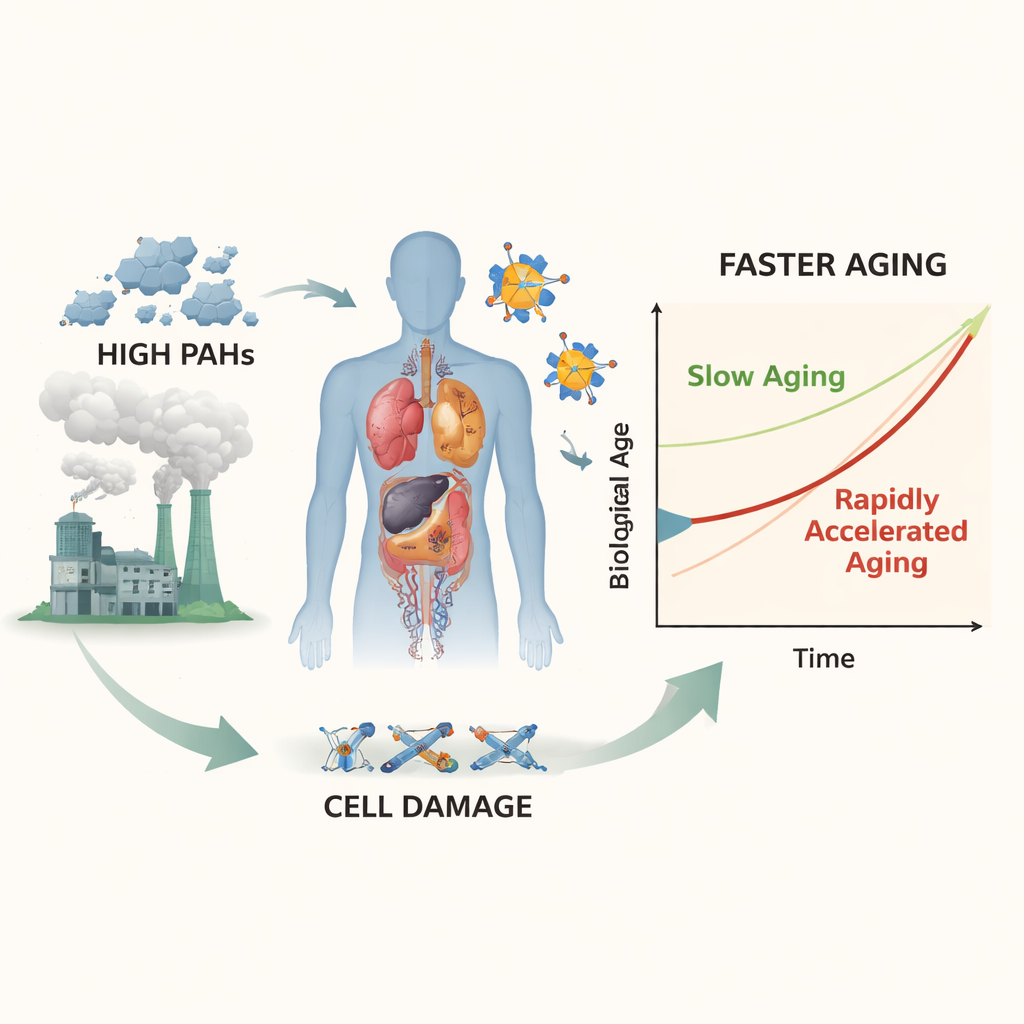
When the scientists compared these aging paths with urine PAH levels, clear patterns emerged. Workers with higher total PAH metabolites in their urine (Σ‑OHPAHs), and especially those with higher levels of two markers—1‑hydroxypyrene and 2‑hydroxyphenanthrene—tended to show greater aging acceleration. Statistically, each step up in these pollutants nudged biological age forward by a fraction of a year, and workers in the top exposure group were much more likely to fall into the rapidly accelerated aging track. In contrast, one PAH marker (2‑hydroxyfluorene) showed a weaker, opposite pattern, hinting that different PAH compounds may act differently in the body. Overall, coke oven workers had higher PAH levels and steeper aging curves than the comparison group, even after accounting for smoking, alcohol, exercise, and income.
What this means for workers and the rest of us
To a non‑specialist, the numbers boil down to this: in heavily exposed workers, the internal wear and tear linked to PAH‑filled air builds up faster, pushing their bodies onto a "fast track" of aging. The study does not prove that PAHs are the only cause, and it cannot yet say exactly how much earlier disease will appear. But it strongly suggests that cutting occupational exposure—through better ventilation, protective gear, and cleaner technologies—could slow the biological clock for thousands of workers. More broadly, it adds to growing evidence that the quality of the air we breathe at work and in cities is not just about comfort or short‑term illness; it may quietly shape how quickly we age over decades.
Citation: Wang, Y., Geng, S., Wang, W. et al. Occupational polycyclic aromatic hydrocarbons (PAHs) exposure is associated with accelerated aging trajectories in Chinese coke oven workers. Sci Rep 16, 6852 (2026). https://doi.org/10.1038/s41598-026-36579-y
Keywords: air pollution, occupational health, biological aging, coke oven workers, polycyclic aromatic hydrocarbons