Clear Sky Science · en
Evaluation of seismic behavior and collapse capacity of dual RC frame–shear wall structures considering soil-structure interaction under varying soil conditions
Why the Ground Beneath Buildings Matters
When we picture earthquake-resistant buildings, we often focus on the strength of columns, beams, and walls. Yet a crucial part of the story lies out of sight, in the soil and foundations that support the structure. This study asks a deceptively simple question with big safety implications: how much does the flexibility of the ground itself change the way reinforced-concrete buildings behave in strong earthquakes, and could current design rules be underestimating the risk of collapse—especially on soft soils?
How Modern Concrete Buildings Stand Up to Shaking
Many medium- and high-rise concrete buildings use a "dual" system to resist earthquakes. Vertical concrete walls, called shear walls, work together with surrounding frames made of beams and columns. The stiff walls carry most of the sideways shaking, while the frames provide backup strength and help control damage. Building codes typically assume that the base of the structure is fixed to the ground, meaning the foundation does not rock or slide. In reality, especially on softer soils, the structure, foundation, and soil all move and deform together. This soil–foundation–structure interaction can stretch the building’s natural period, change how forces travel through the frame and walls, and alter where damage concentrates during an earthquake. 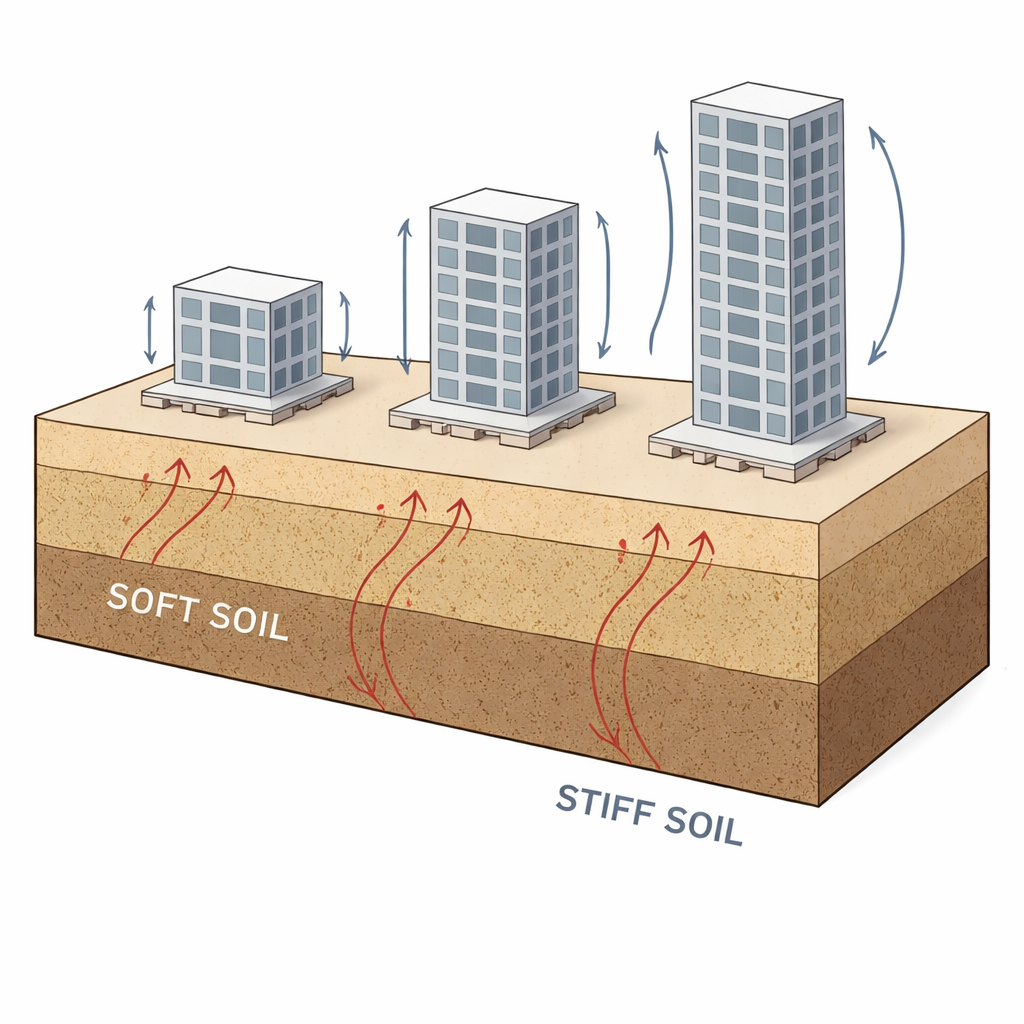
Putting Buildings and Soils to the Test
The researchers created detailed computer models of three reinforced-concrete buildings—5, 10, and 15 stories tall—designed according to current U.S. codes for two common site types: a stiffer soil (Type C) and a softer one (Type D). For each height and soil, they compared an idealized fixed-base version with a more realistic flexible-base version in which foundations could rock and settle on springs representing soil behavior. They then ran thousands of simulations using real earthquake records, including design-level events and far more intense shaking. These simulations captured not only overall drifts (how much each story sways) but also "plastic hinges"—zones where beams and columns yield and accumulate permanent damage—and ultimately whether the building would be expected to collapse.
What Happens on Soft Versus Stiff Ground
The results show that flexible foundations can both soften and endanger buildings, with the strongest effects on shorter structures and soft soil. Allowing the building to rock lengthened its vibration period and reduced the peak base forces, but it also increased story drifts and beam damage. On the softer soil, interstory drifts in the 5‑story model rose by up to 100 percent compared with the fixed-base case; even the 10‑ and 15‑story versions on soft soil saw drift increases of about 58 and 18 percent. As the soil grew softer, the shear walls carried a smaller share of the shaking, shifting more load into the surrounding frames. That redistribution caused larger rotations at beam ends—up to 65 percent higher on soft soil and 36 percent higher on stiffer soil—especially in the lowest stories and at the outer bays where damage tends to trigger collapse.
From Extra Sway to Higher Collapse Risk
To move beyond individual simulations, the team used a method called incremental dynamic analysis to build fragility curves—statistical relationships between ground shaking intensity and the probability of collapse. These curves revealed that flexible bases consistently increased collapse likelihood, particularly on soft ground. For buildings on the softer soil, the margin between design-level shaking and collapse shrank by as much as 35 percent when soil flexibility was included. At maximum considered earthquake levels, the chance of collapse for structures on soft soil jumped into the 9–12 percent range, compared with only a few percent when foundations were assumed perfectly fixed. Notably, for tall buildings the extra rocking appeared modest at design-level shaking, but at very high intensities it amplified sideways drifts and so‑called P–Delta effects, in which leaning gravity loads further destabilize the structure. 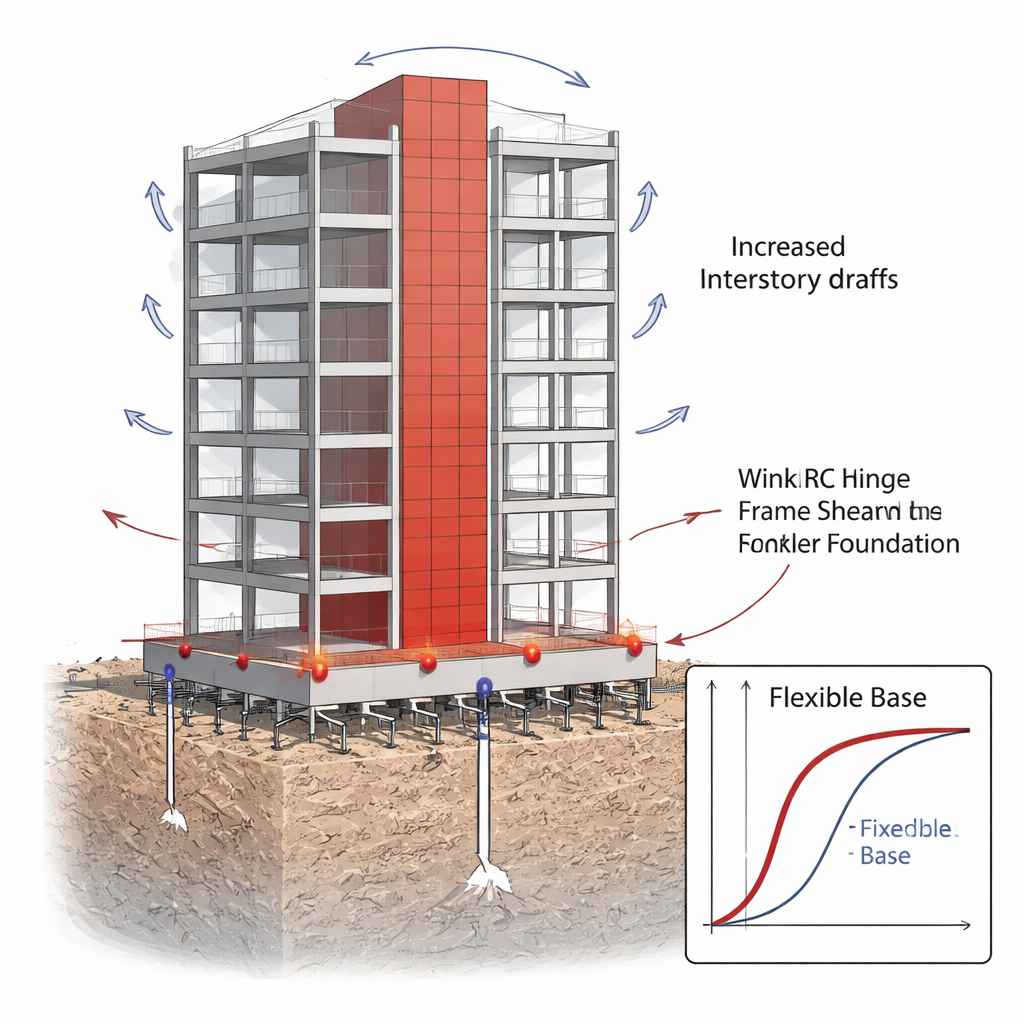
What This Means for Safer Cities
For non-specialists, the key message is that the “give” in the ground can quietly erode the safety margin built into modern concrete buildings, especially dual wall–frame systems on soft soils. Designs that look robust when foundations are treated as rigid may, in reality, be closer to collapse if the soil allows significant rocking and settling. The authors conclude that building codes and engineering practice should more explicitly account for soil–foundation–structure interaction, rather than assuming it is always beneficial. Doing so would yield more reliable estimates of earthquake demands and more consistent safety across different sites, helping ensure that buildings on soft ground do not face a hidden disadvantage when the next big earthquake strikes.
Citation: Yousefi, A., Tehrani, P. Evaluation of seismic behavior and collapse capacity of dual RC frame–shear wall structures considering soil-structure interaction under varying soil conditions. Sci Rep 16, 6211 (2026). https://doi.org/10.1038/s41598-026-36577-0
Keywords: soil structure interaction, earthquake engineering, reinforced concrete buildings, seismic collapse risk, soft soil effects