Clear Sky Science · en
Beyond decoration: free-standing lace embroidery for 3D shaped surgical mesh implants
Why sewing can matter in surgery
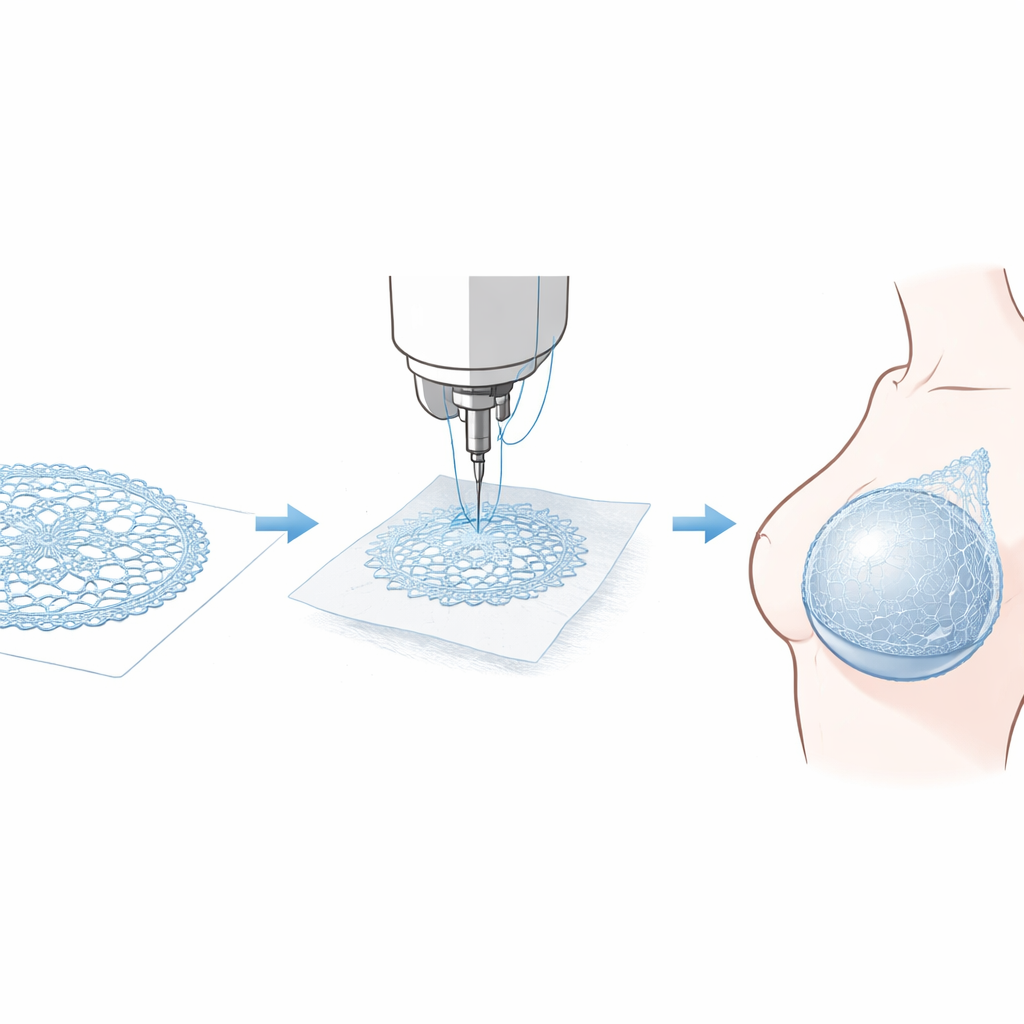
Most of us think of embroidery as a way to decorate clothes or linens, not as a tool that could change surgery. Yet surgeons who rebuild breasts after cancer often rely on fabric-like meshes to cradle and support soft implants inside the body. These meshes are usually cut from flat sheets and stitched into simple pockets, which can wrinkle, bunch up, or fail to hug the rounded shape of an implant. This study explores an unexpected idea: using free‑standing lace embroidery to "draw" custom 3D mesh pockets that match an implant’s shape far more precisely, while using less material.
From fancy stitches to medical support
Machine embroidery normally sews pairs of threads onto a temporary backing to create decorative patterns. When that backing is later dissolved, what remains is a delicate web of intersecting threads known as free‑standing lace. The researchers behind this work wondered whether this same technique could be turned into a precise, lightweight support structure for breast implants used in reconstruction and cosmetic surgery. Current meshes start as flat textiles that must be folded and sewn in the operating room or bought as simple pre‑formed pockets. Either way, it is difficult to cover a dome‑shaped implant smoothly, so folds and thick seams tend to appear, and extra operating time is needed to shape the pocket by hand.
Designing a pocket that starts in 3D
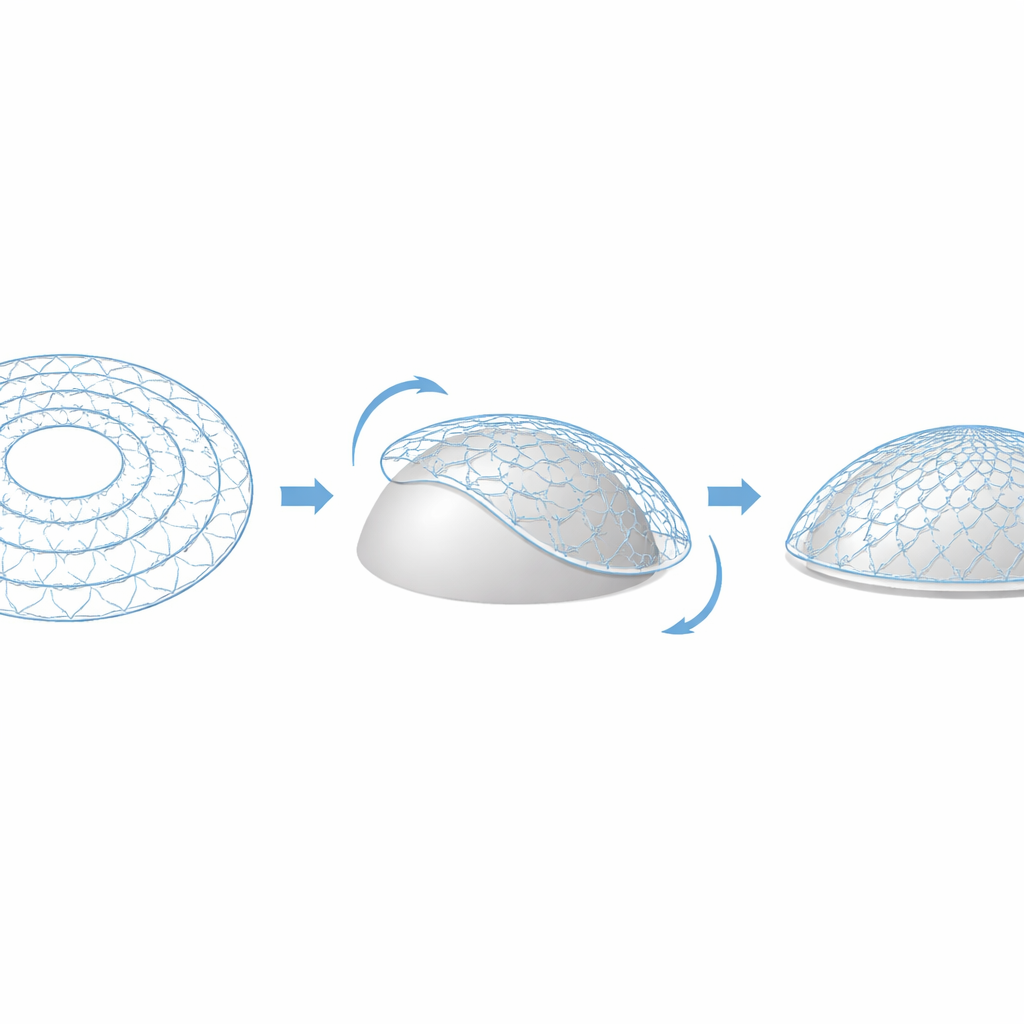
Instead of cutting and stitching flat fabric, the team designed the pocket directly as a pattern of stitches in computer‑aided design software. The pocket was divided into three parts: a dome that reinforces the breast’s front side, a back that keeps the implant from slipping out, and extensions that let the surgeon anchor everything to nearby tissue. The dome was drawn as a set of concentric rings linked by zigzagging connections that act like tiny reservoirs of extra thread. When this flat lace is draped over a round form, those zigzags straighten and let each ring rotate slightly, so the whole structure pops up into a smooth 3D shell instead of wrinkling. Because the entire stitch path is digital, the designers can calculate in advance how high and curved the dome will be and how big the pores between threads are, then adjust the pattern before any fabric is made.
Putting embroidered pockets to the test
To see whether these embroidered meshes would work in practice, the researchers 3D‑printed models of standard breast implants and then manufactured several pocket designs on a commercial embroidery machine using thin polypropylene threads and a water‑soluble backing. After the backing was washed away, the lace was draped over the implant models and the back was closed with a final thread pull and knot. Some patterns formed a closed dome, others left a central opening or a deliberately flat center, and one was scaled up for a larger implant size. Mechanical tests stretched each pocket until it failed, while drop tests mimicked sudden jolts, such as accidental bumps during daily life. The team also used 3D scanners and computer simulations to measure how closely each mesh hugged the implant surface and where stresses concentrated.
What the measurements revealed
The embroidered domes held the 3D‑printed implants securely and, in optimized designs, showed only tiny gaps—typically 1–2 millimeters—between mesh and implant. Closed dome pockets carried higher forces before breaking than versions with large openings or flat tops, confirming that a smooth, continuous shell spreads load more evenly. Thicker threads and denser stitch patterns made the pockets stronger, while still keeping their overall weight lower than that of some commercial meshes. In drop tests using real silicone implants, only the designs with a reinforced back thread successfully contained the heavier implant without tearing or letting it escape. Computer models pointed to the transition zone between the dome and the attachment band as a hotspot for stress, highlighting exactly where future designs can be refined.
Why this approach could matter for patients
In simple terms, this work shows that you can "draw" a made‑to‑measure mesh pocket in thread, rather than cutting it out of flat cloth and hoping it will fit a curved body. Free‑standing lace embroidery lets engineers control the 3D shape, weight, and pore layout of the mesh down to fine detail, and scale the same design to different implant sizes without losing its fit. The resulting pockets are light, strong, and capable of wrapping smoothly around rounded implants with very little wrinkling. Although this is still an early, proof‑of‑concept study, it suggests that future breast reconstruction—and potentially other implant surgeries—could use digitally tailored embroidered meshes that are quicker for surgeons to place and put less foreign material into the body.
Citation: Tonndorf, R., Elschner, C., Osterberg, A. et al. Beyond decoration: free-standing lace embroidery for 3D shaped surgical mesh implants. Sci Rep 16, 8270 (2026). https://doi.org/10.1038/s41598-026-36575-2
Keywords: breast reconstruction, surgical mesh, machine embroidery, medical textiles, 3D implants