Clear Sky Science · en
An LSTM architecture for real-time multi-domain stability boundary prediction beyond post-fault dependency in power systems
Keeping the Lights On in a Shakier Grid
As power grids absorb more wind and solar farms and operate closer to their limits, it becomes harder for operators to know how close they are to a blackout. This paper presents a new way to watch the grid in real time, using an artificial intelligence model that reads fast electrical measurements and turns them into an easy-to-understand health score. The goal is to give control-room staff precious extra seconds to react before a disturbance snowballs into widespread outages.
Why Grid Stability Is Getting Harder
Electric power systems must keep three things in check at once: voltage, frequency, and the delicate dance of rotating generators staying in step. A problem in any one of these areas can drag down the others, leading to cascading failures. Traditionally, engineers assess these stability types separately and often only after a fault has already occurred, using slow simulations or simplified yes/no rules. That approach is increasingly inadequate for modern, renewable-heavy grids, where conditions change quickly and there is little margin for error.
One Safety Gauge for Many Hidden Risks
The authors propose a single "comprehensive dynamic security index" (CDSI) that condenses several complex stability measures into one number between 0 and 1. This index blends how well voltages recover after a disturbance, how safely generator angles behave, and how far system frequency stays from dangerous limits. A value near 1 means the grid is comfortably safe; a value near 0 signals danger. The index is also divided into five categories—normal, alarm, strong risk, urgent, and unstable—so operators can match their actions to the level of threat rather than relying on a crude stable/unstable verdict. 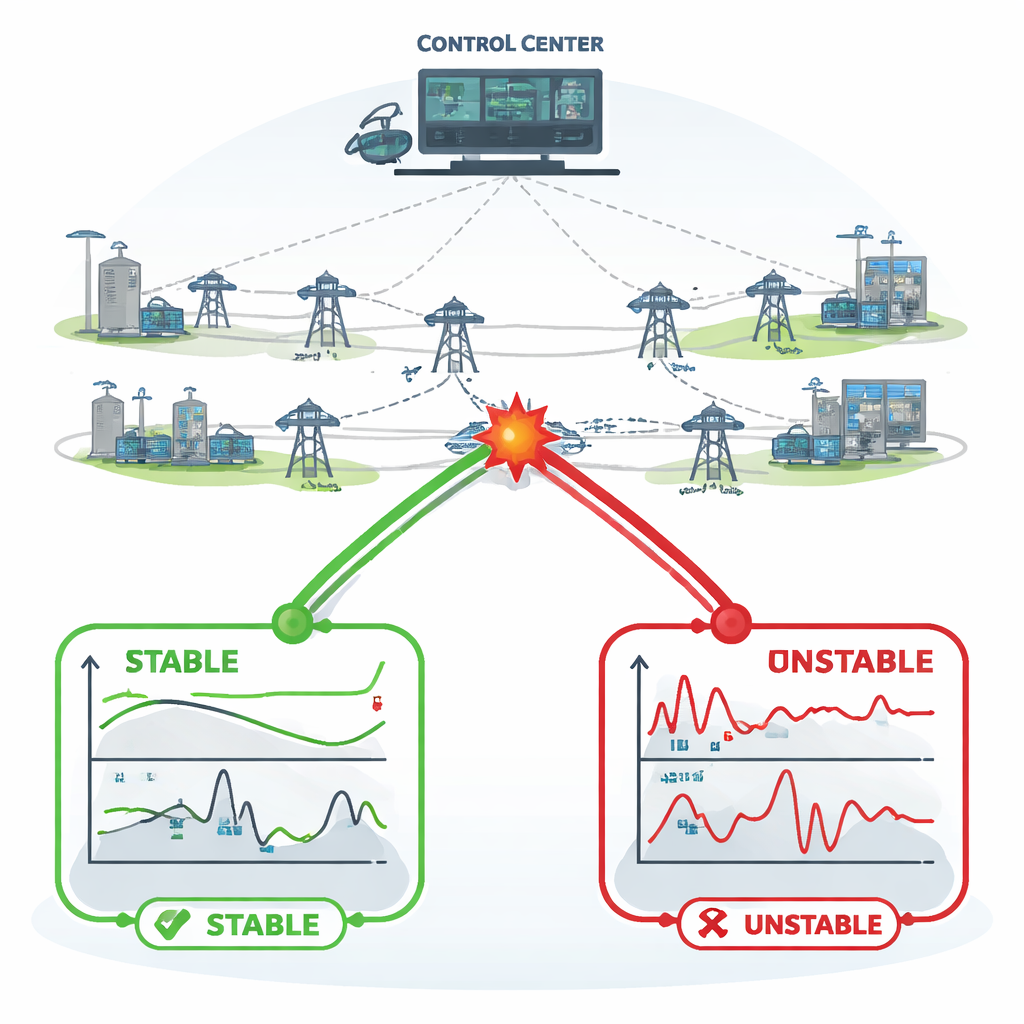
Teaching AI to Read the Grid in Real Time
To predict this index before things go wrong, the study uses a type of neural network designed for time series, called a long short-term memory (LSTM) network, combined with a standard deep network. Instead of waiting for full post-fault behavior, the model only needs measurements taken just before and during a fault, mainly at generator terminals where high-speed sensors (phasor measurement units) are already common. These measurements include voltages and power flows and how quickly they change. In extensive computer experiments on standard test grids, the system learned to map these short snippets of data to the CDSI categories with more than 98% accuracy.
Making AI Predictions Easier to Trust
A key concern in control rooms is understanding why an algorithm raises an alarm. The authors address this by adding an "attention" mechanism that highlights which inputs influenced each prediction the most. For example, during an event that mainly threatens frequency, the model naturally focuses on changes in generator power; for voltage problems, it focuses more on rapid voltage swings at weak points in the network. This makes it easier to trace warnings back to specific equipment or locations, increasing confidence that the system reflects real physics rather than acting like a black box. 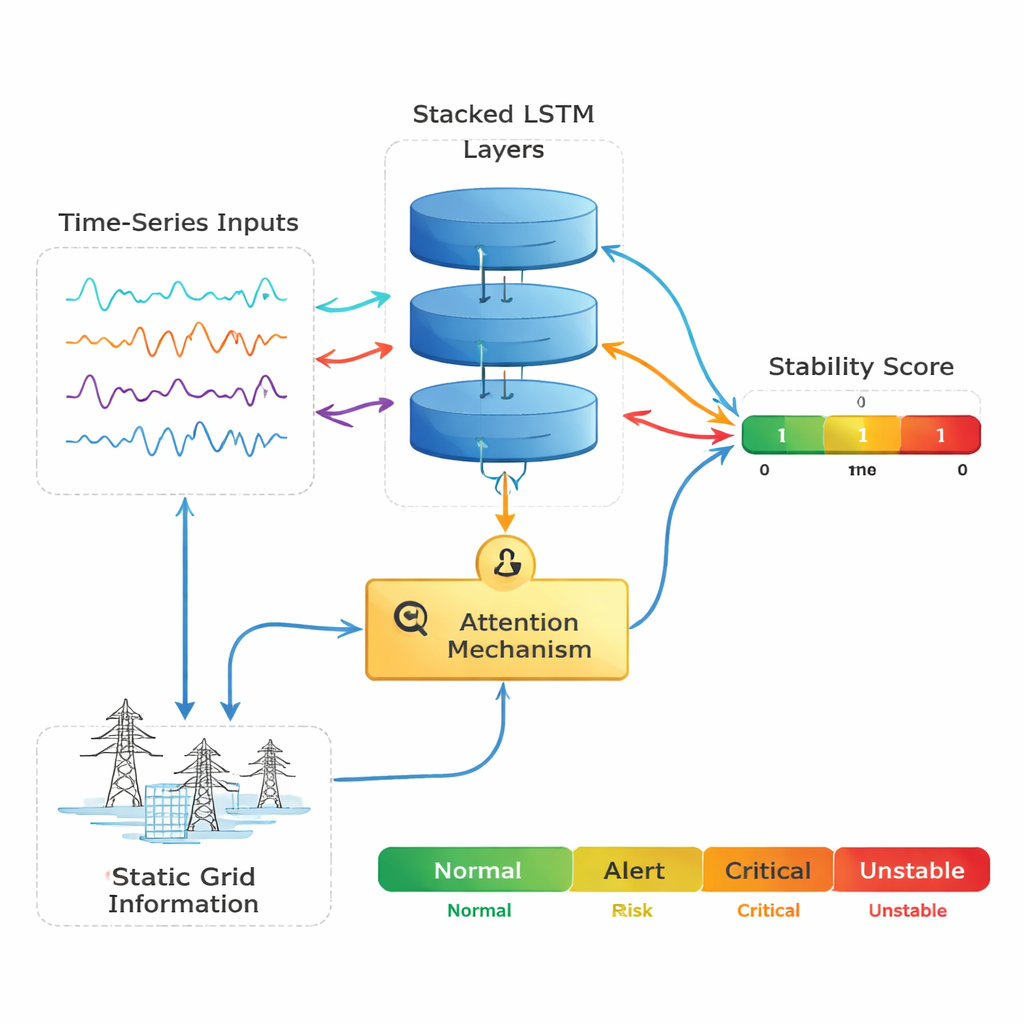
From Research Tool to Control-Room Aid
Overall, the work shows that it is possible to combine rich physics-based simulations with modern AI so that a running grid can be monitored by a single, continuously updated stability score. Because the model only needs a short window of data and limited sensor coverage, it can produce results in under a millisecond per operating condition—fast enough for real-time use. For a layperson, the takeaway is that this approach could give grid operators a clearer "fuel gauge" of stability, allowing them to take modest corrective actions early instead of drastic emergency measures later, helping keep the lights on in a cleaner but more fragile power system.
Citation: Shahriyari, M., Safari, A., Quteishat, A. et al. An LSTM architecture for real-time multi-domain stability boundary prediction beyond post-fault dependency in power systems. Sci Rep 16, 6330 (2026). https://doi.org/10.1038/s41598-026-36571-6
Keywords: power grid stability, renewable energy integration, deep learning, real-time monitoring, electricity reliability