Clear Sky Science · en
Male collegiate volleyball players’ depth jump biomechanical adaptations to eight-week complex–contrast training
Why Jump Training Matters
In modern volleyball, the ability to jump high can decide who wins long rallies and crucial points. Male collegiate players may perform hundreds of jumps in a single match, whether attacking above the block or reaching to stop an opponent’s spike. This study explores a specialized strength-and-jump routine called complex–contrast training and asks a simple question with big implications for coaches and athletes: can this method change how the body uses force and energy during a jump, not just how high players get off the ground?
A New Spin on Jump Practice
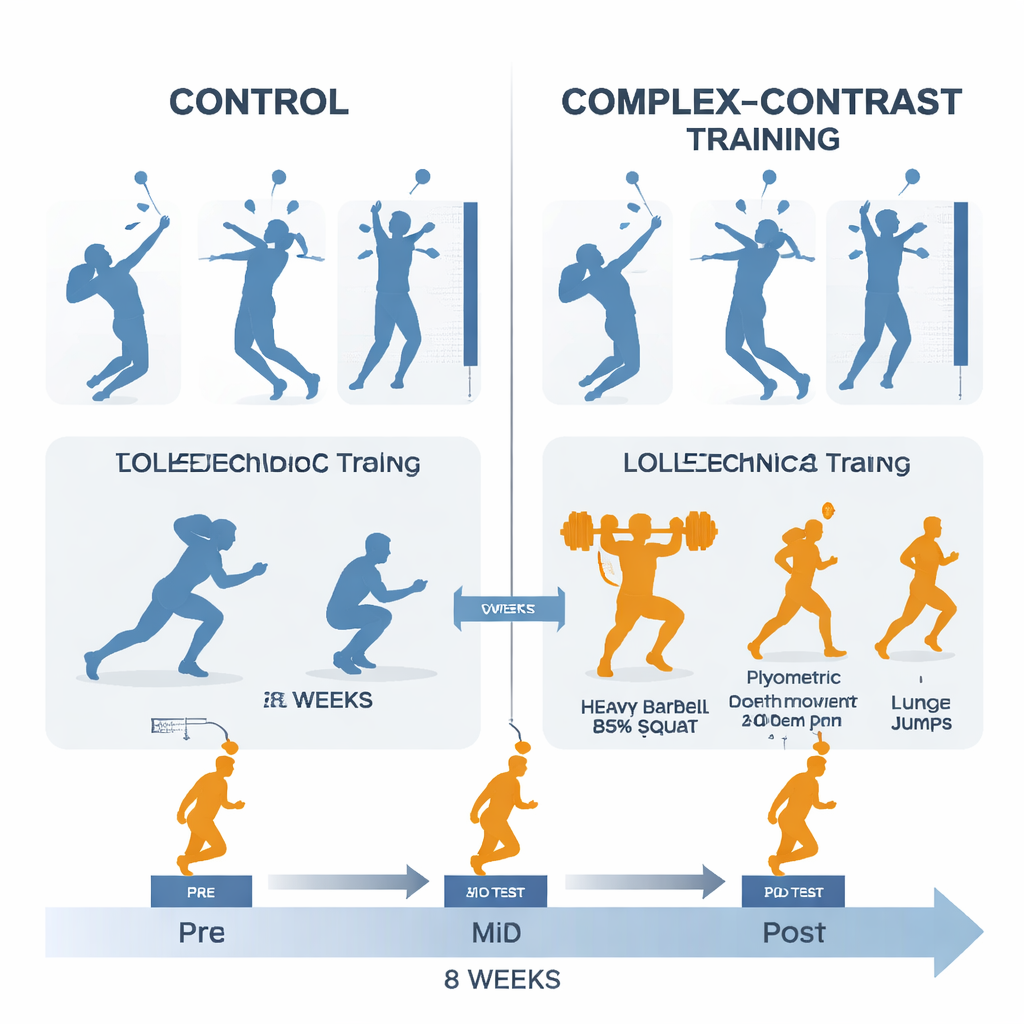
Rather than simply repeating jumps, the researchers used a style of training that pairs heavy lifting with explosive jumping in the same session. In this approach, an athlete first performs heavy back squats and, after a short rest, immediately completes fast, light, jump-style movements such as depth jumps from a 30-centimeter box or lunge jumps. This pairing is designed to take advantage of a short-lived boost in muscle performance that follows heavy contractions, potentially teaching the body to explode off the ground more efficiently over time.
How the Study Was Set Up
Nineteen male collegiate volleyball players were randomly split into two groups. Both groups continued their usual volleyball skill practices three times a week, including serving, spiking, and blocking drills. One group, the experimental group, added complex–contrast training twice a week for eight weeks, using heavy squats followed by various jump drills. The control group did no extra physical training beyond volleyball practice. All players performed depth jump tests before training began, halfway through the program, and after eight weeks. During each test, motion-capture cameras and force plates measured how their bodies moved and how much force they produced from the moment they landed to the instant they left the ground.
Looking Inside a Single Jump
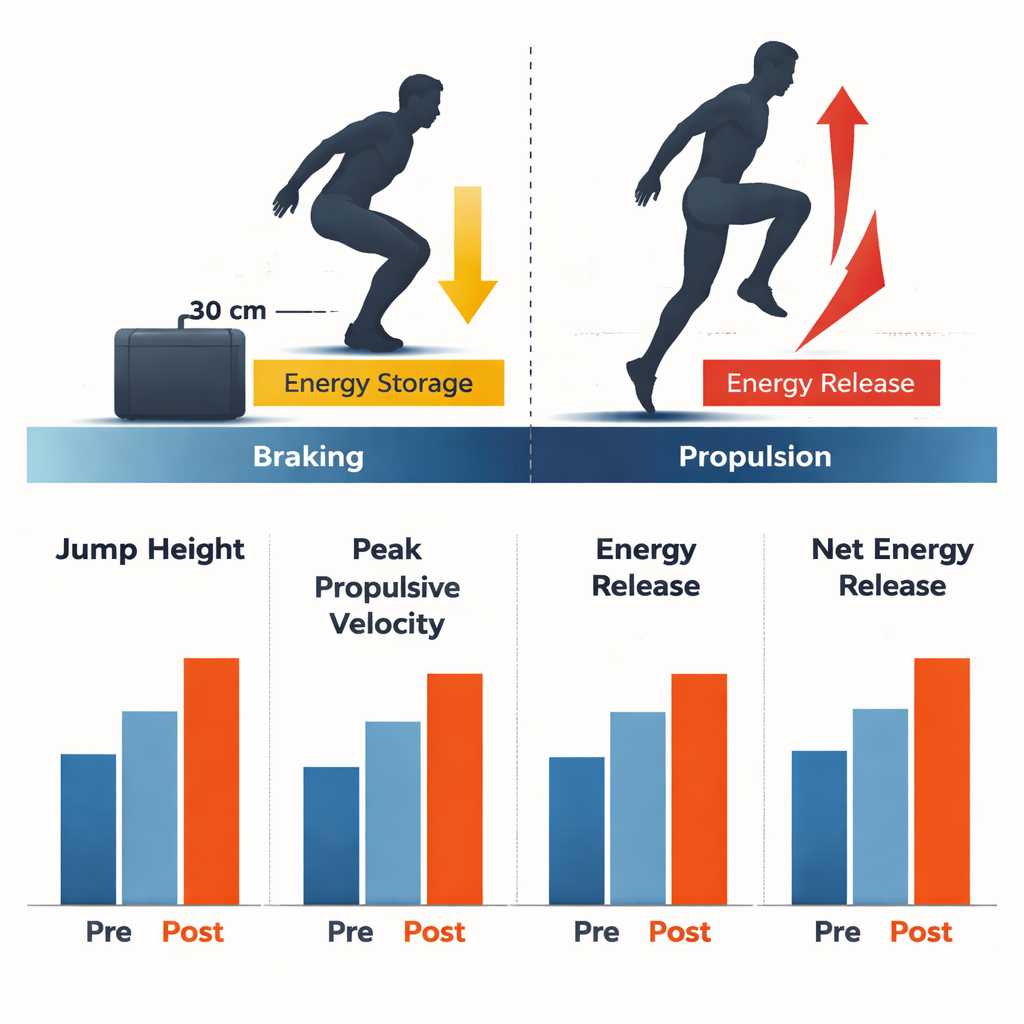
To understand more than just jump height, the scientists broke each depth jump into two key parts. The first part, called the braking phase, starts when the athlete lands and bends down, storing energy in muscles and tendons, much like compressing a spring. The second part, the propulsion phase, begins at the lowest point of the dip and ends at takeoff, when the stored energy is released to drive the athlete upward. The team measured how deeply athletes dipped, how large the ground forces were, how quickly the body’s center of mass moved upward, and how much energy was stored and then released between landing and takeoff. They also calculated a “net energy release,” which reflects how much more energy the body sends back out than it first absorbs.
What Changed After Eight Weeks
After the training period, the complex–contrast group showed clear gains in several important measures during the depth jump. Their jump height increased by roughly 10 percent on average, and their upward movement during takeoff became faster, reflecting higher peak propulsive velocity. They also released more energy during the push-off and increased their net energy release, suggesting that their muscles and tendons were working together more effectively to turn stored energy into upward lift. In contrast, most changes in the control group were related to how they landed and dipped—such as bending deeper and altering landing forces—without the same clear improvements in overall jump performance.
Early Answers, With Caution
To a layperson, the main message is that pairing heavy squats with explosive jumps, done in a structured way over eight weeks, seems to help college volleyball players jump higher and use their stored energy more efficiently during a depth jump. However, because the study involved a relatively small number of athletes and some of the more complex statistics did not show strong group-by-time differences, the authors warn that these results are preliminary. Even so, the findings hint that complex–contrast training may be a promising tool for improving not just how high athletes jump, but how smartly their bodies use force and energy each time their feet leave the floor.
Citation: Li, Y., Li, W., Lin, G. et al. Male collegiate volleyball players’ depth jump biomechanical adaptations to eight-week complex–contrast training. Sci Rep 16, 5966 (2026). https://doi.org/10.1038/s41598-026-36569-0
Keywords: volleyball training, vertical jump, complex–contrast training, plyometrics, sports biomechanics