Clear Sky Science · en
Short-term storage conditions do not affect canine fecal cortisol and secretory immunoglobulin A concentrations
Why This Matters for Dogs and Their Caretakers
When scientists and shelter workers want to understand how stressed or healthy a dog is, they increasingly turn to an unexpected source of information: poop. Dog feces can reveal levels of stress hormones and immune defenses without ever touching the animal. But until now, many researchers worried that unless these samples were frozen almost immediately at ultra-cold temperatures, the results might be useless. This study tested whether those fears are justified—and the findings could make welfare research in shelters and in the field far easier and safer.
Reading Stress and Immunity from Poop
Two key substances in dog feces give a window into how the animal is coping with its environment. The first is cortisol, a hormone that rises and falls with physical and emotional stress. While cortisol in blood can change quickly, fecal cortisol reflects what has been happening over the past day or so, offering a calmer, averaged picture. The second is secretory immunoglobulin A, or sIgA, an antibody that coats the gut and helps block harmful germs. Chronic stress is thought to push cortisol up and sIgA down, so looking at both together can tell a richer story about a dog’s welfare in crowded shelters or challenging environments.
How the Samples Were Collected and Stored
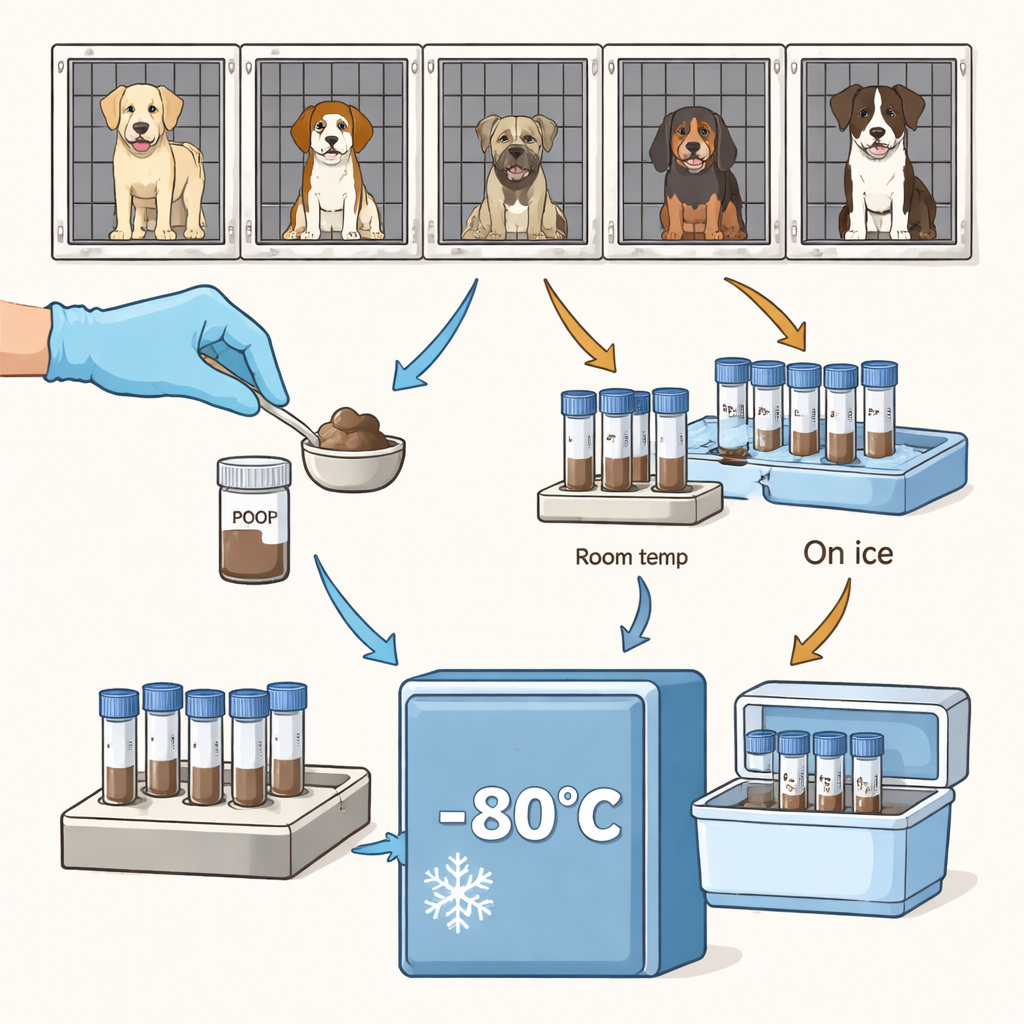
The researchers worked with ten adult dogs living in two animal shelters near Philadelphia. When a dog defecated, a researcher immediately collected the feces from the kennel floor without handling the dog, mixed the sample thoroughly, and divided it into many small tubes within 15 minutes. One set of tubes was frozen right away on dry ice and then moved to a -80 °C freezer, serving as the “gold standard” baseline. The remaining tubes were left either at normal indoor room temperature (about 15–21 °C) or placed on wet ice at around 4 °C. These tubes sat for different lengths of time—1, 2, 4, 8, 12, or 24 hours—before they too were frozen for later testing. This design mimicked realistic shelter and field situations where a sample might wait on a counter or in a cooler before reaching a lab.
Testing Whether Time and Temperature Change the Signal
In the lab, the team used standard commercial test kits to measure how much cortisol and sIgA were present in each fecal sample. They took care to account for how wet or dry each sample was and to correct for dilution, so results reflected true concentrations inside the feces. They then used statistical models that could follow repeated measurements from the same dog over time while comparing room temperature against ice. Importantly, a small number of cortisol readings had to be discarded because they fell outside the test’s reliable range—either too high or too low—but the overall pattern remained clear.
What They Found About Stability
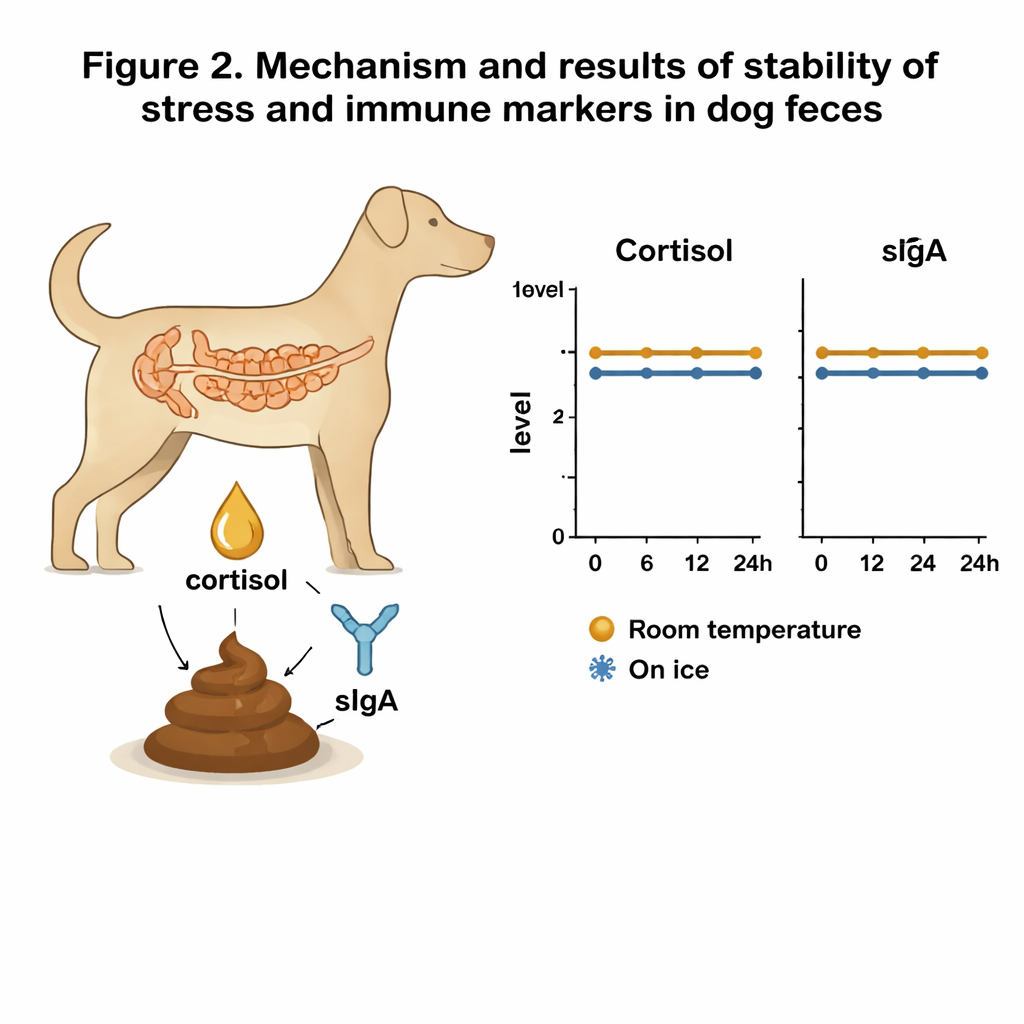
For both cortisol and sIgA, the concentrations in dog feces stayed essentially stable over the full 24-hour period, whether the samples were kept on ice or at room temperature. There were normal ups and downs between individual tubes and dogs—expected in any biological measurement—but no systematic drift over time, and no meaningful differences between the two storage conditions. Cortisol values were a bit more technically finicky to measure than sIgA, yet even with this added noise the data did not show a steady rise or fall that would suggest the hormone was breaking down or being altered in a way that would mislead researchers.
What This Means for Real-World Dog Studies
For shelters, veterinarians, and field biologists, the take-home message is both simple and powerful: dog fecal samples for cortisol and sIgA do not need to be frozen immediately at ultra-low temperatures to yield valid results, at least within 24 hours. Staff or volunteers can collect and temporarily store samples at room temperature or on ice, then hand them off later for freezing and analysis. This flexibility lowers costs, reduces safety and transport concerns linked to dry ice and liquid nitrogen, and makes it much easier to study stress and gut immunity in dogs without disturbing them. While larger studies and work in other species are still needed, this research shows that valuable welfare information can be reliably captured from poop, even when perfect lab conditions are out of reach.
Citation: Lenz, O.C., Powell, L., Reinhard, C.L. et al. Short-term storage conditions do not affect canine fecal cortisol and secretory immunoglobulin A concentrations. Sci Rep 16, 7132 (2026). https://doi.org/10.1038/s41598-026-36566-3
Keywords: dog stress, cortisol, fecal biomarkers, animal shelter welfare, noninvasive sampling