Clear Sky Science · en
Artificial neural network-guided phyto-synthesis of Pd/Pt bimetallic nanoparticles on cotton: sustainable textile functionalization with antibacterial and colorimetric properties from saffron waste
Turning Crop Waste into Smarter Fabrics
Most of us wear cotton every day, but few stop to think about how those fabrics could be made safer and more sustainable. This study shows how leftovers from saffron production—material that is usually thrown away—can be transformed into high‑value ingredients that give cotton strong antibacterial power and richer, longer‑lasting color. By combining green chemistry with artificial intelligence, the researchers outline a path toward clothing and medical textiles that protect both people and the environment.
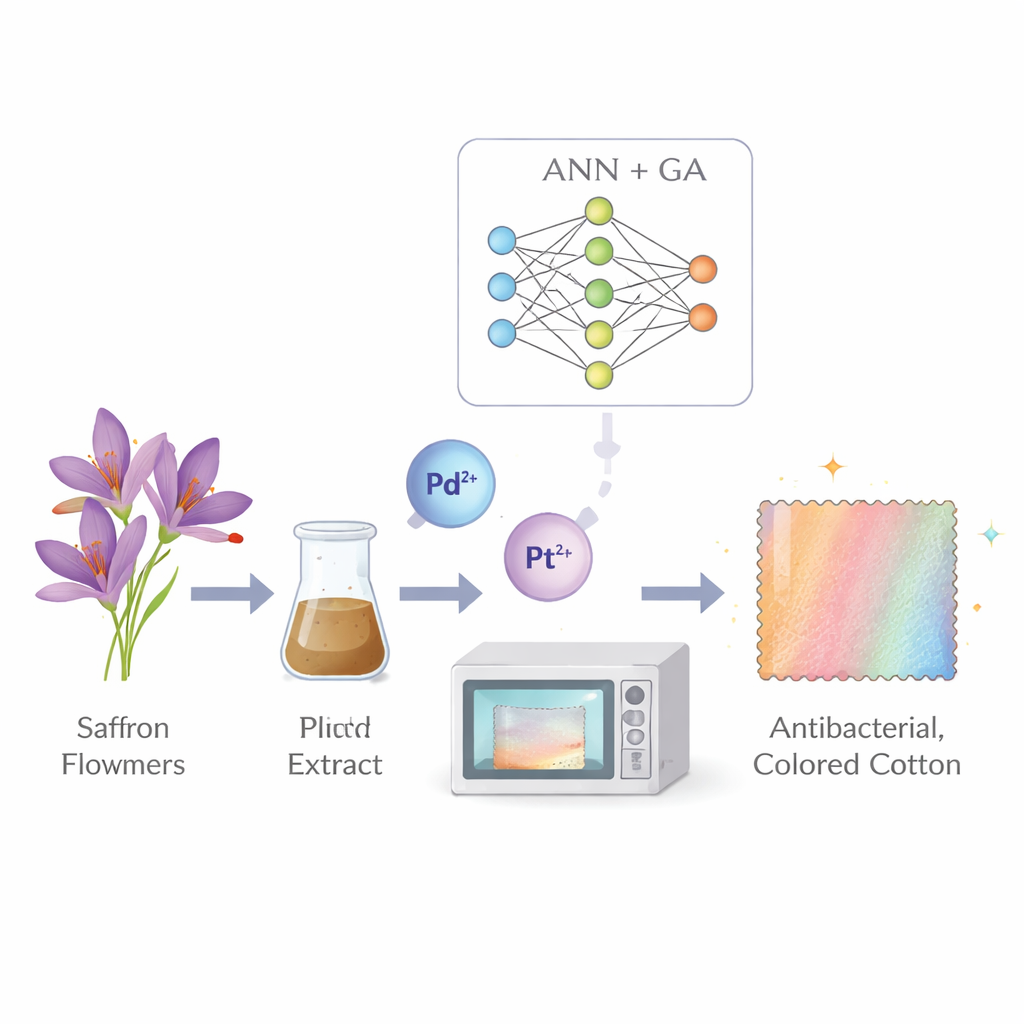
From “Red Gold” Waste to Useful Dye
Saffron is famous for its vivid red stigma, yet the bulk of each flower—its petals and stamens—ends up as low‑value agricultural waste. These discarded parts are actually rich in natural compounds such as polyphenols and flavonoids, which can both color fabrics and help build tiny metal particles. In this work, the team prepared water‑based extracts from dried, ground saffron petals and stamens using a household‑style microwave process. This gentle method, carried out at relatively low power and short times, pulls colorful and reactive molecules into solution without harsh chemicals, making it an appealing option for large‑scale, eco‑friendly textile finishing.
Growing Tiny Metal Helpers Directly on Cotton
Instead of first making nanoparticles in a separate step, the researchers formed palladium–platinum (Pd/Pt) nanoparticles directly on cotton fibers in water. When solutions of palladium and platinum salts were mixed with the saffron extracts and heated in a microwave, the plant compounds acted like miniature factories: they converted metal ions into solid particles and simultaneously glued them onto the cotton. Microscopy and other analytical tools confirmed that the resulting particles were truly nanoscale—around 50–70 nanometers in diameter—and were spread fairly evenly along the fibers without damaging the cotton’s natural structure. Chemical fingerprints showed that plant molecules and the cotton’s own surface groups helped anchor the particles, improving their stability through washing.
Letting a Neural Network Tune the Recipe
Because many factors can affect how deeply a fabric takes up color—such as how much petal extract, stamen extract, palladium, and platinum are used—the team turned to machine learning to find the best combination. They fed data from 50 carefully designed dyeing experiments into an artificial neural network, a computer model inspired by the brain’s web of neurons. Coupled with a genetic algorithm that “evolves” better solutions over many generations, the model searched the design space for the mixture that maximized color strength, a measure of how deep and intense the shade appears. The optimized recipe predicted by the model matched experiments extremely well, with a correlation of 0.99, and produced cotton with a noticeably darker, more saturated color than extracts alone.
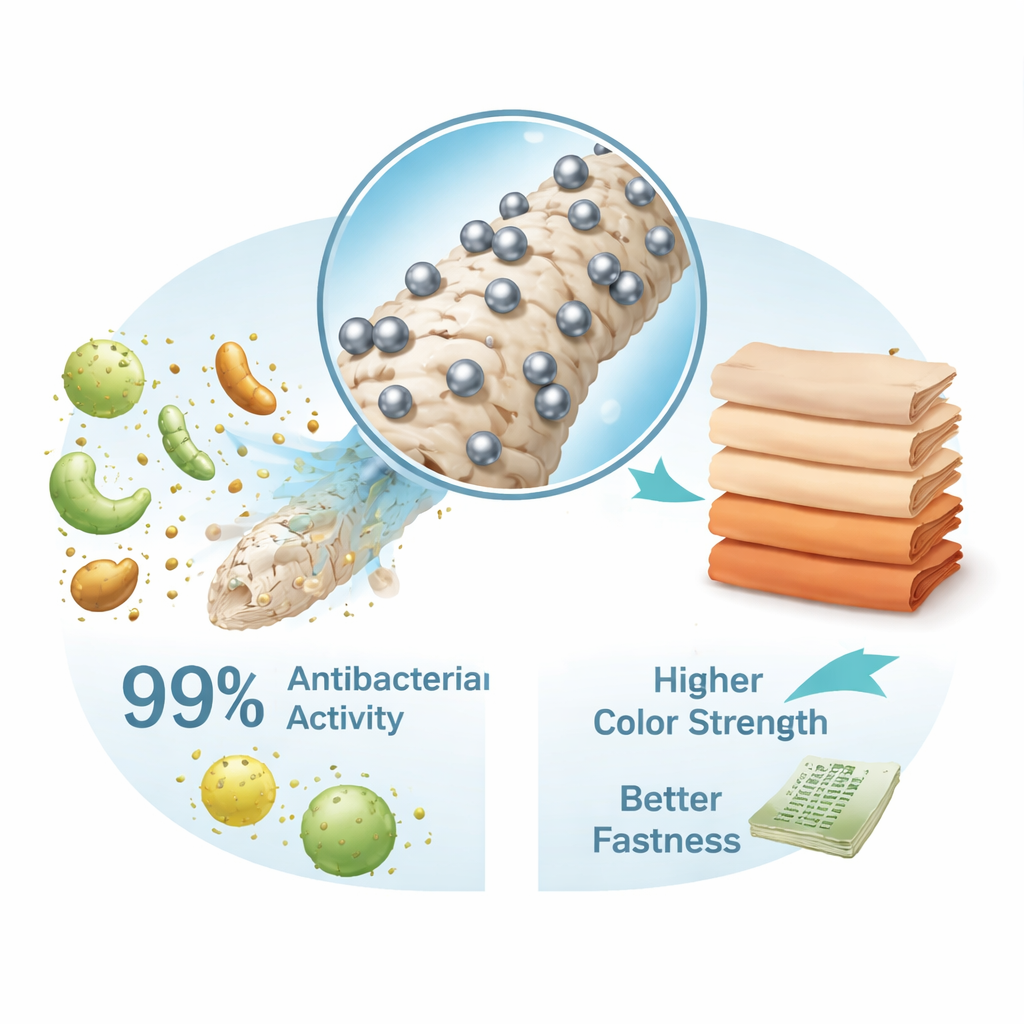
Color That Lasts and Fabrics That Fight Germs
Beyond looking good, the treated fabrics performed impressively in practical tests. Cotton dyed with saffron waste extracts on their own already showed some natural antibacterial activity, thanks to plant‑based compounds that stress or disrupt bacterial cells. When Pd and Pt nanoparticles were added, that effect was dramatically amplified: the best samples killed about 99% of both Escherichia coli (a common Gram‑negative bacterium) and Staphylococcus aureus (a Gram‑positive species), based on standard textile test methods. At the same time, the presence of the nanoparticles significantly deepened the color and improved resistance to fading from washing, rubbing, and light, with only small losses of metal content after ten laundering cycles.
What This Means for Everyday Clothing and Medical Gear
For non‑specialists, the takeaway is straightforward: this study shows that agricultural waste can be turned into a key ingredient for next‑generation textiles. Saffron by‑products, which once had little value, are used here to grow and fix tiny metal particles directly onto cotton in water, using modest microwave heating. Guided by artificial intelligence, the process yields fabrics that are more colorful, hold their shade longer, and strongly resist harmful bacteria—all while avoiding many of the toxic chemicals and energy‑intensive steps of conventional finishing. If scaled up, such approaches could help bring to market hospital gowns, masks, and everyday clothing that are both safer to wear and kinder to the planet.
Citation: Sadeghi-Kiakhani, M., Hashemi, E., Norouzi, MM. et al. Artificial neural network-guided phyto-synthesis of Pd/Pt bimetallic nanoparticles on cotton: sustainable textile functionalization with antibacterial and colorimetric properties from saffron waste. Sci Rep 16, 6857 (2026). https://doi.org/10.1038/s41598-026-36565-4
Keywords: antibacterial textiles, green nanotechnology, saffron waste, palladium platinum nanoparticles, smart cotton fabrics