Clear Sky Science · en
Genome-wide analysis reveals differential admixture dynamics and historical demographic contractions in African cattle
Cows That Tell a Story About People and the Past
Africa’s cattle are far more than farm animals: they are savings accounts on four legs, sources of milk and meat, and central to ceremonies and cultural identity. This study uses modern DNA tools to ask where these cattle came from, how different types have mixed over thousands of years, and whether their genetic health is at risk today. The answers matter for food security and for protecting hardy local breeds that may be crucial as climates become hotter and drier.
A Continent of Many Cattle Stories
Across Africa, more than 150 local cattle types graze environments ranging from humid forests to dry savannas. Broadly, there are two ancestral kinds: humpless taurine cattle and humped zebu cattle. Taurine breeds, common in parts of West and Central Africa, tend to be smaller but can withstand deadly tsetse-borne diseases like trypanosomiasis. Zebu cattle, which originally came from South Asia, carry a distinctive hump and do better in hot, dry climates. Over centuries, herders have crossed these two types, creating composite cattle that combine disease tolerance, heat resistance, and acceptable production. 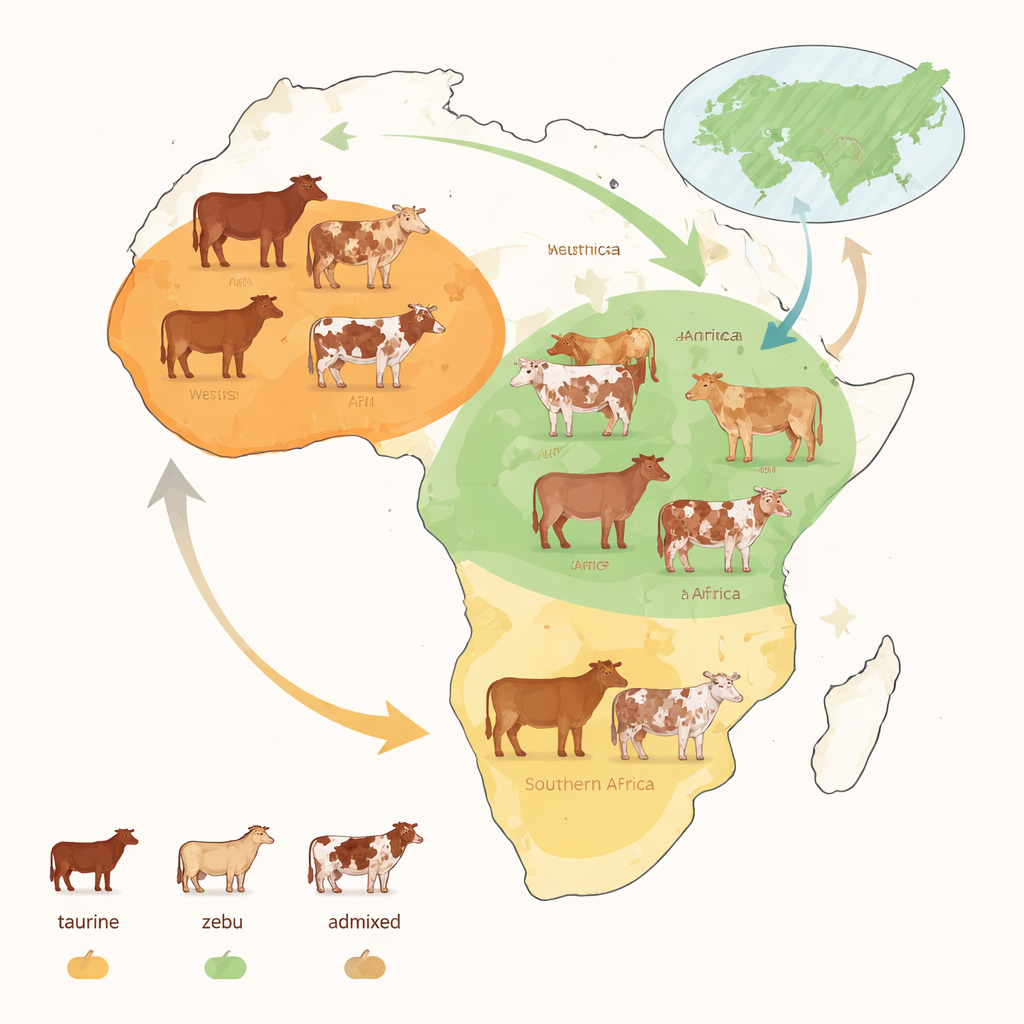
Reading the Genetic Map of African Herds
The researchers analyzed DNA from nearly 2,000 animals representing 36 African breeds from West, East, and Southern Africa, along with Asian zebu and European cattle for comparison. Using tens of thousands of genetic markers, they measured how much variation exists within breeds, how inbred they are, and how different they are from each other. They also used computer models to reconstruct how cattle populations grew, shrank, and mixed over the last several hundred generations. This allowed them to link today’s genetic patterns to historical events, trade routes, and breeding practices.
Mixing Bloodlines and Hidden Weak Spots
The study found that African zebu and mixed breeds generally carry more genetic variety than the pure African taurine cattle. Some West African taurine breeds that are famous for resisting trypanosomiasis—such as N’Dama and Lagunaire—showed low genetic diversity and signs of long-term inbreeding, likely because they have been kept relatively isolated in tsetse-infested areas where outside animals could not easily survive. By contrast, many zebu and crossbred populations have higher diversity thanks to ongoing exchanges of animals among herders and repeated introductions of zebu from Asia and other African regions. Yet this constant mixing comes with a trade-off: as zebu genes spread, some unique local adaptations in taurine cattle, like strong disease tolerance, may be diluted.
Echoes of a Cattle Plague in Today’s DNA
When the team reconstructed the rise and fall of cattle population sizes through time, a striking pattern appeared. Many breeds across the continent showed a sharp drop in their “effective population size” several dozen generations ago, roughly matching the late 19th century. This period coincides with a devastating outbreak of rinderpest, a viral cattle plague that killed most of the continent’s herds. The genetic scars of that disaster are still visible today. At present, several taurine and localized zebu populations have very small effective population sizes—fewer than about 50 breeding animals in genetic terms—putting them at risk of future inbreeding and loss of rare, useful genes. 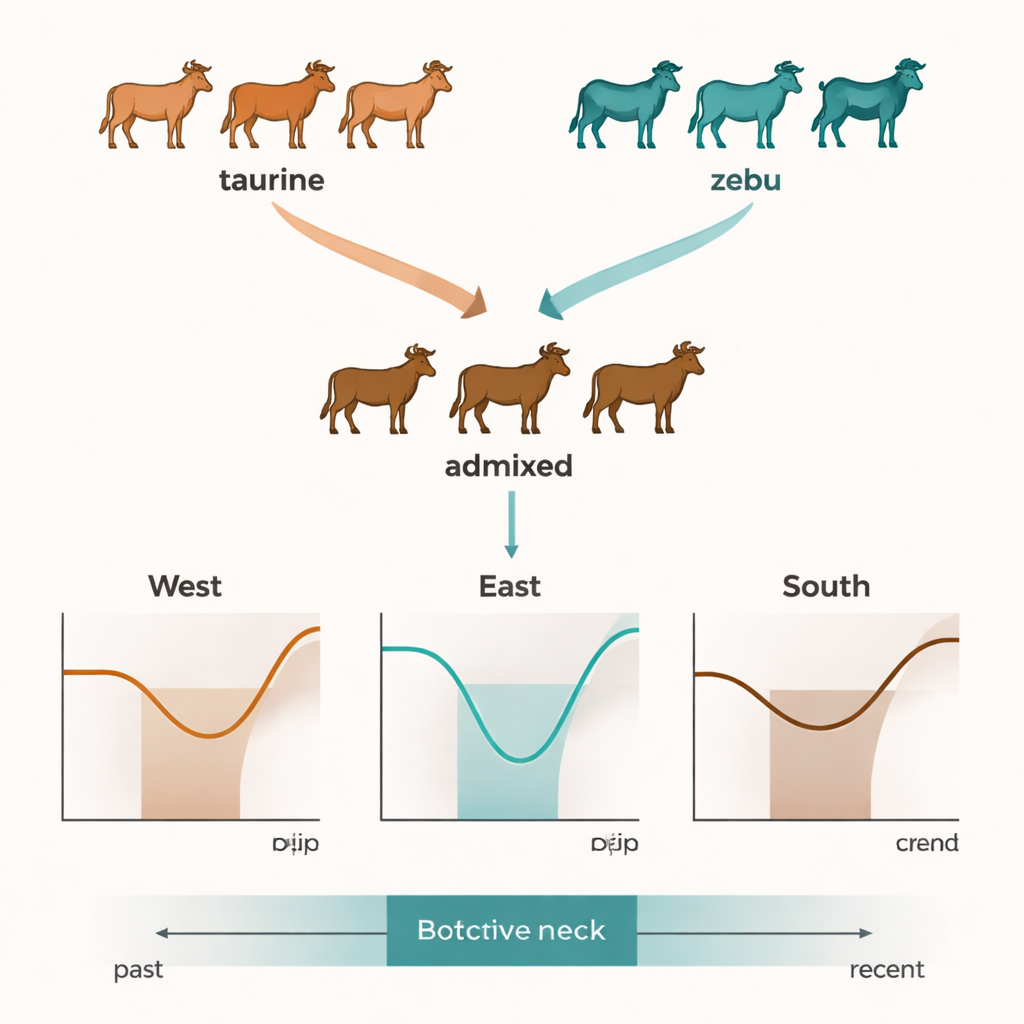
Guiding the Future of Africa’s Cattle
For non-specialists, the main message is that African cattle are a living record of ancient migrations, trade across the Sahara and Indian Ocean, and past disease outbreaks. They are also a reservoir of traits—such as heat tolerance and resistance to parasites—that will be increasingly valuable as climates change. This study shows that all so-called African zebu still carry a substantial dose of taurine ancestry, and that each region holds its own distinctive mix. Protecting this diversity will require breeding programs that consciously maintain small, vulnerable taurine breeds and carefully manage crossbreeding so that productivity gains do not erase hard-won local adaptations.
Citation: Mavunga, T.K., Sölkner, J., Mészáros, G. et al. Genome-wide analysis reveals differential admixture dynamics and historical demographic contractions in African cattle. Sci Rep 16, 6495 (2026). https://doi.org/10.1038/s41598-026-36562-7
Keywords: African cattle, genetic diversity, admixture, zebu and taurine, livestock conservation