Clear Sky Science · en
Machine learning for individual epigenetic fingerprints as predictors of well-being in young adults
Why your sensitivity to stress matters
Many young adults feel overwhelmed by exams, social media, and an uncertain future, yet standard mental health questionnaires can miss who is most at risk. This study asks whether a simple combination of surveys and a saliva sample can reveal a more precise, biological “fingerprint” of how sensitive each person is to stress. By blending psychology, genetics, and modern machine learning, the researchers explore a future in which early, personalized mental health support could be offered long before serious problems appear.
From simple surveys to hidden biology
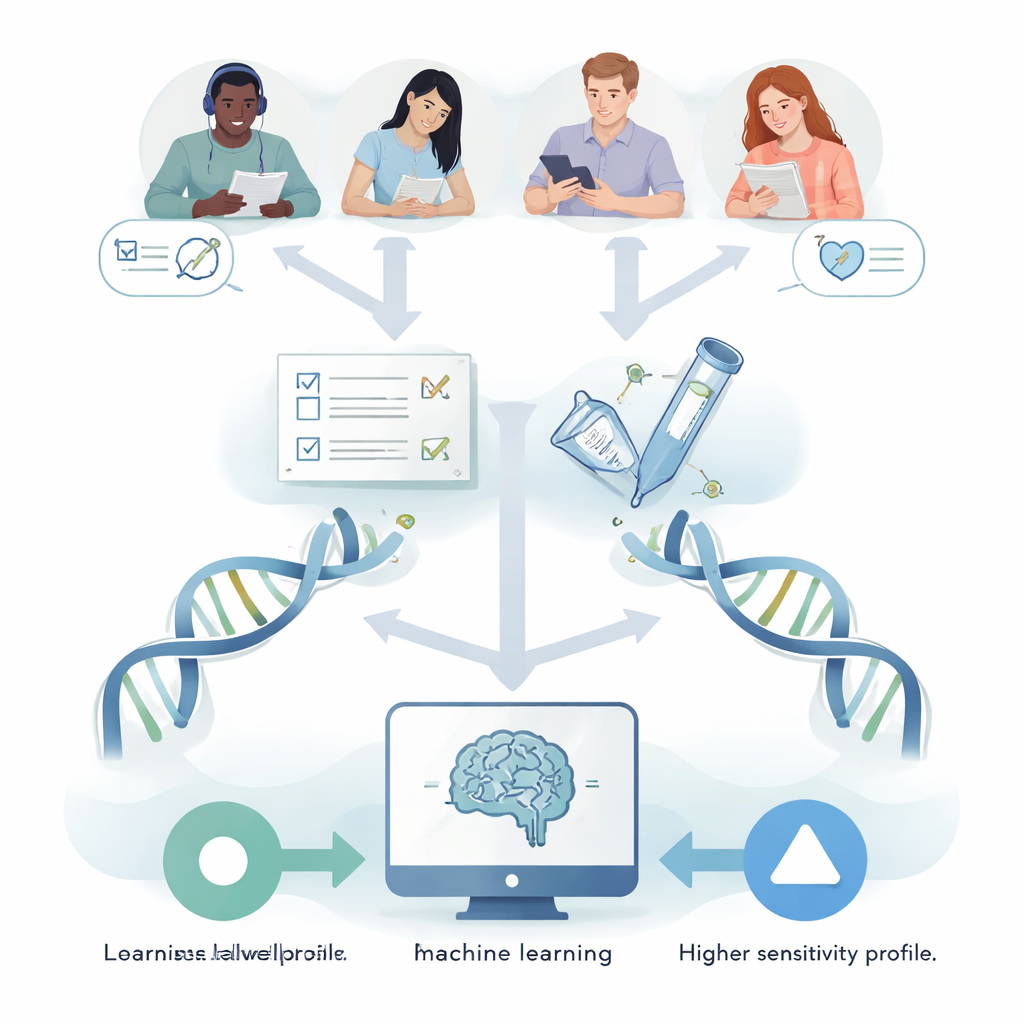
The researchers focused on a trait called environmental sensitivity—how strongly someone reacts to everyday events. People who score high on the Highly Sensitive Person (HSP) scale tend to feel more overwhelmed in noisy, demanding, or emotionally intense situations, and they make up a large share of those seeking counseling. In this study, 104 university students completed several brief questionnaires about perceived stress, impulsiveness, eating habits, and internet use. At the same time, they provided saliva samples so that the team could examine small chemical tags on specific genes involved in brain signaling. These tags, known as epigenetic marks, can change with life experiences and may help explain why some people are more stress-sensitive than others.
Reading epigenetic fingerprints
The saliva samples were used to study epigenetic marks—specifically DNA methylation—on three key genes that help regulate brain chemicals: dopamine and serotonin transporters (DAT1 and SERT) and the oxytocin receptor (OXTR). Instead of looking at the full genome, the researchers zoomed in on 10 positions along these genes where methylation varied the most across students. Together with nine questionnaire-based measures, this created a pool of 19 possible features. The central question was: which combination of these behavioral and biological measures best separates students with high HSP scores from those with low or medium sensitivity?
Letting the algorithm choose
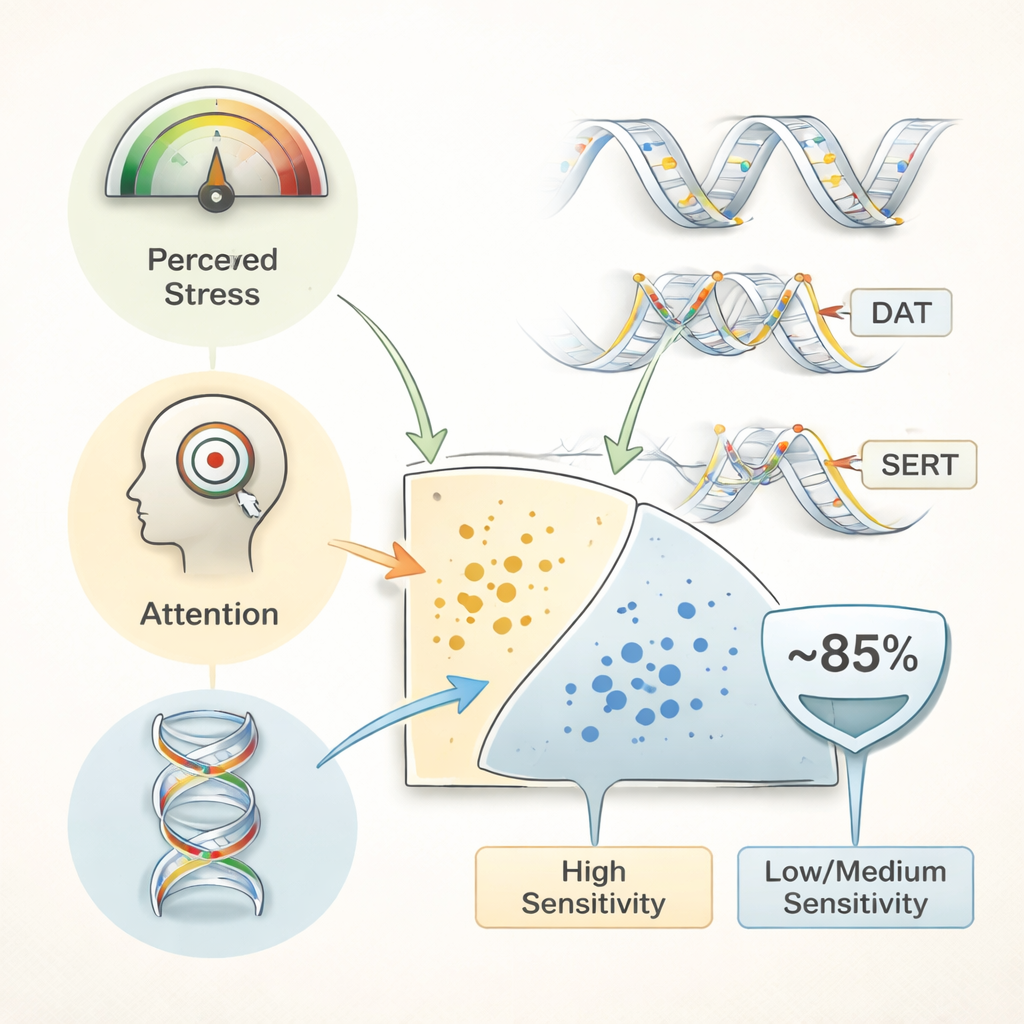
To answer this, the team used a machine learning method called a Support Vector Machine. Rather than guessing which features mattered, they tried every possible combination—from single measures up to all 19—and tested each one in a careful, leave-one-out procedure. This meant training the model on 103 students and predicting the remaining one, repeating the process for everyone. Out of more than half a million tested models, the best-performing solution turned out to be surprisingly simple: just six features were enough to form a clear “fingerprint” of sensitivity. Two came from questionnaires (Perceived Stress Scale and an Attention score from an impulsiveness test), and four were specific methylation sites on the dopamine and serotonin transporter genes.
What the model actually learned
Using only these six features, the model correctly classified students as high versus low/medium sensitivity about 85% of the time. It was especially good at identifying highly sensitive individuals, with high sensitivity and precision, and showed similar performance in both men and women despite the sample being mostly female. A deeper analysis of the model’s inner workings highlighted one dopamine-related site as the single strongest biological contributor, followed closely by perceived stress and attention. In other words, the algorithm did not latch onto just one questionnaire or one gene—it combined both psychological reports and subtle epigenetic signals to reach its decisions, mirroring the real-life blend of mind and biology.
What this could mean for future care
For non-specialists, the takeaway is that a short set of survey questions plus a saliva sample may one day help flag young adults who are especially sensitive to stress, even before they seek help or show clear symptoms. While the study is still small and needs replication in larger and more diverse groups, it shows that individual “epigenetic fingerprints” can meaningfully improve predictions beyond self-report alone. If confirmed, this approach could support more tailored prevention and treatment strategies—helping clinicians offer the right kind of support, at the right time, to those whose biology and psychology together make them most vulnerable, but also potentially most responsive, to positive change.
Citation: Caporali, A., Di Domenico, A., D’Addario, C. et al. Machine learning for individual epigenetic fingerprints as predictors of well-being in young adults. Sci Rep 16, 6015 (2026). https://doi.org/10.1038/s41598-026-36561-8
Keywords: youth mental health, environmental sensitivity, epigenetics, machine learning, stress vulnerability