Clear Sky Science · en
Accurate modelling of intrabeam scattering and its impact on photoinjectors for free-electron lasers
Why the sharpness of electron beams matters
Modern X‑ray free‑electron lasers (XFELs) are among the brightest light sources ever built, letting scientists watch atoms move and chemical bonds break. To work well, these machines rely on exquisitely sharp and orderly beams of electrons. This paper explains how subtle "jostling" among electrons—called intrabeam scattering—silently blurs these beams much more than standard computer models predict, and why this hidden effect matters for building the next generation of powerful X‑ray machines.
How X‑ray lasers turn electron order into brilliant light
In an XFEL, a compact bunch of electrons is accelerated to nearly the speed of light and sent through a special magnetic structure called an undulator. As the electrons wiggle, they emit intense X‑ray pulses. The brightness of these pulses depends on how tightly packed the electrons are and how small their spread in position and direction is. Physicists summarize this with the concept of "brightness" in a six‑dimensional space of positions and momenta. The higher this 6D brightness, the better the laser can amplify light, generate very short pulses, and reach extremely small wavelengths useful for probing matter at the atomic scale.
Why tiny energy differences inside the bunch are a problem
Even if a beam starts out very bright, its quality can deteriorate as it travels down the injector—the front end of the accelerator that prepares the beam. A key quantity here is the slice energy spread, which measures how much the energy varies within very thin time slices of the bunch. For efficient lasing, this spread must stay smaller than a characteristic FEL parameter, otherwise the electrons fall out of step and the X‑ray signal weakens. At the SwissFEL facility, careful measurements showed that the slice energy spread in the injector was much larger than predicted by widely used simulation codes. That gap hinted that important physics was missing from the standard models.
Intrabeam scattering: electrons jostling each other
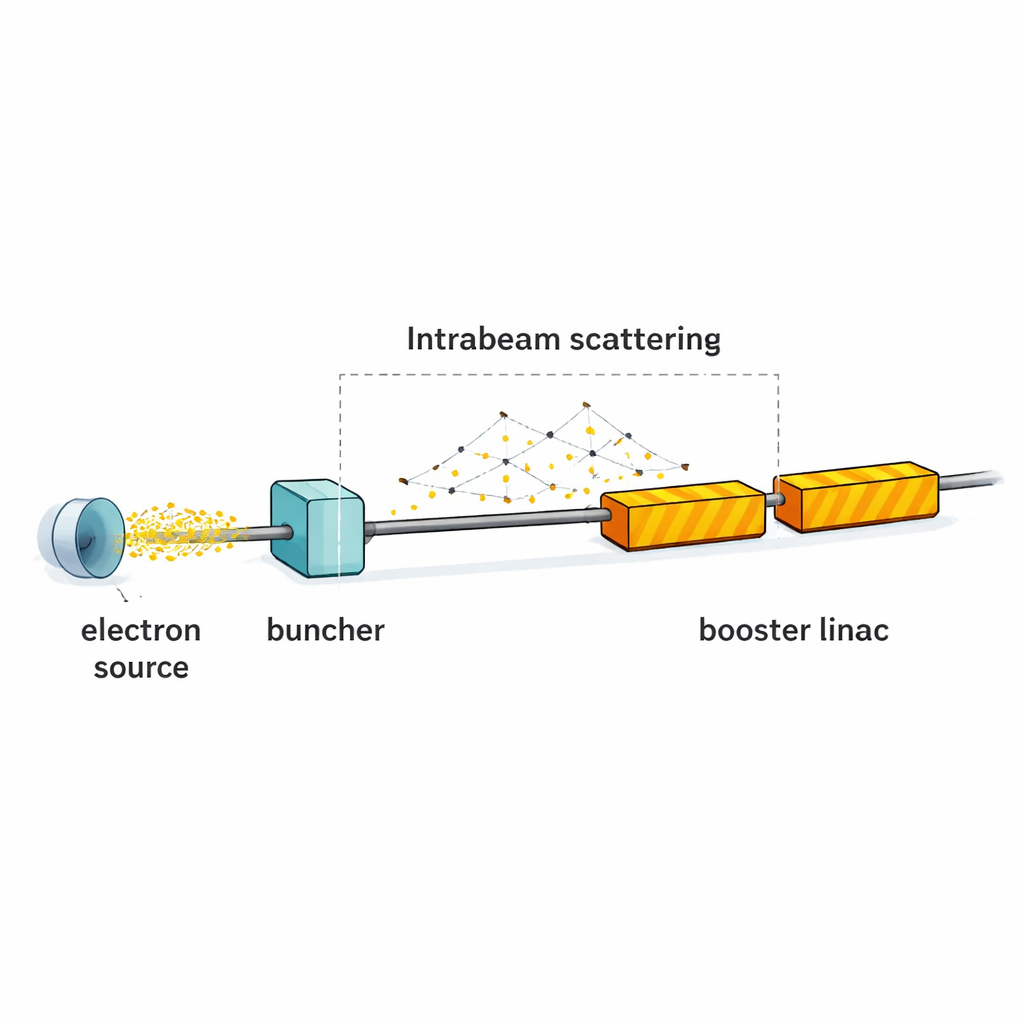
The main suspect is intrabeam scattering, in which electrons in the bunch constantly nudge one another through their electric fields. These are small, random, binary collisions that happen on timescales much shorter than the steps used in routine simulations, and they act at the level of individual particles rather than averaged "macroparticles." The authors developed two complementary tools to capture this effect properly: a new analytical formula that adapts a classic theory to low‑energy injectors, and a detailed Monte Carlo model implemented in the REPTIL tracking code. Both approaches were applied to the SwissFEL injector, from the photocathode up to a diagnostics station more than 100 meters downstream, and were benchmarked against real measurements of slice energy spread.
What the new models reveal about beam quality
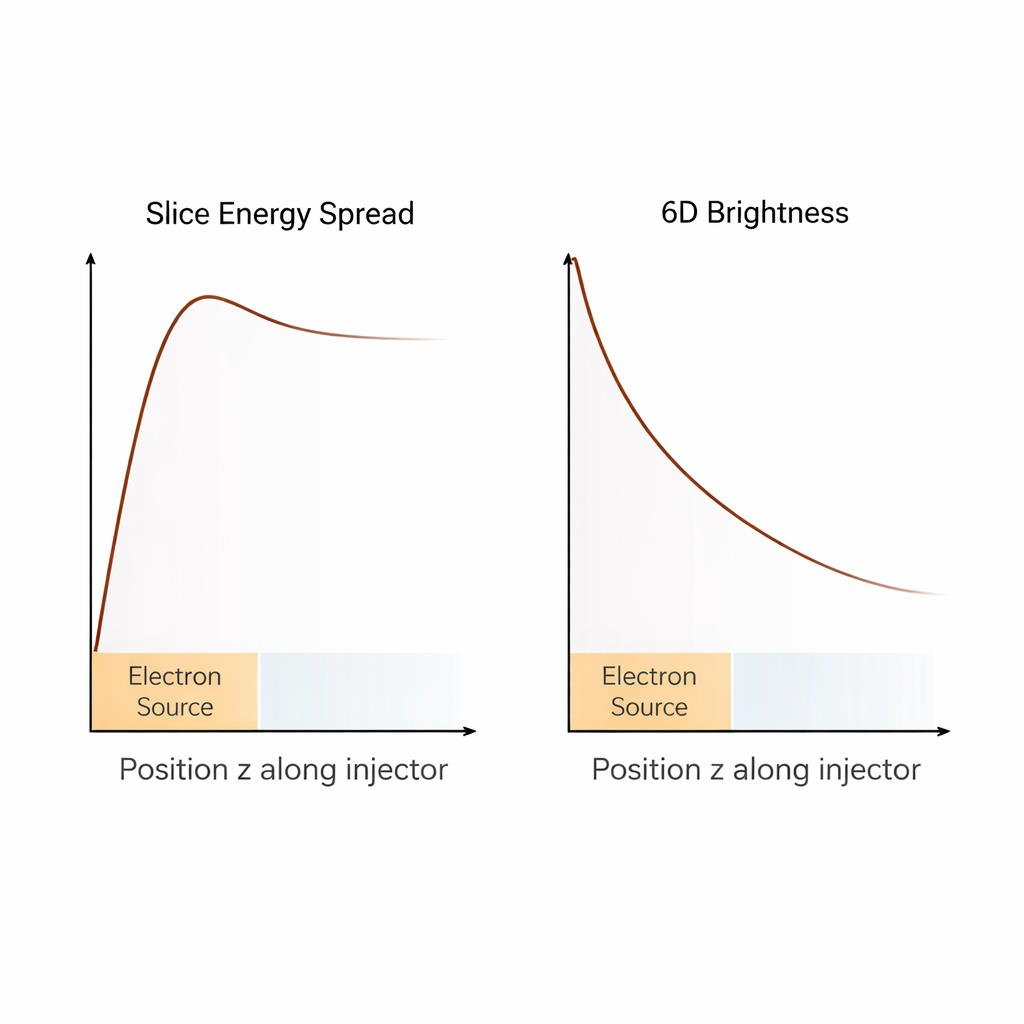
The improved models show that intrabeam scattering is strongest in the earliest part of the machine, the electron source, before the beam has been fully accelerated and spread out. There, the slice energy spread grows rapidly, then levels off as the beam gains energy and its transverse size increases. When intrabeam scattering is included, the predicted slice energy spread along the injector rises by about an order of magnitude compared to standard space‑charge simulations, bringing the predictions into close agreement with measurements. The study also examines different designs and laser pulse shapes for the electron source, including a proposed higher‑brightness traveling‑wave gun. While these designs can significantly boost the traditional 5D brightness (based on current and transverse emittance), the 6D brightness still degrades with distance because the energy spread keeps growing due to intrabeam scattering.
What this means for future X‑ray machines
The main takeaway is that focusing only on improving the traditional 5D brightness of an electron source can be misleading. Intrabeam scattering quietly converts some of that gain into extra energy spread, which reduces the true 6D brightness that ultimately governs FEL performance. For machines that demand very low energy spread—such as seeded XFELs or setups with strong bunch compression—this effect becomes a fundamental design constraint. By providing both a fast analytical tool and a detailed simulation method that agree with experiment, the authors show that intrabeam scattering must be built into realistic performance estimates and into the design of next‑generation photoinjectors and electron sources.
Citation: Lucas, T.G., Craievich, P., Prat, E. et al. Accurate modelling of intrabeam scattering and its impact on photoinjectors for free-electron lasers. Sci Rep 16, 2629 (2026). https://doi.org/10.1038/s41598-026-36558-3
Keywords: intrabeam scattering, free-electron lasers, electron beam brightness, photoinjectors, slice energy spread