Clear Sky Science · en
Strawberry straw-derived hierarchical porous carbon with naturally aligned channels for high performance supercapacitors
Turning Farm Waste into Fast Power
Every year, tons of leftover crop stalks are burned or dumped, adding to air pollution and wasting useful material. This study shows that a humble by‑product—strawberry straw—can be transformed into a powerful ingredient for next‑generation supercapacitors, devices that charge in seconds and can deliver bursts of energy for electric cars, grid backup, and portable electronics.
From Strawberry Fields to Energy Storage
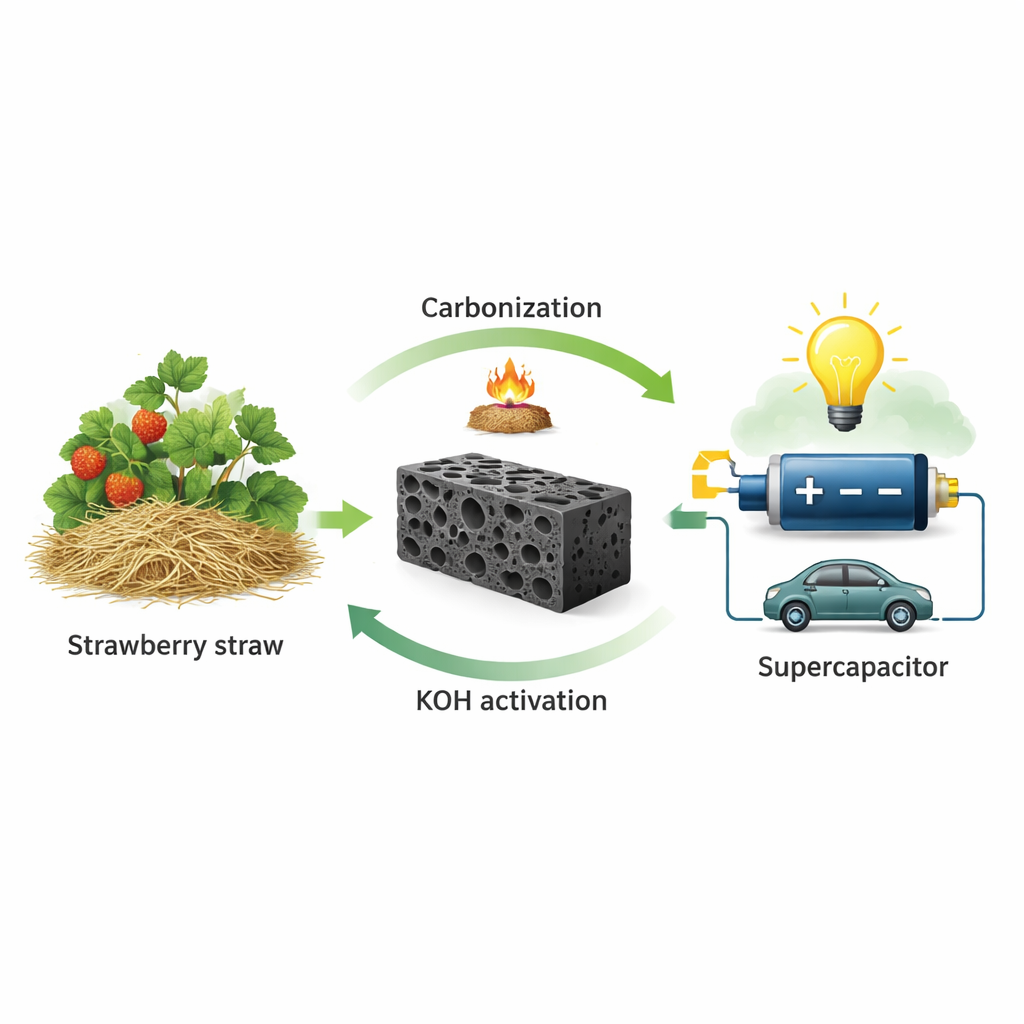
After strawberries are harvested, the remaining straw is usually treated as trash that can harm the environment if burned. Yet this straw already contains a built‑in transport system: long, straight channels that once carried water and nutrients through the plant. The researchers realized these natural channels could act like tiny highways for electric charge if the straw were converted into a special form of carbon. By doing so, they could both reduce agricultural waste and create a low‑cost, eco‑friendly material for energy storage.
Building a Sponge for Electric Charge
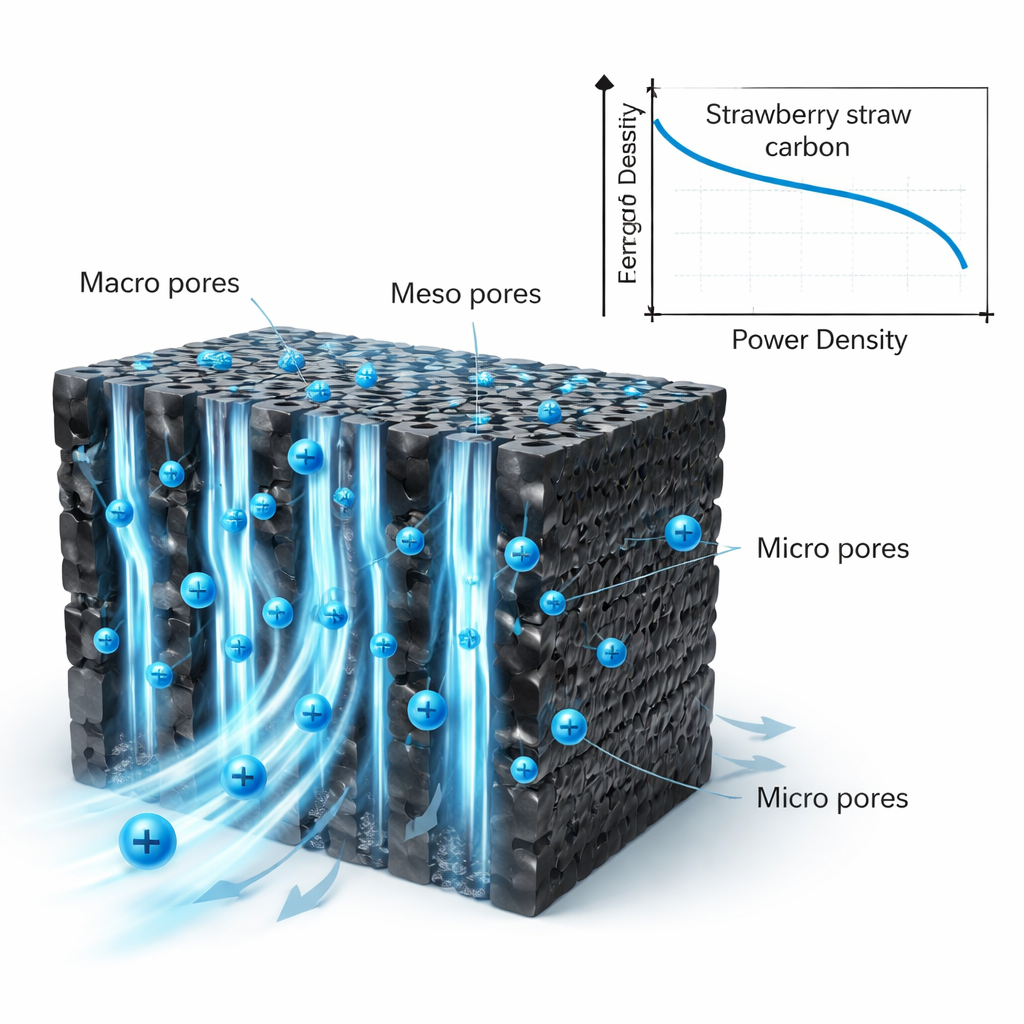
To turn straw into a supercapacitor material, the team first heated the strawberry straw in a low‑oxygen furnace to make basic carbon. They then mixed this carbon with potassium hydroxide (a common chemical also found in some soaps) and heated it again. This step “etched” the carbon, opening up a dense forest of pores—tiny holes—at many size scales while preserving the original straight channels. The result was a hierarchical porous structure: large pores and channels serve as highways, mid‑sized pores help traffic spread out, and ultra‑small pores provide enormous surface area where electric charge can be stored.
Tuning the Recipe for Best Performance
The scientists carefully varied how much potassium hydroxide they used, changing how aggressively the carbon was etched. Too little, and the carbon stayed relatively smooth with few storage sites; too much, and the structure began to collapse. At a middle ratio—three parts potassium hydroxide to one part carbon—the material, called SPC3, struck the best balance. It reached an extremely high surface area of about 2,700 square meters per gram, roughly equivalent to the floor area of half a football field packed into something that weighs less than a paperclip. At the same time, its straight channels and well‑distributed pores allowed liquid electrolyte to flow in and out quickly.
Fast Charging, Long‑Lasting Power
When tested as the working layer on an electrode, SPC3 behaved like an excellent electrical sponge. It stored a large amount of charge while keeping its performance at high charge–discharge speeds. In laboratory tests, it delivered a high capacitance (a measure of how much charge it can store) and kept over three‑quarters of that value even when the current was increased tenfold. The material also endured 10,000 rapid charge–discharge cycles while losing only a few percent of its capacity, a sign of strong durability. Built into a full symmetric supercapacitor device, SPC3 provided an energy density of about 21 watt‑hours per kilogram at moderate power and still held nearly 17 watt‑hours per kilogram at very high power, outperforming many other carbon materials made from biomass.
What This Means for Everyday Technology
In simple terms, this work shows that plant waste with naturally straight channels, such as strawberry straw, can be upgraded into a finely tuned carbon sponge that both stores a lot of energy and moves ions very quickly. That combination is crucial for devices that must charge fast, deliver short bursts of power, and survive many years of use—traits needed in electric vehicles, backup systems for renewable energy, and advanced consumer electronics. By marrying the smart use of plant structure with careful chemical treatment, the researchers point toward a future where agricultural leftovers help power our devices instead of polluting our air.
Citation: Yang, X., Chen, W., Yan, Q. et al. Strawberry straw-derived hierarchical porous carbon with naturally aligned channels for high performance supercapacitors. Sci Rep 16, 5729 (2026). https://doi.org/10.1038/s41598-026-36557-4
Keywords: strawberry straw carbon, biomass supercapacitor, porous carbon, energy storage, agricultural waste reuse