Clear Sky Science · en
Resonant laser excitation for nanoscale photocatalytic gold growth on patterned templates
Light-Guided Wiring on a Chip
Our brains build and prune connections between nerve cells in response to experience. Engineers dream of mimicking this kind of adaptable wiring directly on a chip. This study explores a way to “draw” and “erase” metal pathways using only light and a chemical solution, potentially offering a new route toward brain-inspired electronics, sensitive detectors, and reconfigurable optical circuits.
Turning a Simple Material into a Smart Surface
The researchers start with a well-known material, titanium dioxide, which is already used in sunscreens and self-cleaning surfaces. Under ultraviolet light, it becomes chemically active and can help transform dissolved gold ions in a liquid into solid gold. By carefully structuring this titanium dioxide layer at the nanoscale—carving it into fine ridges and grooves—they turn it into a kind of optical antenna that can trap and intensify incoming laser light at specific colors and angles. This concentrated light boosts the chemical activity right where it is needed.
Designing Tiny Patterns That Steer Light
To control where light energy collects, the team fabricated several kinds of repeating nanoscale patterns on glass: square patches, triangular and hexagonal networks, and straight lines, all coated with a thin titanium dioxide film. The spacing between ridges was only about one-fifth of a micrometer, tuned so that a UV laser beam at 355 nanometers would resonate with the structure. Under these “sweet spot” conditions, the incoming light couples into guided waves trapped in the patterned layer, creating bright zones of enhanced electric field. To visualize where these hot spots appeared, they first coated the surface with a thin blue-emitting organic film that glows more strongly when the local light intensity is higher. 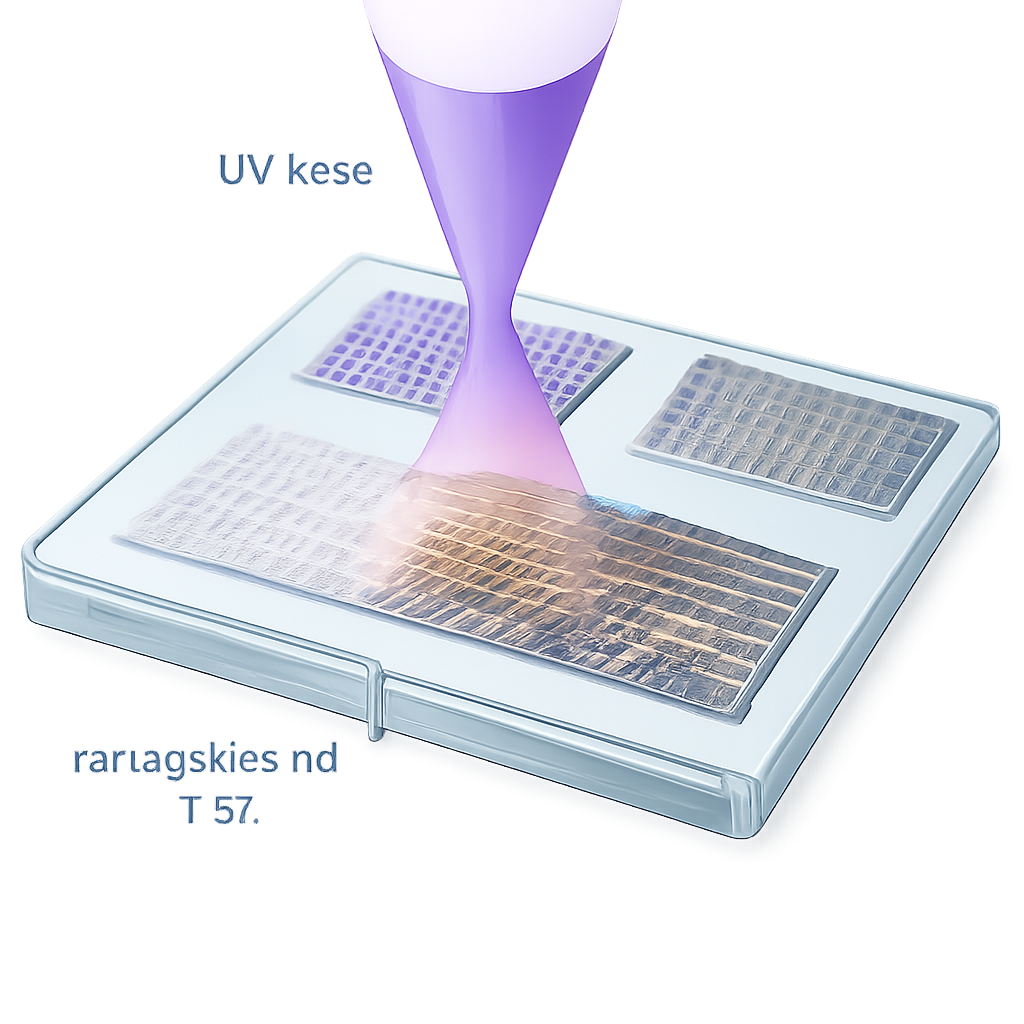
Seeing Where the Light Really Works
Using a microscope and spectrometer, the team measured how the blue film lit up across different patterns. Certain square gratings with a specific spacing showed a sharp increase in brightness, revealing strong resonant trapping of light. Hexagonal networks, which contained fewer repeating ridges, still enhanced the glow but over a broader range of spacings, indicating that their resonance was less sharply tuned. In both cases, the brightest emission closely followed the underlying pattern, confirming that the energy concentration was highly localized on the nanostructures rather than spread out across the chip.
Growing Gold Lines Where Light Is Strongest
After mapping these optical hot spots, the researchers removed the glowing film and placed the patterned titanium dioxide face-down in a small chamber filled with a gold salt solution. When the UV laser illuminated selected areas at the right angle, electrons excited in the titanium dioxide reduced dissolved gold ions to solid gold on the surface. Because existing gold particles accelerate further growth, regions with the strongest light quickly developed dense, continuous lines and patches of gold, while darker regions accumulated only scattered particles. By comparing different ridge spacings and shapes, using 3D surface scans, electron microscopy, and chemical mapping, they showed that one particular grating spacing produced the richest gold coverage, matching the resonance conditions identified in the earlier light-mapping experiments. 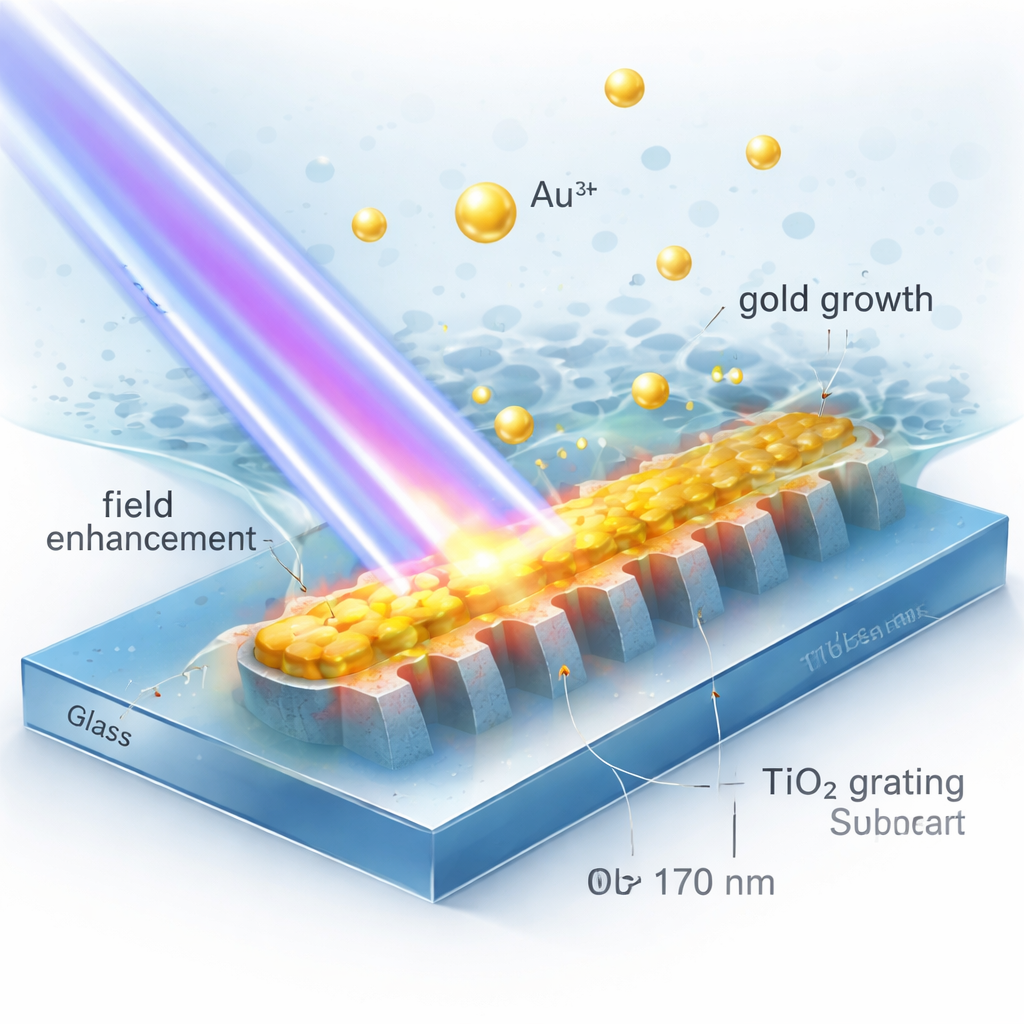
Toward Light-Directed Neural-Like Circuits
In everyday terms, this work demonstrates a light-controlled “pen” that can draw metal traces on a surface wherever the optical pattern focuses energy. The underlying titanium dioxide is continuously active, but the nanoscale patterning and laser tuning decide where growth takes off and where it remains sparse. Although the study does not yet build a functioning artificial brain, it provides a clear proof of principle for stimulus-dependent formation of conductive paths: a foundation for future neuromorphic hardware whose wiring can be written, adjusted, and perhaps eventually erased simply by changing how and where we shine light.
Citation: Schardt, J., Paulsen, M., Abshari, F. et al. Resonant laser excitation for nanoscale photocatalytic gold growth on patterned templates. Sci Rep 16, 2592 (2026). https://doi.org/10.1038/s41598-026-36556-5
Keywords: photocatalytic gold growth, nanostructured TiO2, resonant waveguide gratings, laser-controlled wiring, neuromorphic computing