Clear Sky Science · en
Enhanced cricket match prediction using kernel methods for feature extraction and back-propagation neural networks
Smarter Predictions for Cricket Fans
Cricket lovers know the thrill of trying to guess who will win as a match swings back and forth. This study turns that gut feeling into numbers by using modern data tools to forecast the outcome of One Day International (ODI) matches ball by ball. Instead of waiting until the end, the system updates its guess after every over, giving a running estimate of each team’s chances as the game unfolds.
Reading the Game Like a Data Expert
At the heart of the work is a simple idea: every over represents a snapshot of the match. The authors treat each of these snapshots as a separate game state and ask, “Given what we know right now, how likely is Team B to win?” To answer this, they feed six kinds of information into a prediction system: how many balls are left, how many runs Team A is ahead by, how many wickets remain, how strong each team is overall, whether the home crowd favors one side, and who won the toss. By blending these pieces, the system captures both the scoreboard pressure and the broader context that human commentators talk about.
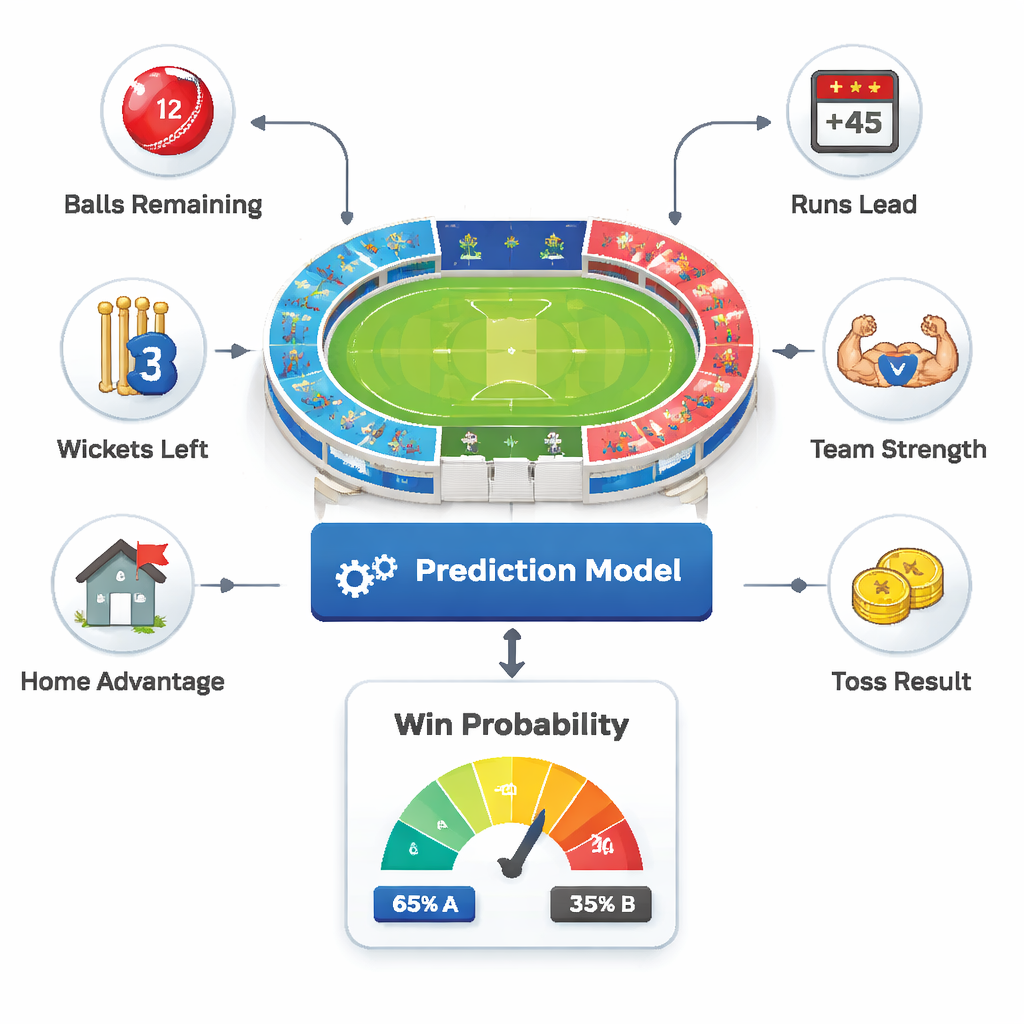
Building Strength Scores from a Century of Matches
The model is trained on a vast collection of international cricket data stretching back to 1877 and covering ODI, Test, and T20 formats. For each player, the researchers collect batting, bowling, and fielding records such as averages, strike rates, and economy rates. These are combined into a “team strength” score that reflects how powerful a side is on paper before a ball is bowled. During the match, this long-term strength is blended with short-term conditions like home advantage and the current chase situation, producing about 100,000 carefully cleaned match-state records for the learning system to study.
Letting Algorithms Pick the Most Telling Clues
Not every statistic helps the computer make a better call, and including too many can actually confuse it. To tackle this, the authors use a search method inspired by sports leagues, called the League Championship Algorithm. In this approach, many different subsets of features “compete” with each other. The subsets that lead to better predictions are treated like winning teams, and weaker ones copy parts of their strategy. Over many rounds, this process homes in on a small set of especially useful inputs. Tests show that this selection method beats more common techniques, leading to higher accuracy and a simpler, more efficient model.
How the Neural Network Learns to Call a Winner
Once the best features are chosen, they are sent into a back-propagation neural network, a flexible pattern-recognition tool that adjusts internal weights until it can reliably link match states to outcomes. Each over becomes one training example: the input is the six key criteria, and the output is whether Team B eventually won or lost. By repeatedly comparing its guesses to real results and nudging its internal settings to reduce errors, the network gradually learns subtle combinations of conditions—such as a strong chasing team with wickets in hand and home advantage—that typically lead to victory.
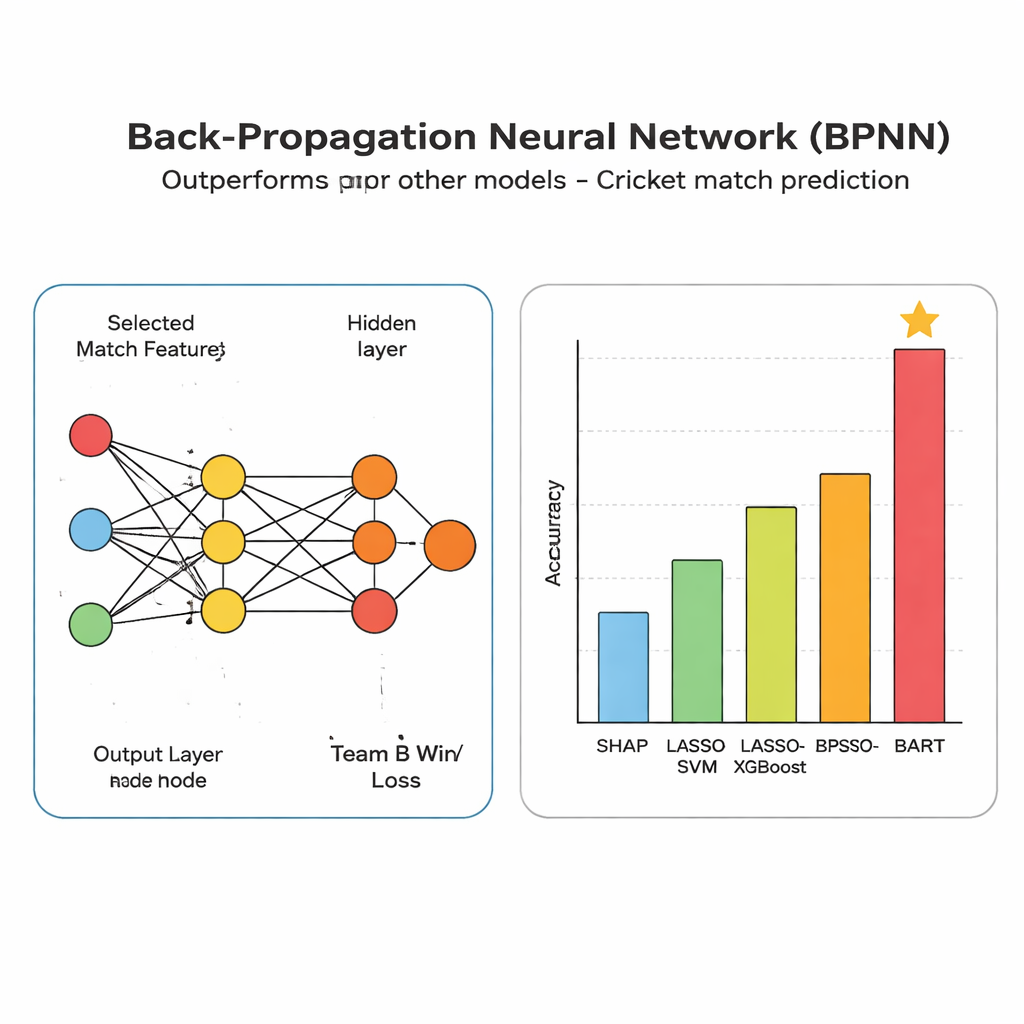
Outperforming Rival Models Across Formats
The authors pit their network against several rival approaches, including models that rely on hand-picked features and tree-based methods widely used in sports analytics. Across ODI, Test, and T20 data, their system delivers higher accuracy, with test-set scores around the mid-80 percent range, and stronger performance on measures that capture both how often it spots a likely winner and how often those positive calls are correct. The most influential factors turn out to be scoring-related statistics such as strike rate and total runs, echoing a fan’s intuition that fast, consistent scorers can tilt close contests.
What It Means for Fans, Teams, and Broadcasters
For a general reader, the takeaway is that the ebb and flow of a cricket match can now be translated into precise, regularly updated win probabilities. By mixing long-term player records, immediate match conditions, and a carefully tuned learning system, the study shows that we can forecast outcomes with impressive reliability while the game is still in progress. Such tools could support live commentary, coaching decisions, and even viewer apps that show how every ball nudges the odds. In simple terms, the research demonstrates that when cricket’s rich statistics are combined with smart algorithms, our instinctive sense of “who’s on top” can be turned into a clear, data-driven picture.
Citation: Dhinakaran, K., Anbuchelian, S. Enhanced cricket match prediction using kernel methods for feature extraction and back-propagation neural networks. Sci Rep 16, 6478 (2026). https://doi.org/10.1038/s41598-026-36555-6
Keywords: cricket analytics, sports prediction, machine learning, neural networks, match forecasting