Clear Sky Science · en
Predicting compressive strength of mortars containing recycled CRT glass using GMDH and GEP methods
Turning Old TVs into Safer, Stronger Building Blocks
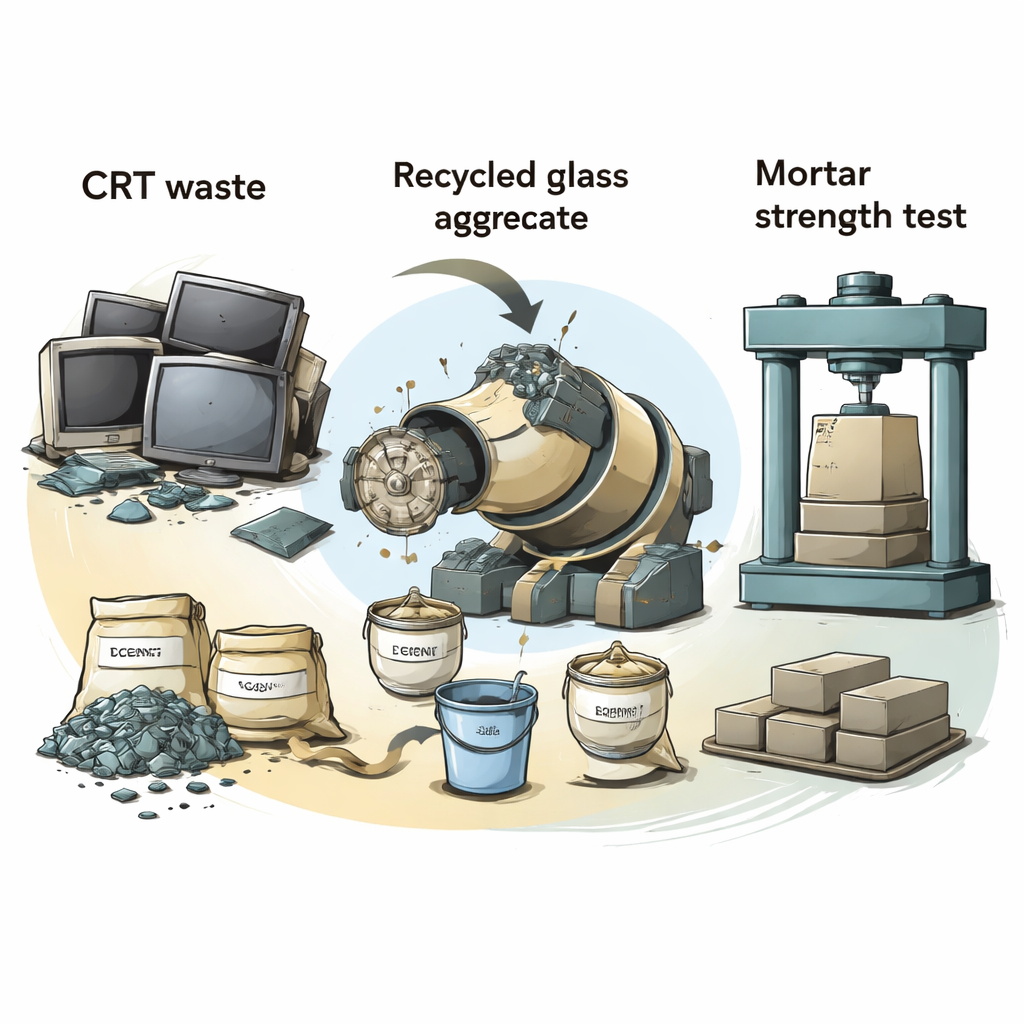
Millions of discarded cathode-ray-tube (CRT) televisions and monitors are piling up in landfills around the world. Their heavy glass contains a lot of lead, which can leak into soil and water. This study explores a way to lock that hazardous glass safely inside construction mortars while still keeping the material strong enough for real-world use. By combining recycling with modern data-driven modeling, the researchers show how we might turn a toxic waste stream into a useful ingredient for greener buildings and even radiation-shielding walls.
Why Old Screen Glass Is a Problem and an Opportunity
CRT glass is unusually dense and contains about 20–25% lead oxide. If crushed and dumped, this lead can slowly wash out and contaminate the environment. Earlier experiments showed that when CRT glass is mixed into cement-based mortars, the highly alkaline cement pore fluid helps trap heavy metals, sharply reducing their leaching. At the same time, the high density of the glass can improve X-ray and radiation shielding. The drawback is that replacing natural sand with recycled CRT (RCRT) glass often weakens the mortar because the smooth glass particles bond poorly to the surrounding paste. Engineers therefore face a trade-off between environmental benefits, shielding performance, and mechanical strength.
From Costly Lab Tests to Smart Prediction
Designing mortar mixes that strike the right balance has typically required many trial-and-error laboratory tests, which are slow and expensive. Previous research mostly reported individual test results and sometimes used traditional statistical formulas to predict strength, but these approaches struggled with the complex, nonlinear interactions among mix ingredients. In particular, no earlier work had built predictive models tailored specifically to mortars with RCRT glass, and most modern machine-learning studies focused on other recycled materials or used "black-box" algorithms that offer little insight into how each ingredient affects strength. This study set out to fill that gap using transparent, equation-based models.
How the Researchers Taught the Models
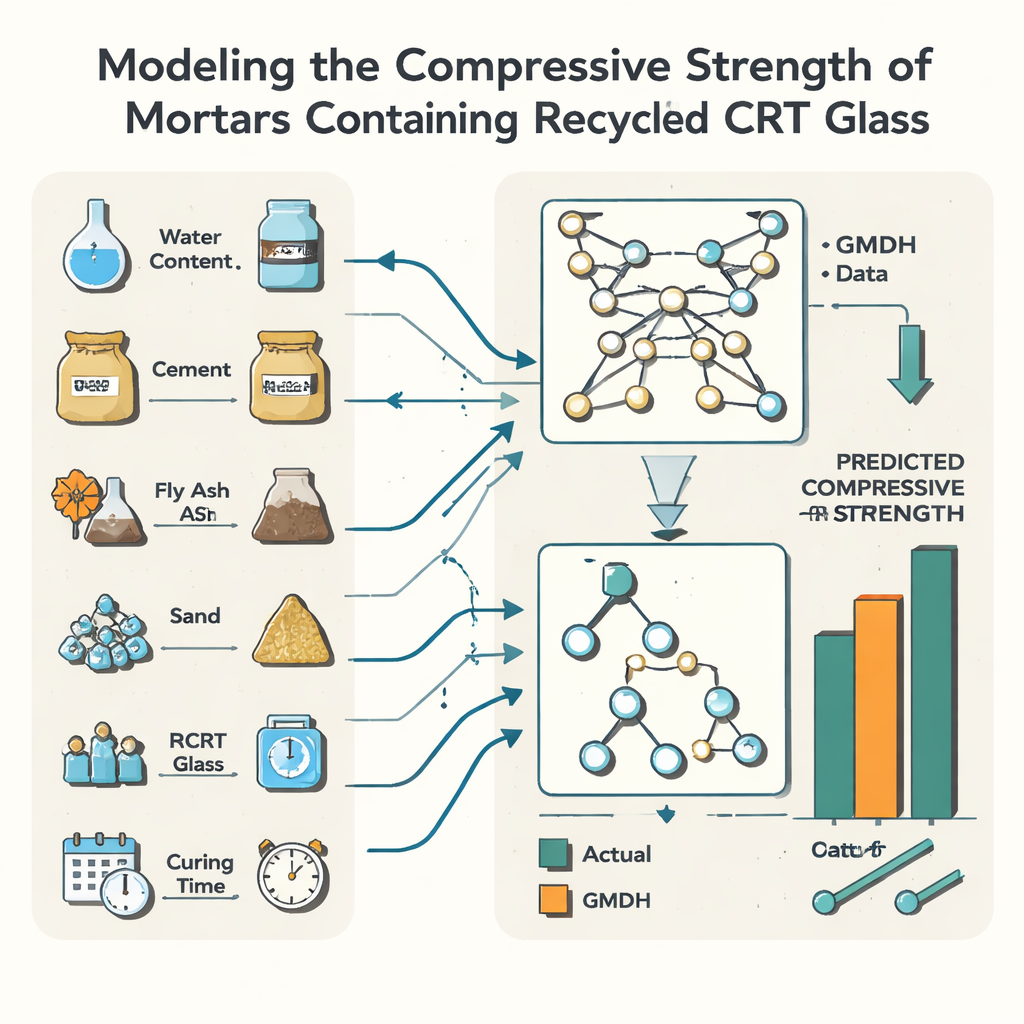
The team compiled a database of 139 mortar samples made with different proportions of water, cement, fly ash, natural sand, RCRT glass, and different curing times. They first cleaned the data by removing outliers and standardizing the scales of all variables. Two so-called "white-box" soft-computing methods were then trained to predict compressive strength: Group Method of Data Handling (GMDH), which builds a multi-layer network of simple polynomial equations, and Gene Expression Programming (GEP), which evolves mathematical formulas in a way inspired by genetics. Both methods produce explicit equations that engineers can plug into calculators or spreadsheets rather than opaque code. The data were split into training and testing sets, and the models were also checked using five-fold cross-validation to gauge their stability.
Which Method Won and What Matters Most
The GMDH model clearly outperformed both the GEP model and classical regression methods. On unseen test data, GMDH achieved a coefficient of determination (R²) of 0.942, with low prediction errors, meaning its calculated strengths closely matched laboratory measurements. GEP did reasonably well but showed more scatter and higher errors, while simple linear and nonlinear regressions missed much of the underlying complexity. To understand which ingredients influenced strength the most, the researchers used a modern explanation tool called SHAP. It revealed that water content was the dominant factor: too much water tends to create extra pores and reduce strength. Curing time came next—longer curing allowed more hydration reactions and stronger mortars. Cement content had a moderate effect, while the amounts of RCRT glass and sand played smaller, secondary roles over the range of mixes studied.
What This Means for Greener Construction
For a general reader, the key takeaway is that it appears both safe and practical to recycle moderate amounts of CRT glass into cement mortars without severely sacrificing strength, provided the mix is carefully designed. The GMDH equations give engineers a reliable, easy-to-use tool to predict how strong a given RCRT-rich mortar will be before mixing a single batch. Because the method is transparent, designers can also see how changing water, cement, or curing time will shift performance and compensate for the small strength loss caused by the glass. In short, the study shows that combining industrial waste recycling with interpretable machine-learning models can help turn hazardous e-waste into a predictable, structurally sound ingredient for sustainable and even radiation-shielding construction materials.
Citation: Ghorbani, V., Seyedkazemi, A. & Kutanaei, S.S. Predicting compressive strength of mortars containing recycled CRT glass using GMDH and GEP methods. Sci Rep 16, 6655 (2026). https://doi.org/10.1038/s41598-026-36553-8
Keywords: recycled CRT glass, cement mortar strength, sustainable construction, machine learning models, radiation shielding materials