Clear Sky Science · en
Community resilience to urban flooding across comparative neighborhoods in China
Why flood-ready neighborhoods matter
As climate change brings heavier rains and cities grow ever larger, floods are reaching more people than ever before. Yet whether a neighborhood bounces back quickly or struggles for years is not just about levees and drains; it is also about neighbors who help one another, trusted local leaders, and clear warning systems. This study explores how three different types of neighborhoods in Chengdu, one of China’s largest cities, are building the social strength needed to live with frequent urban flooding.
Three very different places, one shared risk
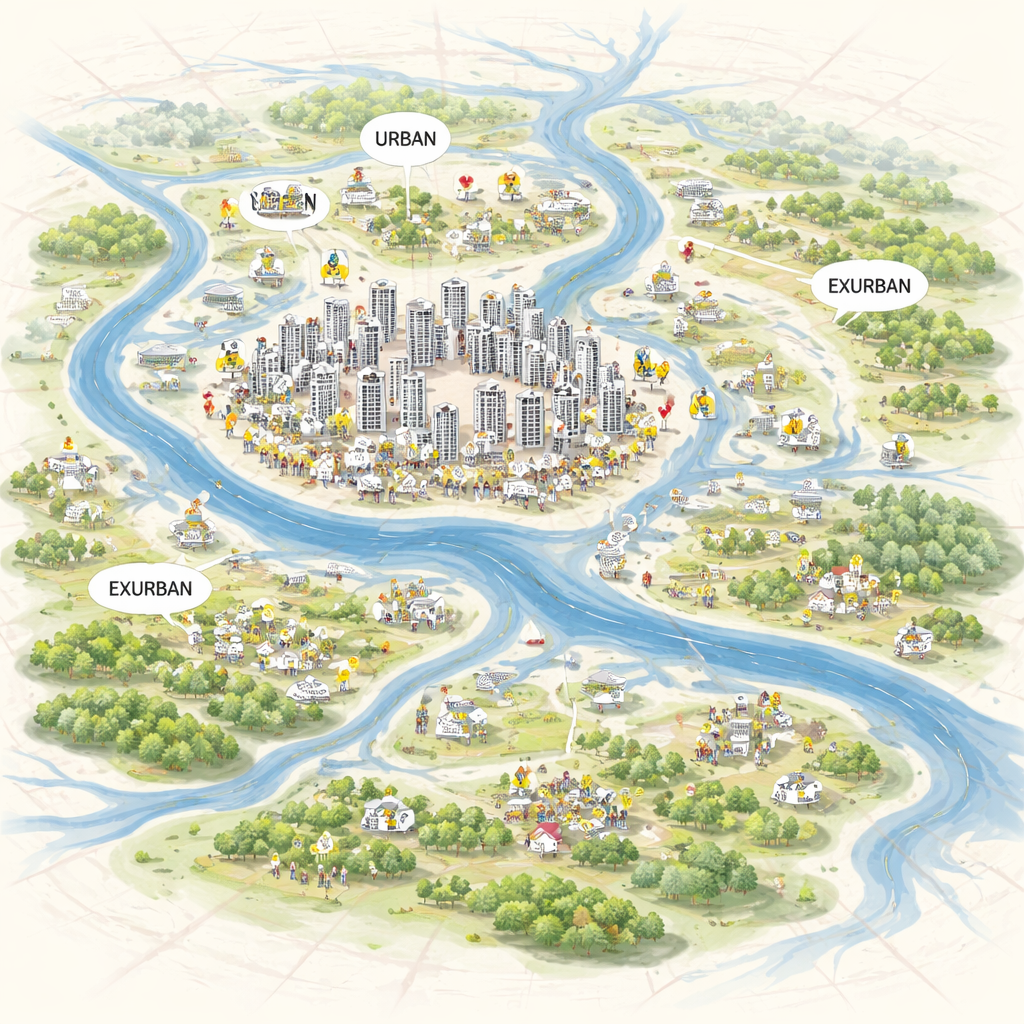
The researchers focused on three neighborhoods that all face similar flood danger: a crowded downtown district, a newer middle-class suburb on the city’s edge, and a lower-density exurban area on the rural fringe. Each sits near major waterways and has a history of flooding, so the basic hazard is comparable. What differs is how people live: the inner-city area is dense and fully built up, the suburb is made of newer residential blocks, and the exurban community mixes village-style housing with newer apartments. All three are officially recognized by the government for disaster preparedness, but they use different strategies to get ready for floods.
Listening to residents, not just measuring pipes
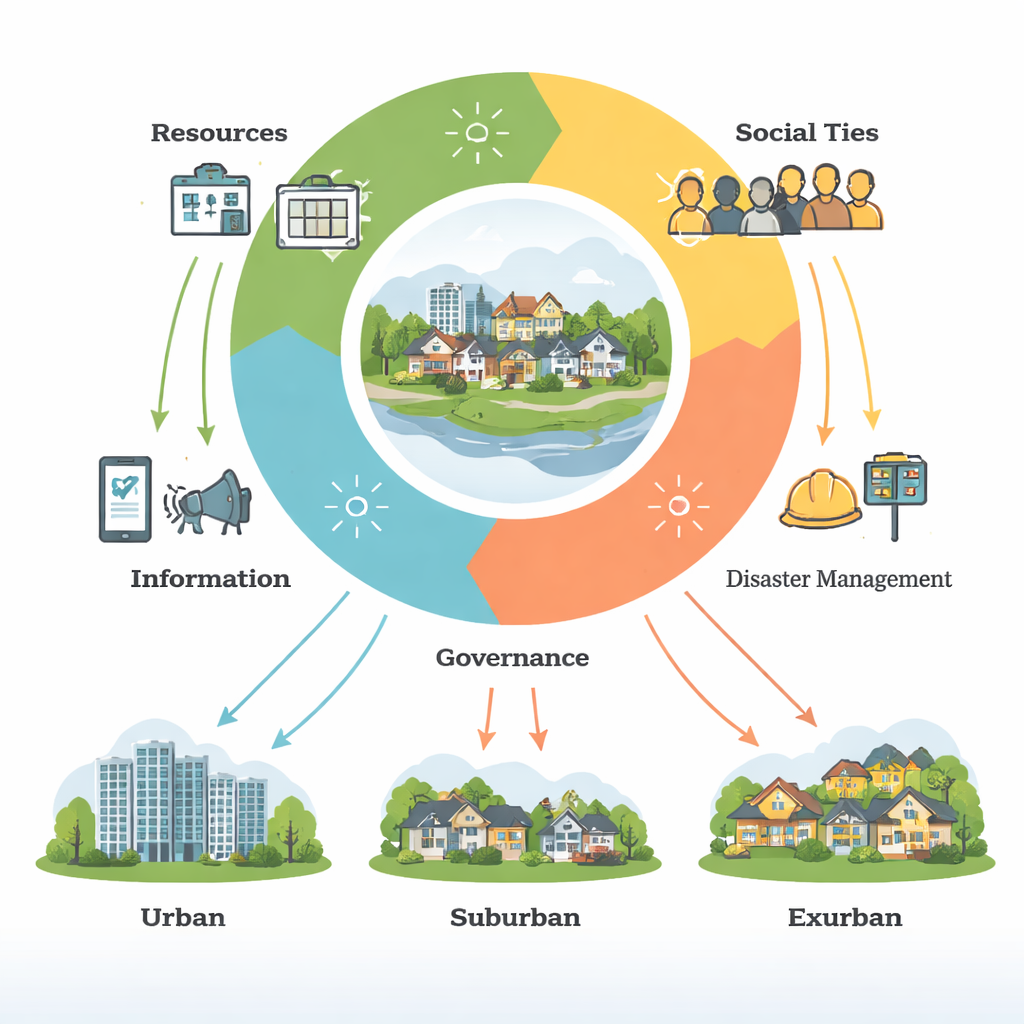
Instead of starting with engineering data, the team asked residents how resilient they felt their communities were. Using a survey tool called the Communities Advancing Resilience Toolkit, adapted and tested for China, they gathered 387 responses. The questions covered five everyday foundations of resilience: basic services like food, health care, housing, and shelters; how strongly neighbors feel connected and willing to help; how well the community prevents, prepares for, and recovers from disasters; how fast and clearly information is shared; and how local leadership, cooperation, and learning from past events work in practice. The survey proved highly reliable, suggesting it can be used more widely in Chinese cities.
Who feels safest when the waters rise?
Overall, people rated their communities’ flood resilience slightly above the middle of the scale. Information and communication scored highest, meaning many residents receive warnings and updates in time. Governance and the ability to learn and improve scored lowest. The downtown neighborhood reported the strongest sense of resilience, especially in access to food, services, and facilities. The suburban area scored lowest, particularly in neighborly ties and sense of belonging, while the exurban neighborhood stood out for its strengths in disaster management, such as drills and organized responses. Maps of smaller sections inside each neighborhood showed big differences even within the same area: in the city center, newer, better-served blocks felt much safer than older walk-up buildings with few services.
People, practice, and participation
By analyzing the survey data, the researchers found that who you are and what you do strongly shape how resilient you feel. Older adults and women tended to feel less prepared and had weaker access to services, marking them as more vulnerable. Higher education and income were linked to better access to information and a stronger voice in community decisions. Residents who had volunteered, taken part in disaster education, or joined evacuation drills consistently reported higher resilience. Comparing local policies, the study found that the urban and exurban communities relied heavily on community volunteers, social organizations, and joint activities, while the suburb leaned mainly on government-led engineering projects like "sponge city" drainage. The more a community blended physical measures with active social engagement, the stronger and more confident residents felt.
Building flood resilience for everyone
The authors argue that relying only on government projects and hard infrastructure is not enough to protect people from urban floods, especially the most vulnerable. Instead, they propose a "multi-sector" approach in which residents, neighborhood committees, social organizations, and local businesses share responsibility. That means improving everyday services in weaker areas, weaving resident participation into routine neighborhood life, expanding drills and education before the rainy season, and using multiple channels—from smartphone apps to loudspeakers—to reach all groups. In simple terms, the study shows that a flood-ready community is not just one with good drainage, but one where people are informed, connected, and able to act together long before the water reaches their doorsteps.
Citation: Wei, Y., Kidokoro, T., Seta, F. et al. Community resilience to urban flooding across comparative neighborhoods in China. Sci Rep 16, 6473 (2026). https://doi.org/10.1038/s41598-026-36552-9
Keywords: urban flooding, community resilience, Chengdu neighborhoods, disaster preparedness, social capital