Clear Sky Science · en
Field pathogenomics and evolutionary conservation unveil CRISPR-targetable susceptibility genes for wheat blast resistance
Why a Wheat Disease Matters to Your Dinner Table
Wheat is a staple food for billions of people, and a fast-spreading disease called wheat blast can wipe out entire fields in a matter of weeks. In recent years this fungal disease has jumped continents, threatening harvests in South America, Asia, and Africa. The study summarized here asks a crucial question: instead of endlessly chasing new resistant varieties and spraying more fungicides, can we rewire wheat itself so the fungus no longer finds an easy way in?
When a Fungus Turns Wheat Fields into Disaster Zones
Wheat blast is caused by a fungus known as Magnaporthe oryzae pathotype Triticum, or MoT. It first emerged in Brazil in the 1980s and has since caused repeated crop failures across South America. In 2016 it surged across Bangladesh, devastating every wheat variety grown there, and similar strains have now been detected in Africa and even on experimental plants in Europe and the United States. Under warm, humid conditions, wheat blast can destroy most of a crop just before harvest. Because wheat is a major source of calories for many countries, these outbreaks are more than farm problems; they are direct threats to food security.
Why Traditional Defenses Keep Failing
Farmers and breeders have two main tools against diseases like wheat blast: fungicides and resistance genes bred into the crop. Both have major weaknesses. Fungicides often arrive too late because the fungus colonizes wheat spikes quickly, and resistance genes tend to be “race-specific” – they only block certain versions of the pathogen. The fungus can escape these defenses by mutating key molecules it uses to infect plants. Several blast resistance genes are known, but many work only in certain growth stages, fail at higher temperatures, or lose effectiveness as the fungus evolves. This arms race forces breeders to constantly search for new resistance genes, a process too slow to keep up with a rapidly spreading disease.
Flipping the Script: Making Wheat a Poor Host
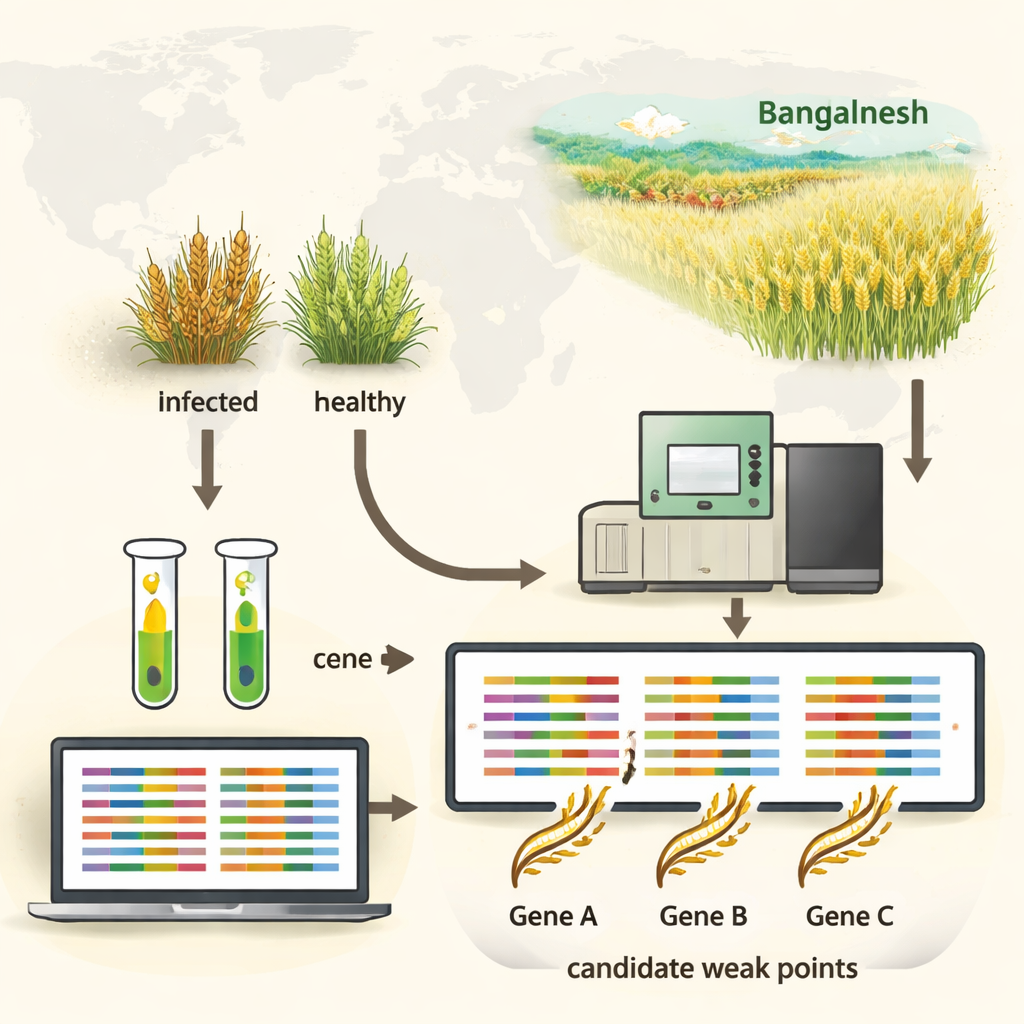
The researchers behind this study take a different approach. Instead of focusing on the plant’s defensive genes, they focus on its “susceptibility” genes – normal wheat genes that the fungus hijacks to establish infection. If these genes are turned off or altered, the pathogen loses a vital foothold. To find such weak points, the team analyzed RNA – the chemical messages that show which genes are active – from wheat leaves collected in blast-stricken fields in Bangladesh during the 2016 epidemic. By comparing infected and healthy plants from different locations and wheat varieties, they identified 273 wheat genes that were consistently more active during real-world infections. Many of these genes were linked to defense and stress responses, but the team wanted those that actually help the fungus.
Homing In on Three Critical Weak Points
To narrow the list, the scientists compared wheat genes with their counterparts in rice, a crop whose blast interactions are better understood. This evolutionary comparison highlighted three wheat genes already known to make plants vulnerable to other diseases: one tied to bacterial blight in rice, and two linked to powdery mildew and stripe rust in wheat. All three showed coordinated activity with fungal genes during field infections, suggesting close interaction between host and pathogen. The team then tested these candidates in greenhouse experiments, infecting wheat spikes from a blast-susceptible variety and a resistant line carrying a known resistance gene. Only one gene, called TaMLO1-5A, was strongly switched on in the susceptible plants after infection, but not in the resistant ones, marking it as a prime suspect in blast vulnerability.
Editing Wheat for Lasting Protection
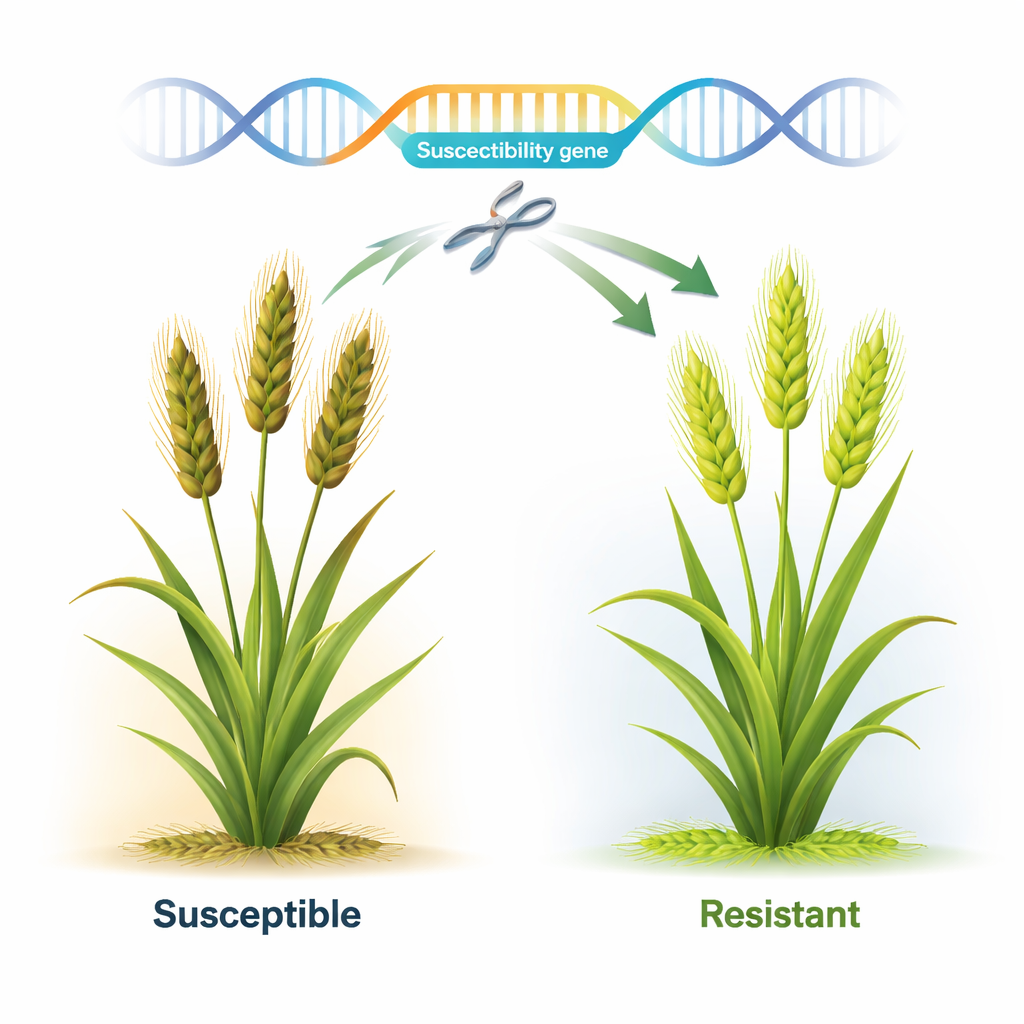
Because relatives of the TaMLO1-5A gene have already been successfully altered with CRISPR gene editing to give long-lasting resistance to powdery mildew in wheat and barley, the authors argue that disabling this gene in wheat could provide durable, broad protection against blast as well. Unlike conventional resistance genes that the fungus can dodge, removing a susceptibility gene takes away something the pathogen depends on, raising the barrier for it to adapt. The study does not claim to have a ready-made resistant wheat variety, but it delivers a clear roadmap: use field data, evolutionary comparisons, and precise gene editing to turn the crop from an easy target into a poor host. In a warming world where fungal diseases are spreading into new regions, such strategies could help secure wheat harvests – and the bread, noodles, and chapatis that depend on them – for years to come.
Citation: Khayer, A., Ye, P., Eti, F.S. et al. Field pathogenomics and evolutionary conservation unveil CRISPR-targetable susceptibility genes for wheat blast resistance. Sci Rep 16, 5677 (2026). https://doi.org/10.1038/s41598-026-36547-6
Keywords: wheat blast, plant disease resistance, CRISPR, susceptibility genes, food security