Clear Sky Science · en
The effect of defocus incorporated multiple segments (DIMS) spectacle lenses on astigmatism in children with myopia
Why these new glasses matter for kids’ eyesight
More and more children around the world are becoming nearsighted, or myopic, meaning they see well up close but poorly in the distance. Parents and doctors are searching for ways not just to correct blurry vision, but to slow myopia from getting worse and leading to serious eye problems later in life. A relatively new type of eyeglass lens, called a DIMS lens, promises to slow myopia progression by subtly changing how light focuses inside the eye. This study asks a key safety question that many parents and clinicians share: do these special lenses accidentally make astigmatism—another common cause of blurred vision—worse over time?
A new kind of glasses for growing eyes
DIMS stands for “Defocus Incorporated Multiple Segments.” Instead of acting like a single smooth lens, these glasses contain many tiny lens segments arranged across the surface. While the central part of the lens gives clear vision, the surrounding segments intentionally focus light slightly in front of the retina. Animal research suggests that this kind of “myopic defocus” can signal the eye to slow its growth in length, which in turn can slow the worsening of nearsightedness. Earlier clinical trials have shown that DIMS lenses can indeed reduce how quickly children’s myopia progresses and how fast their eyes elongate, but the impact on astigmatism has remained uncertain.
How the study was carried out
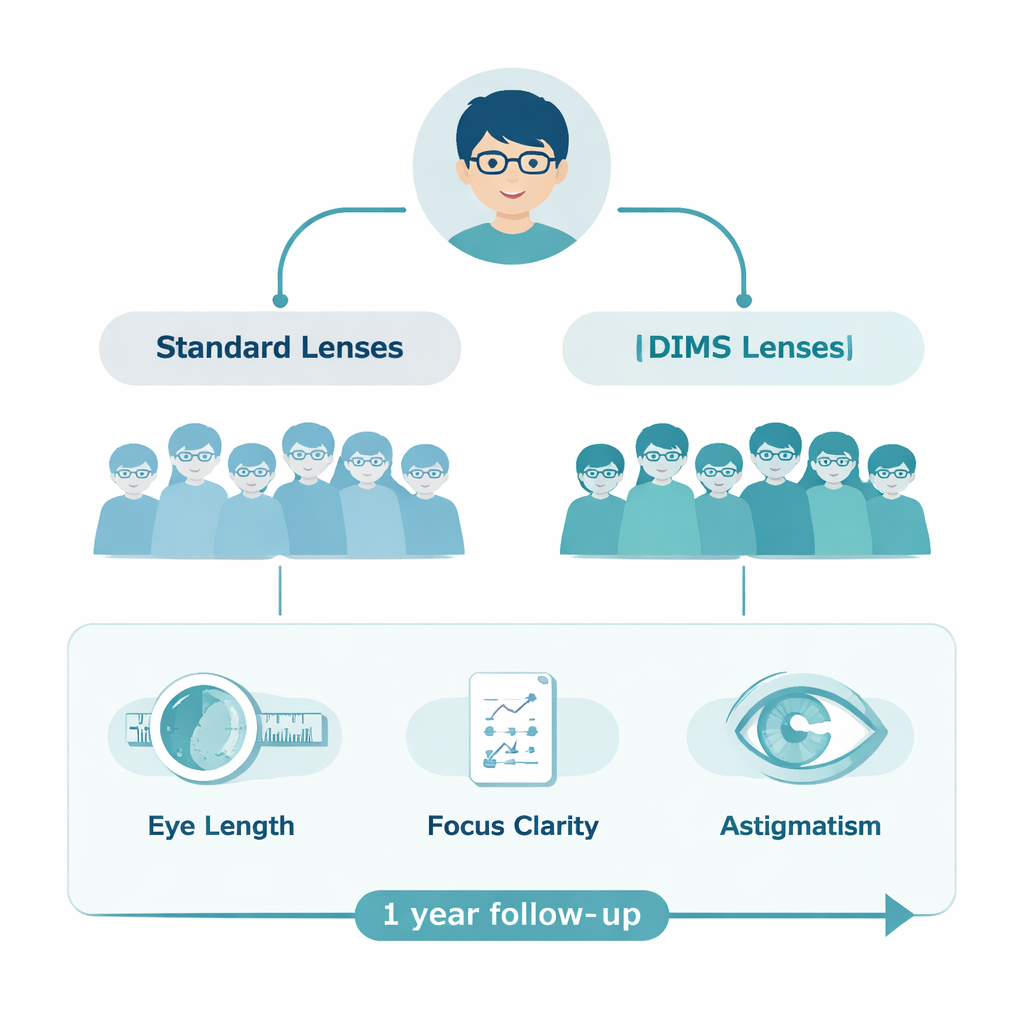
To explore this, researchers in Chongqing, China followed 396 myopic children between 6 and 12 years old for one year. Families chose between two options: DIMS lenses or regular single-vision lenses, the standard type of glasses that simply sharpen focus. After excluding children who did not complete follow-up, 192 wore DIMS lenses and 204 wore single-vision lenses. All children underwent thorough eye exams at the start and then every six months, including measurements of overall prescription strength, the eye’s length from front to back, and different forms of astigmatism arising from the cornea and internal structures of the eye.
What happened to nearsightedness and eye growth
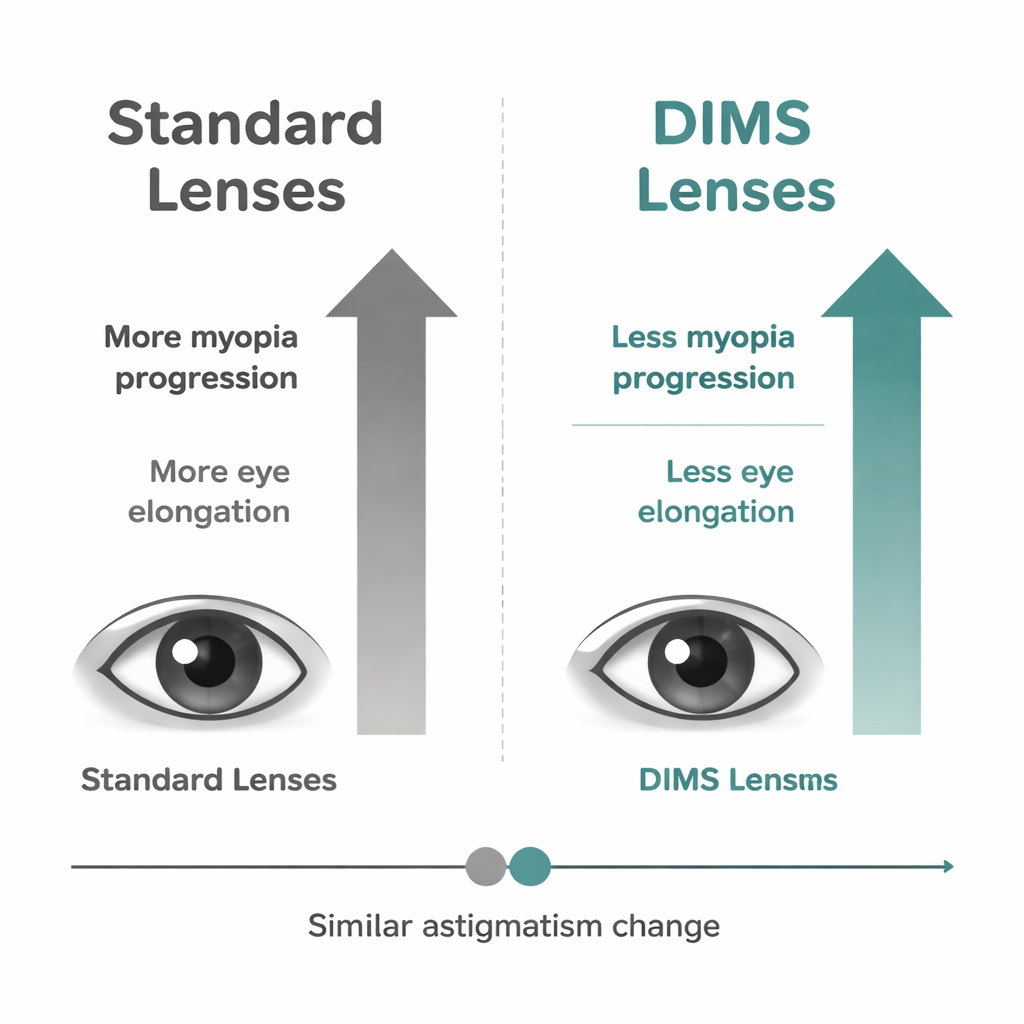
Over the course of a year, both groups became more nearsighted, but not to the same degree. Children wearing regular single-vision lenses showed almost three times as much change in their overall prescription as those wearing DIMS lenses. Their eyes also lengthened more: on average, axial length increased about 0.41 millimeters in the standard-lens group versus only 0.16 millimeters in the DIMS group. These differences were statistically strong, reinforcing previous findings that DIMS lenses are effective at slowing both the refractive shift and structural growth associated with myopia.
Astigmatism stayed essentially the same
The central concern, however, was astigmatism—a distortion caused when the eye curves more in one direction than another. If DIMS lenses altered how different parts of the eye grew, they might twist or stretch the eye in ways that worsen this distortion. The study examined astigmatism from several angles: the usual “cylinder” value from the glasses prescription, the astigmatism coming specifically from the cornea, and the direction of that astigmatism using vector-based analyses. Although there were tiny numerical differences between groups, more detailed statistical models that accounted for starting prescription and corneal shape showed no meaningful effect of lens type on how astigmatism changed. Both DIMS and standard-lens wearers experienced similarly small increases in astigmatism over the year, and the proportion of children with larger shifts was nearly identical in both groups.
What this means for parents and clinicians
For families weighing different options to control a child’s myopia, the results offer reassuring news. In this real-world clinical setting, DIMS spectacle lenses clearly slowed the worsening of nearsightedness and eye lengthening without causing extra astigmatism compared with ordinary glasses. The modest changes in astigmatism that did occur were more closely related to each child’s original corneal shape than to the type of lens they wore. While longer and larger studies are still needed, this work supports DIMS lenses as a promising, safe tool in the fight against childhood myopia, helping protect distance vision now without trading it for new vision problems later.
Citation: Wang, Y., Ouyang, L., Chen, S. et al. The effect of defocus incorporated multiple segments (DIMS) spectacle lenses on astigmatism in children with myopia. Sci Rep 16, 6222 (2026). https://doi.org/10.1038/s41598-026-36545-8
Keywords: myopia control, DIMS lenses, child eye health, astigmatism, spectacle design