Clear Sky Science · en
Sustainable operation of multi-energy systems under cooperative and non-cooperative strategies
Why sharing local clean power matters
As more homes and businesses add rooftop solar, batteries, and small wind turbines, our power grids are quietly changing. Instead of electricity flowing one way from a few big plants, thousands of small "microgrids" can now make, store, and trade energy. This study looks at how those microgrids can work with the local utility in smarter, fairer ways—cutting costs, wasting less energy, and keeping the lights on, especially as we also need heat for buildings. 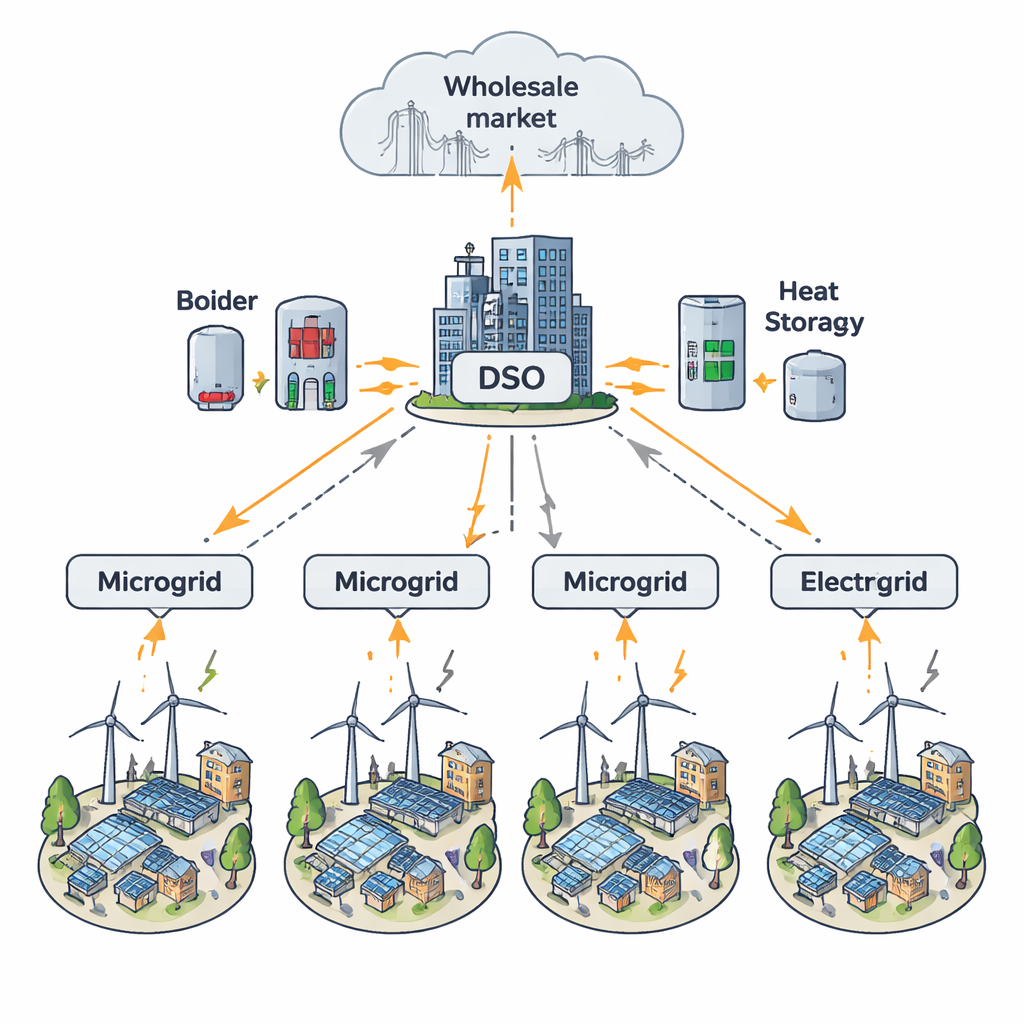
From one-way power to a two-way neighborhood market
Traditionally, a single local operator—called a distribution system operator, or DSO—buys electricity from the big wholesale market and sells it on to customers. In the world this paper studies, that DSO still acts as the middleman but now deals with renewable-based microgrids instead of passive consumers. Each microgrid bundles solar panels, wind turbines, small engines, fuel cells, batteries, and local heating equipment that serve a cluster of buildings. The DSO can also produce heat and electricity using combined heat-and-power units, boilers, and heat storage, then sell both power and heat to the microgrids. The core question is: how should prices and energy trades be set so that the utility earns money while the microgrids keep their costs down?
Letting microgrids bargain together
Most earlier models assume that each microgrid negotiates separately with the DSO. That leaves a lot of power in the DSO’s hands: it sets different prices for each microgrid and focuses mainly on meeting electricity demand, leaving heating needs as an afterthought. This study flips that script by allowing the microgrids to cooperate. When microgrids form a coalition, they can compare offers, trade energy among themselves, and present a united front when dealing with the DSO. The authors build a mathematical “two-level” model in which the DSO, at the upper level, chooses how much to buy from the wholesale market and how to price energy for the microgrids, while the microgrids, at the lower level, decide how to use their local generators, storage units, and possible load reductions to minimize daily cost.
Adding heat to the clean-energy puzzle
What makes the framework stand out is that it treats heat and electricity together. Buildings do not only need power for lights and appliances; they also need hot water and space heating. Supplying heat efficiently can, in turn, change how much electricity is needed from the grid. The model lets the DSO choose when to run its boiler, when to operate combined heat-and-power units that produce both heat and electricity, and when to charge or discharge both electrical and thermal storage. By coordinating these choices with real-time prices for the microgrids, the system can make better use of renewable energy, avoid unnecessary fuel use, and cut back on “energy not supplied”—periods when demand cannot be fully met.
What happens when microgrids team up
The authors test their approach on a sample distribution network with one DSO and four renewable microgrids, each having different mixes of solar, wind, fuel cells, and microturbines, plus their own demand patterns for power and heat. First they examine a non-cooperative case, where microgrids can only buy from the DSO. Then they allow cooperation, so microgrids can trade with one another and act like a single, larger buyer when dealing with the DSO. The results are striking: cooperation cuts the microgrids’ operating costs by about 9 percent and reduces unserved energy by more than a third. To stay competitive, the DSO is forced to lower the retail prices it charges compared with the non-cooperative case, especially during higher-demand hours when microgrids could otherwise rely more on their own resources or their neighbors. 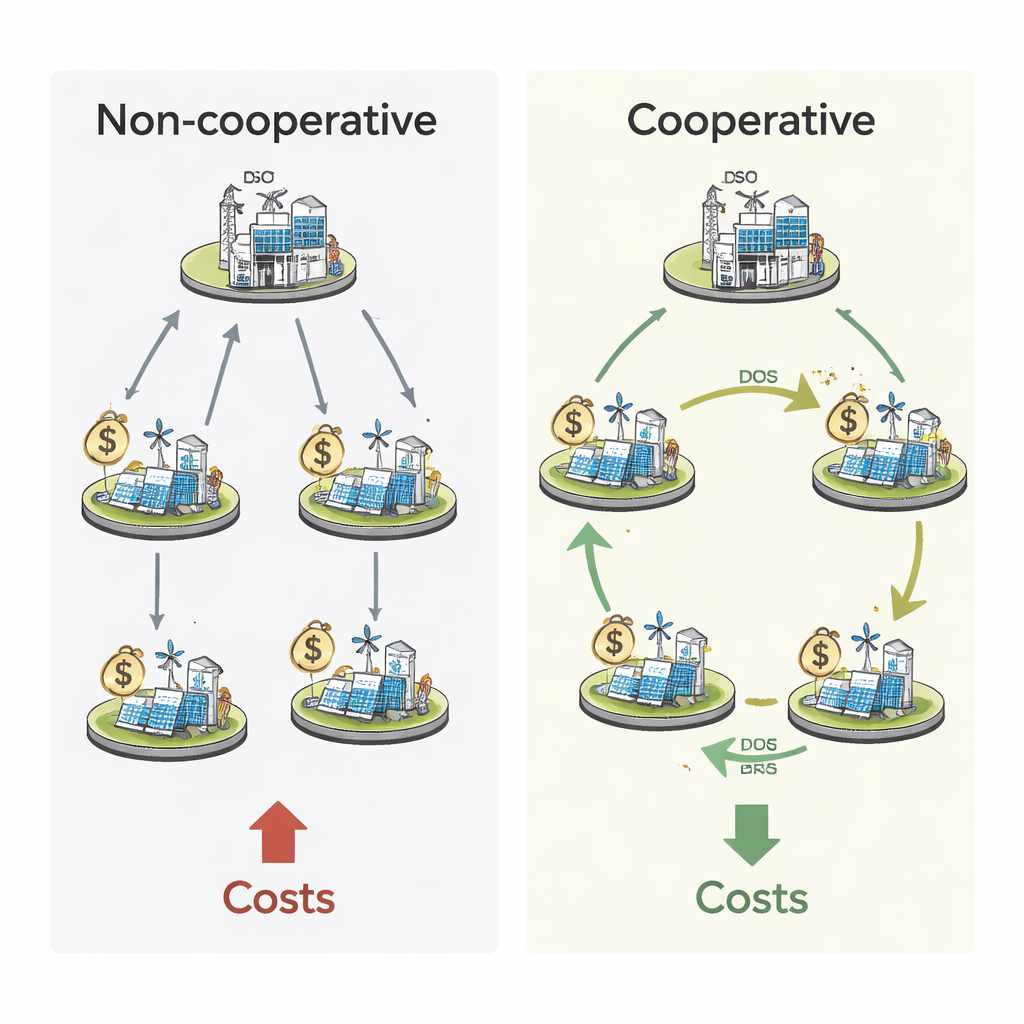
Resilient markets under changing prices
The study also explores how the system behaves when wholesale electricity prices are uncertain. Using a range of possible price scenarios and a robust “worst case” setting, the authors show that cooperation consistently benefits the microgrids, even when power from the larger grid becomes more expensive. In tougher conditions, the DSO’s profit shrinks because it must pay more for electricity but cannot push retail prices too high without losing business to local generation and peer-to-peer trades among microgrids. This suggests that empowering local energy communities can make the overall system more flexible and less vulnerable to price shocks.
What this means for everyday energy users
For non-specialists, the takeaway is straightforward: when small clean-energy systems in neighborhoods are allowed to share energy and bargain together, everyone except the monopoly seller tends to do better. Households and businesses can see lower bills and fewer outages; the local utility still earns money but must offer more reasonable prices; and the energy system as a whole uses fuel and equipment more efficiently, including for heating. As more solar panels, batteries, and smart controls are installed, models like the one in this paper point toward a future in which local cooperation is just as important as new hardware for building a cleaner, more reliable energy grid.
Citation: Karimi, H. Sustainable operation of multi-energy systems under cooperative and non-cooperative strategies. Sci Rep 16, 6177 (2026). https://doi.org/10.1038/s41598-026-36536-9
Keywords: microgrids, renewable energy, energy markets, district heating, peer-to-peer energy trading