Clear Sky Science · en
Enhancing quantum audio watermarking security through joint verification and certification
Protecting Sounds in a Quantum World
Music, podcasts, and spoken recordings are increasingly handled by powerful computers that may one day be quantum. That raises a new question: how do we prove who owns an audio track when it can be copied or altered in strange new ways? This paper explores a quantum-era version of audio watermarking—a way to hide ownership marks in sound—designed to stay both hard to remove and hard to fake, even when quantum computers and quantum communication links are involved. 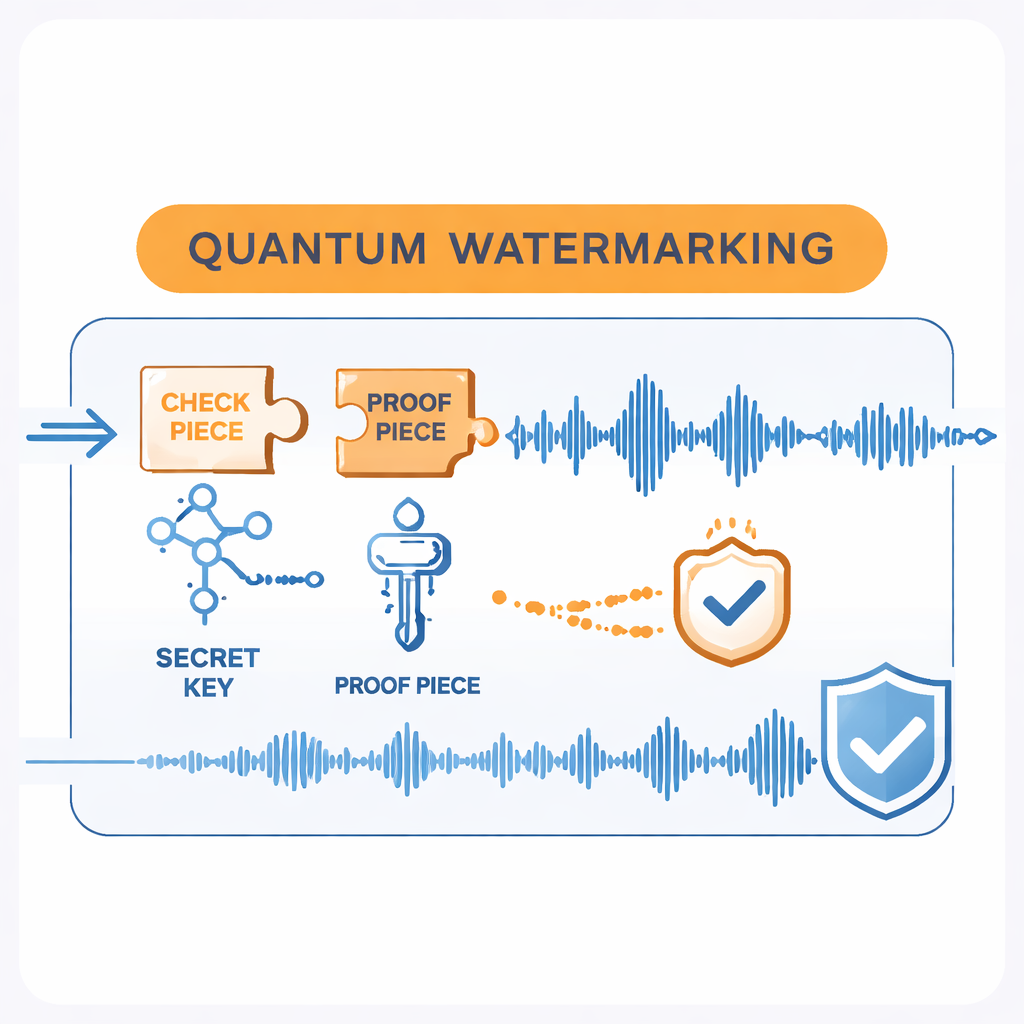
Why Ordinary Watermarks Fall Short
Traditional digital watermarks tuck a hidden pattern into an audio file so quietly that human listeners cannot hear it, but computers can later detect it. Early quantum watermarking methods borrowed this idea, focusing mainly on keeping the watermark intact when the audio is compressed, transmitted, or lightly distorted. However, they paid far less attention to a different kind of danger: what if someone steals the watermark itself, forges a similar one, or pastes a real watermark onto fake audio to claim ownership they do not have? The authors argue that, in a quantum setting where data can be probed and manipulated in new ways, this gap in protection becomes a serious weakness.
A Seal That Only Fits the Right Page
To close this gap, the researchers borrow an idea from a very old security trick: the paging seal used on paper money and contracts. A seal is stamped across two pages or banknotes; each alone looks incomplete, but together they form a perfect mark that proves both items belong together. In the quantum watermarking scheme, the hidden image (such as a logo) is split into two parts. One part acts as a "check" that travels with a secret key derived from features of the audio itself. The other part acts as a "proof" that is woven into the quantum version of the sound. Only if both pieces match—and match the specific audio—does the system accept the watermark as genuine. This joint verification and certification step makes it far harder for attackers to copy, tamper with, or misapply the watermark.
Hiding Marks Inside Quantum Sound
Under the hood, the method relies on ways of describing sounds and images using quantum bits, or qubits. The audio waveform is turned into a quantum state, and the watermark image is similarly converted into a grid of quantum pixels. The "proof" part of the watermark is carefully tucked into the least influential bits of the audio so that the change is inaudible. At the same time, the "check" part is combined with two simple summaries of how the audio behaves over time, producing a long secret key. Because this key depends on both the watermark and the specific audio track, it will not match if either is swapped or altered. To further protect against the natural fragility of quantum information, the proof portion is wrapped in a basic quantum error-correcting code that stores each bit of the watermark across three qubits, allowing the system to repair some kinds of noise before reading it out. 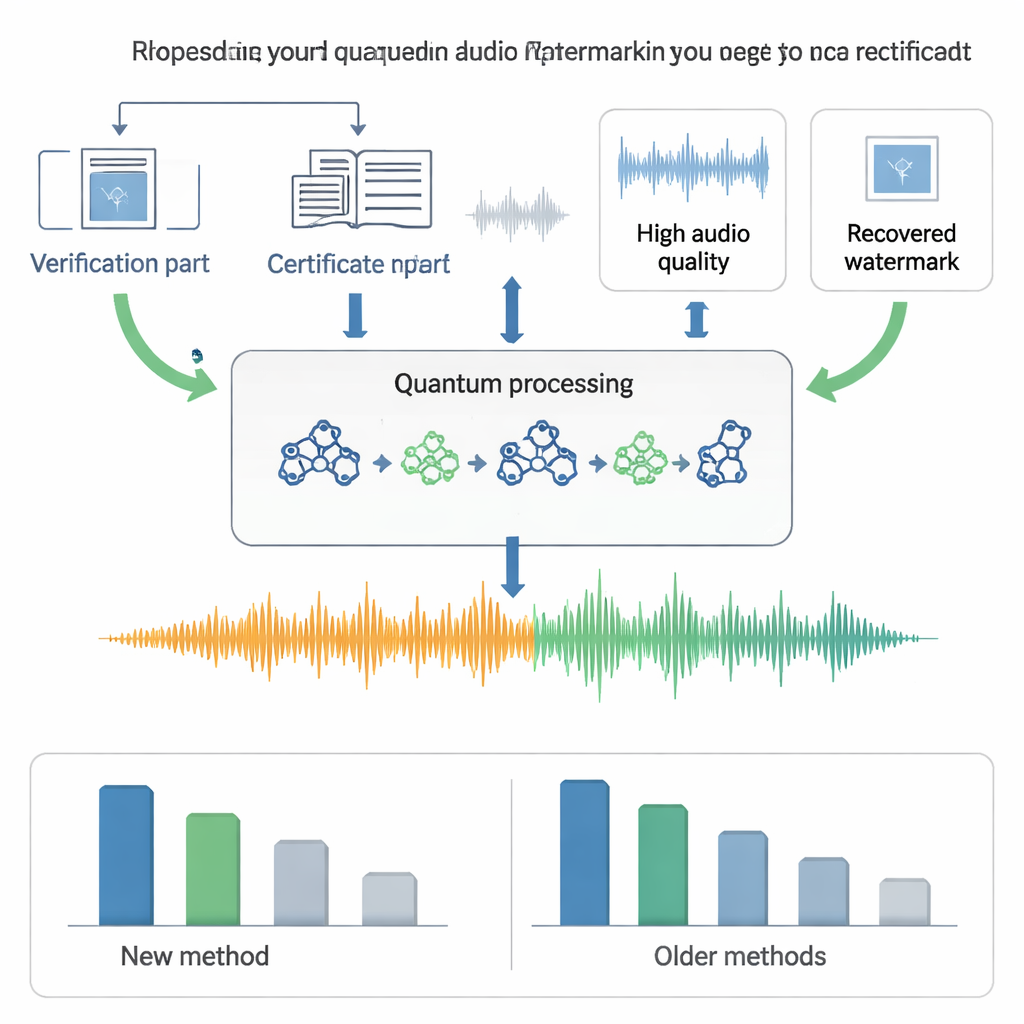
How Well It Holds Up Under Noise and Attack
The authors test their design using computer simulations that mimic how quantum audio might behave when sent through a noisy channel where qubits randomly flip. They embed a logo into several different audio clips and then try to recover it after various levels of disturbance. The results show that the watermarked audio still sounds clean—its signal-to-noise ratio stays above 46 decibels, a level typically considered transparent to listeners—even when the amount of hidden information is relatively high. At the same time, the extracted watermark image remains clear over a wide range of error rates, with far fewer flipped bits than in several leading quantum watermarking schemes. When they simulate common attacks—such as replacing the audio, swapping in a forged watermark image, or trying to reuse a stolen watermark—the system correctly flags all these cases as invalid because the two watermark halves and the audio-dependent key no longer line up.
Balancing Capacity, Quality, and Safety
An appealing feature of the method is that it can be tuned. A single parameter controls how much of the watermark becomes the "proof" part that is deeply protected and how much becomes the "check" part linked to the key. Setting this parameter one way gives high data capacity, useful when a lot of information must be hidden; setting it another way sacrifices capacity but greatly improves resistance to noise and errors. Across these choices, the audio quality remains high, and the watermark still cannot be cleanly copied or misused without detection. In simple terms, the work shows that it is possible not only to hide ownership marks in future quantum audio, but also to bind those marks tightly to a specific recording, so that thieves cannot easily claim, twist, or transplant them.
Citation: Xing, Z., Lam, CT. & Yuan, X. Enhancing quantum audio watermarking security through joint verification and certification. Sci Rep 16, 5616 (2026). https://doi.org/10.1038/s41598-026-36535-w
Keywords: quantum audio watermarking, digital copyright protection, quantum error correction, secure multimedia, quantum information