Clear Sky Science · en
Impact of cemented paste backfill on mechanical properties and stability of coal pillars in open pit highwall mining
Turning Mine Waste into a Support System
Open-pit coal mines often leave huge amounts of valuable coal locked beneath their final slopes, because removing it can weaken the ground and trigger landslides. This study explores how a specially engineered "cemented paste backfill"—made mostly from mining waste—can be used to safely support these slopes while allowing far more coal to be extracted. For readers interested in cleaner resource use, safer mining, and creative recycling of industrial waste, the work offers a concrete example of how engineering can turn a liability into a structural asset. 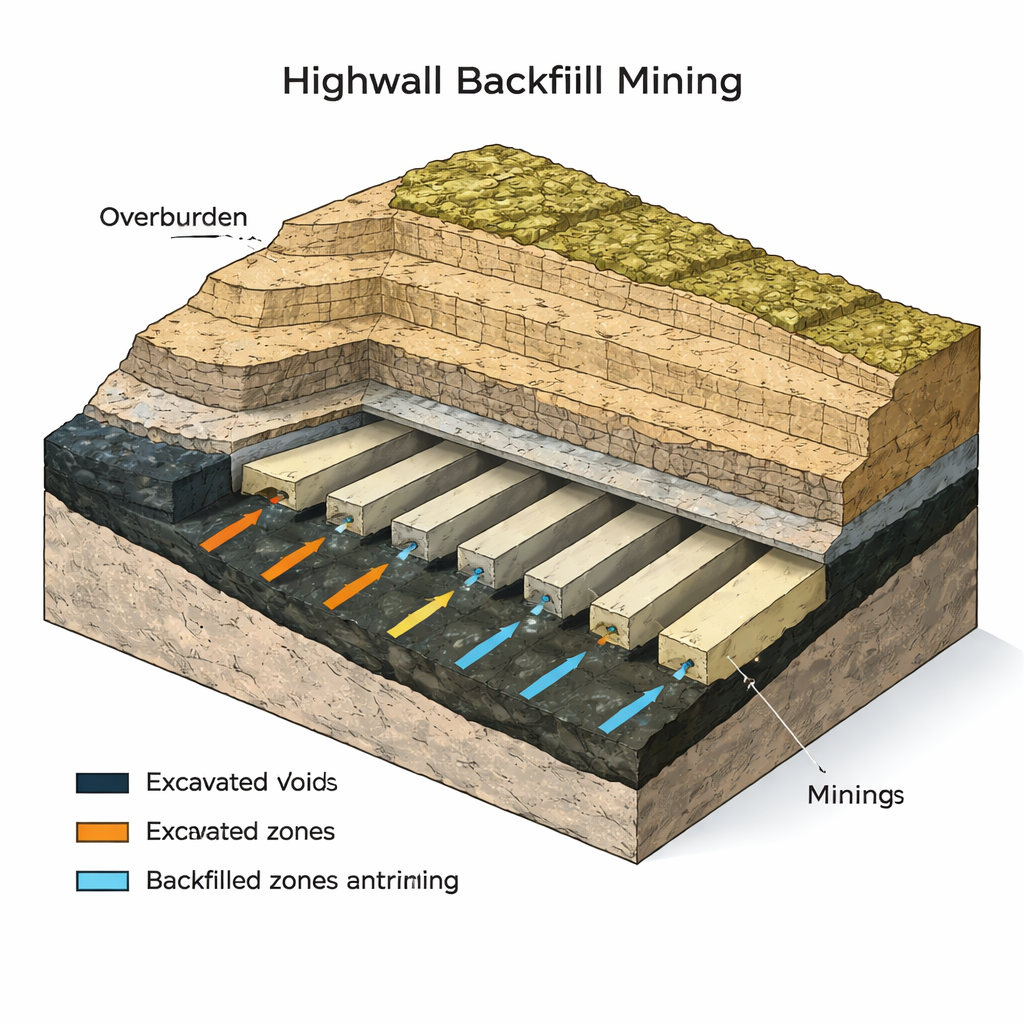
Why Coal Pillars Matter for Safety
In highwall mining, machines cut horizontal tunnels into the exposed coal seam along the pit wall, leaving behind solid columns of coal—called pillars—to hold up the overlying rock. These pillars are crucial for preventing the slope from deforming or collapsing, but leaving them in place means a large amount of coal can never be recovered. At a Chinese open-pit mine, early use of highwall mining without backfill led to ground subsidence on benches and haul roads, raising concerns about long-term stability. The question the researchers asked was: can we partially replace the job of these coal pillars by packing the mined-out voids with a controlled, cemented paste, so that more coal can be safely removed?
Building and Breaking Miniature Pillars
To tackle this, the team recreated the coal-and-backfill system in the laboratory using cube-shaped coal samples from a real mine. They cast cemented paste made from crushed rock waste, fly ash, cement, and water on both sides of the coal, forming a "backfill–coal pillar–backfill" sandwich. By changing two main factors—the height of the backfill compared to the coal pillar (the backfill ratio) and the strength of the paste itself—they could see how much support the backfill actually provided. These specimens were then squeezed in a strong steel container that imitated the tight confinement in an actual highwall, while instruments recorded how the coal and backfill responded as the load increased.
How Backfill Changes the Way Coal Fails
The stress–strain curves—the fingerprints of how a material carries load—revealed a five-step story: pores being compacted, the coal carrying load elastically, cracks forming and joining, the main failure of the coal, and finally, in some cases, the coal still bearing load thanks to the restraining backfill. At low backfill ratios and low paste strength, the coal behaved worse than coal without any backfill; the backfill did not fully constrain the pillar and instead shifted failure into the upper, less-supported part, which broke explosively into fragments. As the backfill was made taller and stronger, the failure pattern changed. Cracking became more evenly spread through the pillar, large sideways bulging was reduced, and at a 95% backfill ratio with strong paste, the coal showed only minor surface cracking and remained largely intact. 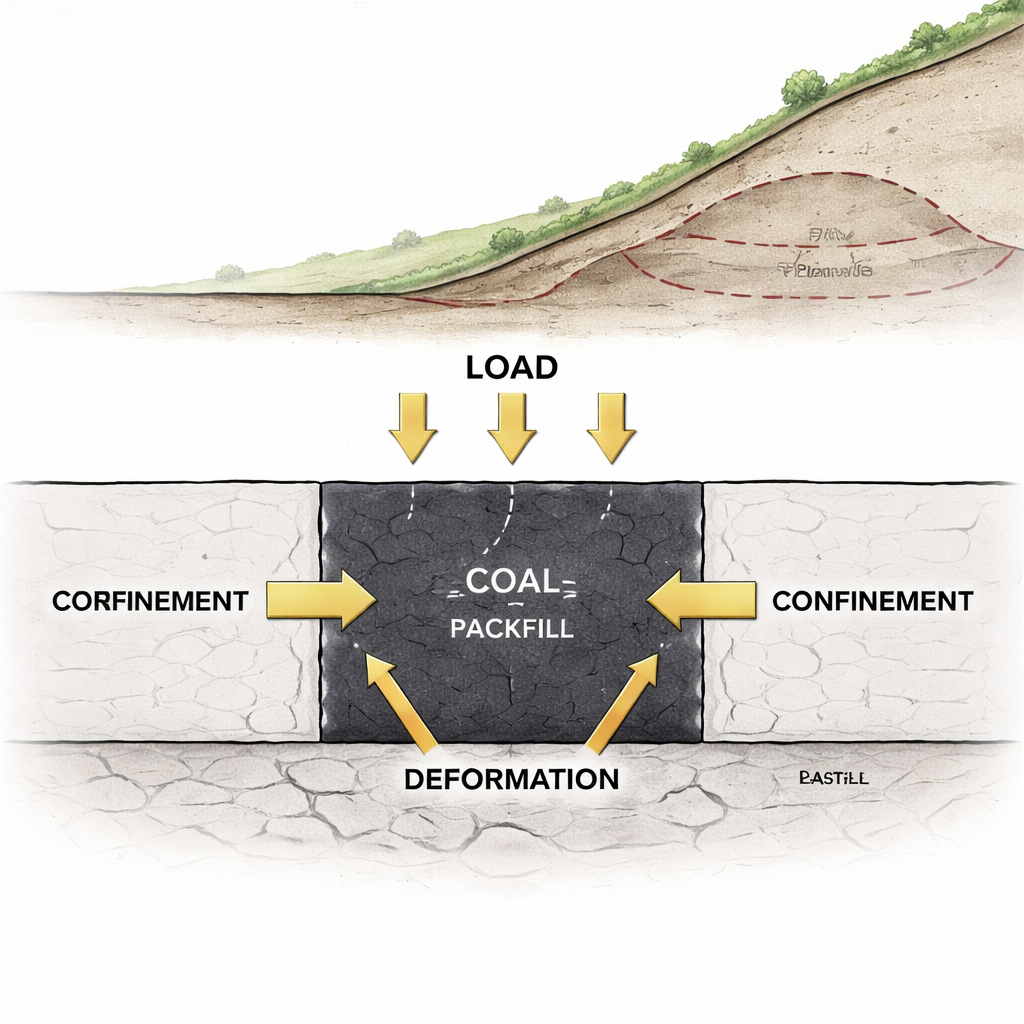
From Passive Filler to Active Partner
A key finding is that backfill does more than simply occupy space. When it is too short to touch the roof rock, it can only push back passively after the coal has already bulged outward, offering limited protection. But when the backfill is tall enough to make roof contact—essentially a 100% backfill ratio—it becomes an active structural partner. It shares part of the vertical load, expands sideways under compression, and presses against the coal pillar before major cracking occurs, putting the coal in a more favorable three-dimensional stress state. In tests, the failure strength of the coal pillars rose steadily with increasing backfill ratio and strength, then surged once roof contact was achieved, and the pillars retained some capacity even after initial failure. Numerical simulations of an entire pit slope confirmed that full-height, strong backfill sharply reduced pillar deformation, shrank the damaged zones in the slope, and enabled all coal between the openings to be safely recovered.
Implications for Safer and Cleaner Mining
For non-specialists, the main message is that how we refill mined-out spaces can decisively shape both safety and resource efficiency. This study shows that well-designed cemented paste backfill—especially when it reaches and firmly contacts the roof—can transform from mere waste disposal into an engineered support system. It can allow open-pit mines to extract nearly all of the coal beneath slopes, while keeping ground movements small and reducing the risk of slope failure. In practice, the authors note, engineers must still overcome technical hurdles, such as shrinkage and small gaps at the roof, using additives or secondary grouting. But the underlying conclusion is clear: smart use of backfill can help mines recover more resources, stabilize their slopes, and recycle huge volumes of waste rock at the same time.
Citation: Han, L., Chen, X., Chen, T. et al. Impact of cemented paste backfill on mechanical properties and stability of coal pillars in open pit highwall mining. Sci Rep 16, 5717 (2026). https://doi.org/10.1038/s41598-026-36528-9
Keywords: highwall mining, cemented paste backfill, coal pillar stability, slope deformation, mine waste recycling