Clear Sky Science · en
Maternal exposure to ambient air pollution and risk of congenital limb defects in offspring
Why the Air We Breathe Matters Before Birth
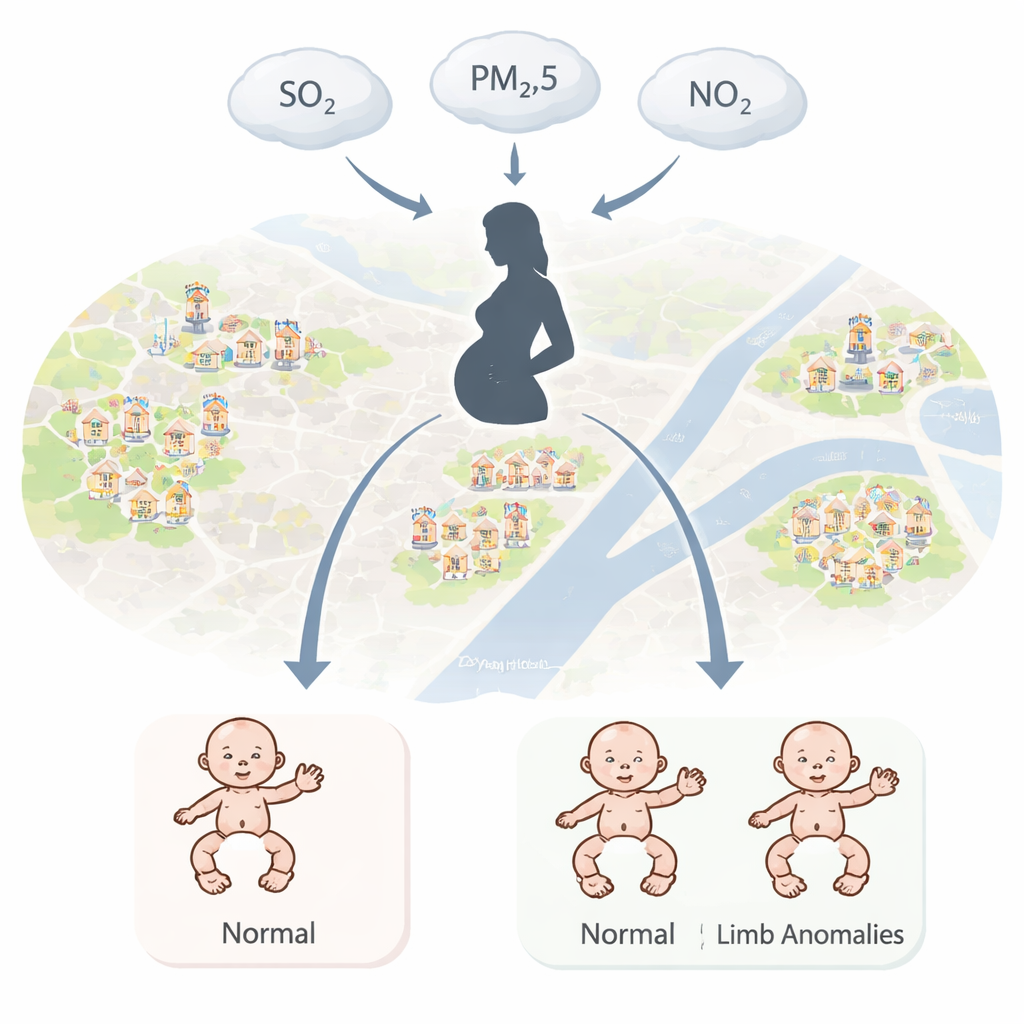
Most parents know that smoking and alcohol can harm a developing baby, but far fewer realize that ordinary city air might also play a role in how a baby’s arms and legs form. This study, based on more than half a million pregnancies in Wuhan, China, asks a simple but important question: can everyday exposure to polluted air during the earliest months of pregnancy raise the chances that a baby is born with limb differences, such as extra fingers or shortened arms and legs?
What Are Limb Differences in Newborns?
Congenital limb defects are birth differences in the arms or legs that appear before a baby is born. They include extra fingers or toes (polydactyly), fused fingers or toes (syndactyly), limbs that are noticeably shorter than usual, and twisted feet (clubfoot). These conditions are among the most common birth defects worldwide. They can affect how children move, play, and grow, and often require surgery, physical therapy, and long-term medical care. Although some limb defects are caused by changes in genes or chromosomes, about half have no clear explanation, which has led scientists to suspect that environmental factors, including air pollution, may be involved.
Following Hundreds of Thousands of Pregnancies
The researchers used a government health registry that tracks nearly all pregnancies and births in Wuhan. They included more than 510,000 mother–infant pairs from 2011 to 2017, counting live births, stillbirths, and pregnancies ended because of serious birth defects. Doctors recorded any limb defects according to international diagnostic rules. In total, 1,864 infants had limb defects, about 3.7 cases for every 1,000 births—similar to national estimates for China. This large, population-based design allowed the team to study not just limb defects overall but also different subtypes, and to explore how personal factors like age, job type, and where a mother lived might influence risk.
Measuring Pollution Around Mothers’ Homes
To estimate what each pregnant woman was breathing, the team started with daily readings of six common air pollutants from 21 official monitoring stations: fine and coarse particles (PM2.5 and PM10), sulfur dioxide (SO2), nitrogen dioxide (NO2), carbon monoxide (CO), and ozone (O3). Using each woman’s home address from her first prenatal visit, they calculated pollution levels by giving more weight to closer stations and less weight to those farther away. They focused on two key time windows: the three months before conception and the first three months after conception, when limb formation is most active. They then used statistical models that accounted for other influences—such as maternal age, work type, urban vs. rural residence, infant sex, and whether the baby was born early—to test how changes in each pollutant related to the odds of limb defects.
Sulfur Dioxide Stands Out
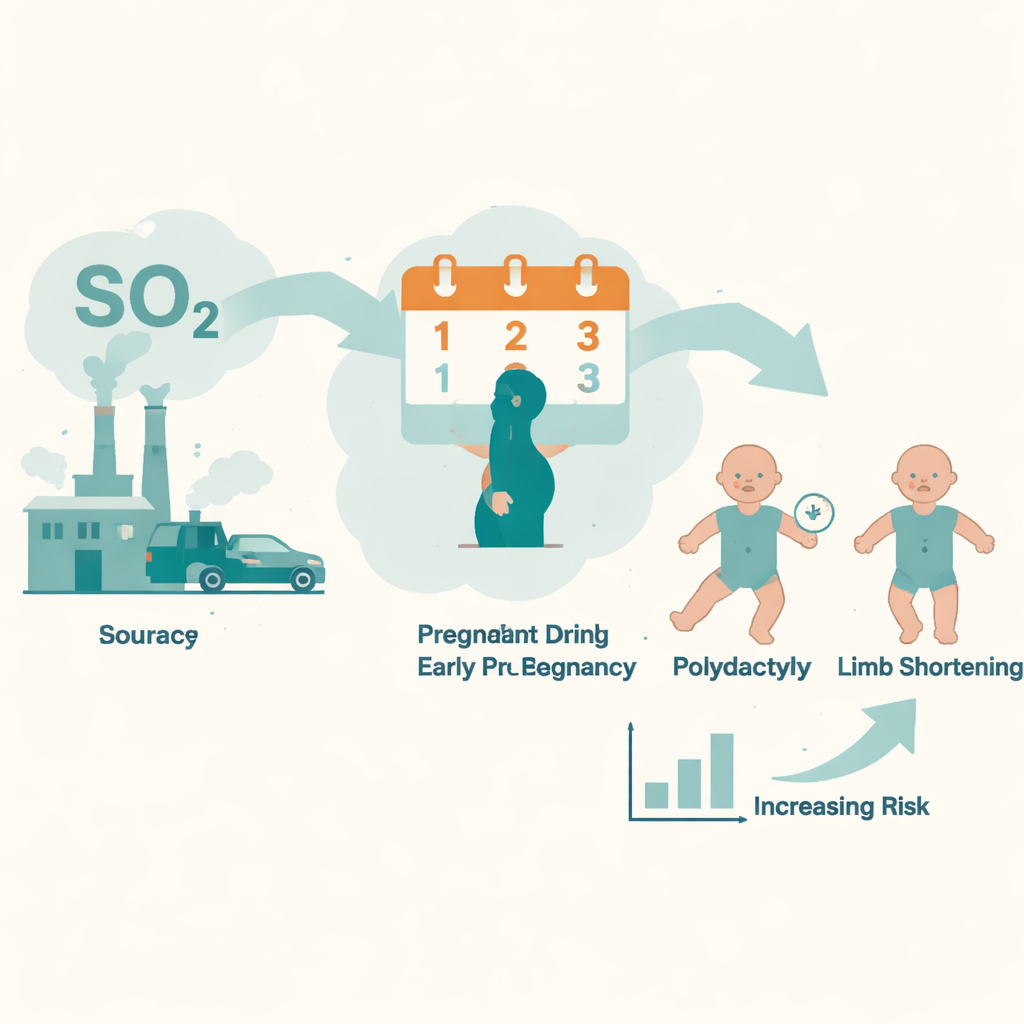
Among all the pollutants studied, sulfur dioxide emerged as the most consistent signal. Higher SO2 exposure during the first, second, and third months after conception was linked to a small but statistically meaningful increase in the risk of any limb defect. The study did not find clear evidence that particle pollution, nitrogen dioxide, carbon monoxide, or ozone raised limb defect risk overall, nor that pollution in the three months before conception did so. When the researchers looked at subtypes, SO2 during the first three months after conception was tied specifically to greater risks of polydactyly and limb shortening, but not clearly to fused fingers or toes or to clubfoot. These relationships held up even when the models included a second pollutant, suggesting that sulfur dioxide itself, or something very closely related to it, is important.
Who May Be More Vulnerable?
The study also suggests that not all families are affected in the same way. The link between sulfur dioxide and limb defects appeared stronger among mothers working in professional occupations, those living in certain residential settings, and pregnancies that ended in preterm birth. Warm-season conceptions showed higher absolute risks, possibly because people spend more time outdoors and may breathe more polluted air. Some patterns hinted that male infants might be slightly more affected, echoing findings from animal research, though these sex differences were not statistically firm. The authors caution that these subgroup results should be viewed as early signals that need confirmation, not as final proof.
What This Means for Parents and Policy
For non-specialists, the key message is that breathing higher levels of sulfur dioxide during the earliest months of pregnancy is associated with a higher chance of a baby being born with certain limb differences, even after accounting for many other factors. The increase in individual risk is modest, but when millions of pregnancies are exposed, the impact on public health could be substantial. The findings support efforts to reduce sulfur dioxide emissions from industry and traffic, and they suggest that women who are pregnant or planning pregnancy—especially in high-pollution areas—may benefit from practical steps to limit outdoor exposure on highly polluted days. Ultimately, cleaner air is not only good for hearts and lungs; it may also help ensure that developing arms and legs have the best possible start.
Citation: Zhang, Y., Tan, Y., Zhang, D. et al. Maternal exposure to ambient air pollution and risk of congenital limb defects in offspring. Sci Rep 16, 5779 (2026). https://doi.org/10.1038/s41598-026-36527-w
Keywords: congenital limb defects, maternal air pollution, sulfur dioxide exposure, pregnancy and birth defects, Wuhan cohort study