Clear Sky Science · en
Immature development time and survivorship of the dengue vectors Aedes aegypti, Aedes vittatus, and the invasive Aedes albopictus in Ghana
Why new mosquitoes matter for dengue risk
Dengue fever and other mosquito-borne viruses are becoming more common in West Africa, and Ghana is no exception. Until recently, most dengue risk there was blamed on long‑established local mosquitoes. Now a new species, Aedes albopictus, often called the Asian tiger mosquito, has arrived in Ghana’s busy port cities. This study asks a simple but crucial question: how well does this newcomer grow and survive compared with the native dengue‑carrying mosquitoes, and what might that mean for future outbreaks?
Three mosquito species under the microscope
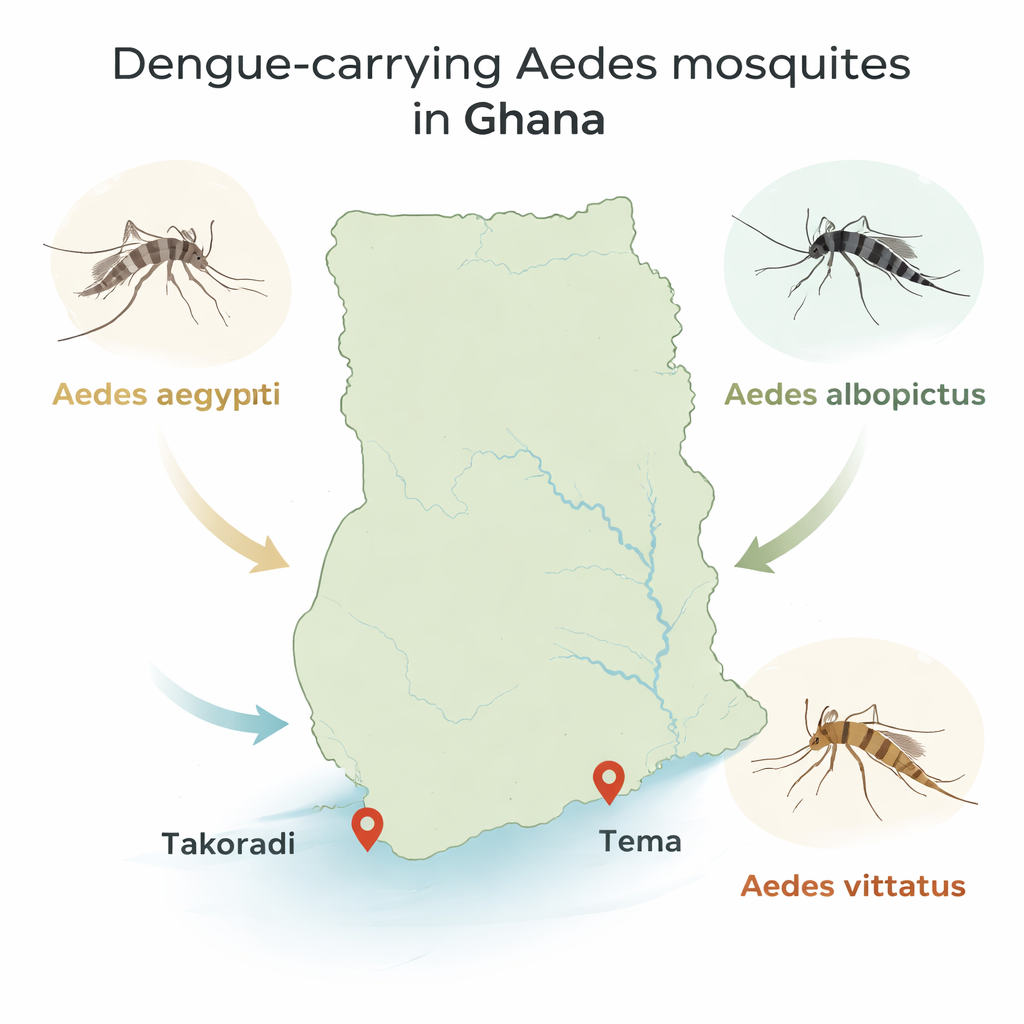
The researchers focused on three species that can spread dengue and related viruses: Aedes aegypti, a long‑standing urban mosquito in Ghana; Aedes vittatus, another native species; and the newcomer Aedes albopictus. They collected larvae from used car tyres and other water‑holding containers in two major seaports, Takoradi and Tema, where international trade can accidentally transport mosquito eggs. Back in a semi‑field setting that mimicked outdoor conditions, they raised the young mosquitoes in water‑filled tyre sections, tracking how long each stage of development took and how many insects survived to adulthood.
Growing up fast in the same neighborhood
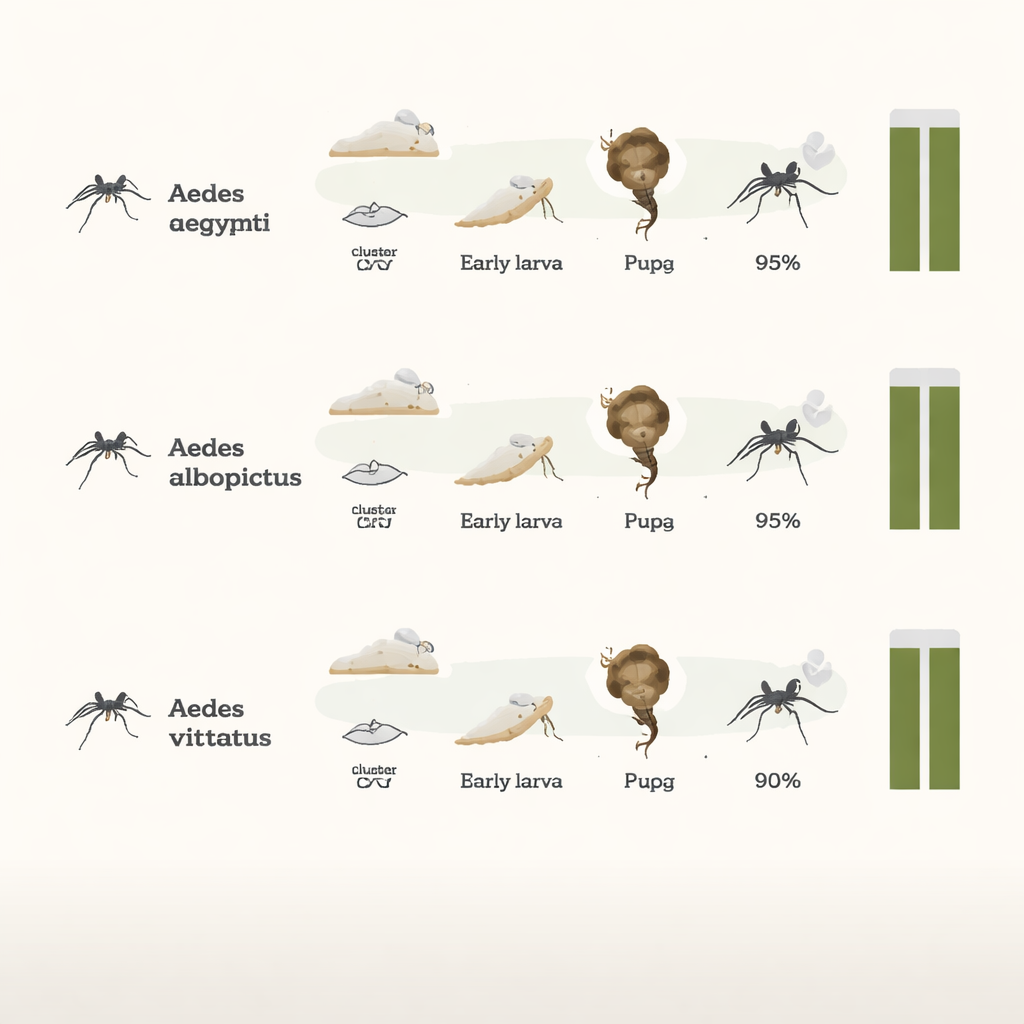
From the earliest larval stage to the pupal stage, the three species developed at similar speeds. On average, Aedes aegypti and Aedes albopictus reached pupae in about nine days, while Aedes vittatus took only a little longer. The percentage of larvae that successfully turned into pupae and then into adults was also high and very similar across species. In other words, the invasive Aedes albopictus did not appear to be held back by Ghana’s climate or conditions; it grew just as quickly and survived just as well as the best‑adapted native species, Aedes aegypti.
Living together and sharing the same space
The team also created “mixed neighborhoods” by placing larvae of all three species into the same tyre microcosms. Even when they shared water, food, and space, all three types of mosquito still developed at about the same rate, and most larvae survived to adulthood. If anything, development from larva to adult tended to be slightly faster in these mixed groups than when each species was raised alone, although the study was not designed to pinpoint exactly why. Aedes vittatus showed a modestly lower chance of surviving to adulthood than the other two, hinting that it may be a slightly weaker competitor under these conditions.
What this means for dengue in Ghana
Because Aedes albopictus develops and survives as well as Aedes aegypti in Ghana’s semi‑natural settings, it is likely to become firmly established wherever it arrives. Rather than replacing the native mosquitoes outright, it may coexist with them, increasing the overall number of mosquitoes capable of transmitting dengue and other viruses. Rapid development and good survival in temporary water sources, such as car tyres that fill with rainwater, mean that all three species can take advantage of common urban habitats, but the invasive Aedes albopictus appears particularly well suited to spread and multiply quickly.
Take‑home message for public health
For non‑specialists, the core message is straightforward: Ghana now hosts not just one, but several efficient dengue‑carrying mosquitoes, and the newcomer Aedes albopictus seems to be thriving. Its ability to grow and survive just as well as native species suggests it could contribute significantly to future outbreaks. This makes basic mosquito control—removing standing water from containers like tyres, buckets, and discarded cans—more important than ever. By targeting the places where these mosquitoes grow up, health authorities and communities can curb the rise of multiple dengue vectors at once and reduce the chances of large, sustained epidemics.
Citation: Akuamoah-Boateng, Y., Machani, M.G., Boadu, E.N. et al. Immature development time and survivorship of the dengue vectors Aedes aegypti, Aedes vittatus, and the invasive Aedes albopictus in Ghana. Sci Rep 16, 5811 (2026). https://doi.org/10.1038/s41598-026-36526-x
Keywords: dengue mosquitoes, Aedes albopictus, Ghana, mosquito development, vector invasion