Clear Sky Science · en
A hybrid deep learning and fuzzy logic framework for robust tomato disease detection and classification
Why smart tomato care matters
Tomatoes are a staple in kitchens worldwide, but their plants are surprisingly fragile. A long list of leaf diseases and nutrient problems can quietly spread through a field, slashing yields and forcing farmers to spend more on pesticides. Spotting these issues early is hard, especially when leaves are photographed in poor light or with cheap cameras, as is common on farms. This paper presents an artificial intelligence (AI) system designed to reliably recognize tomato leaf diseases from photos, even when the images are imperfect, offering a path toward cheaper, faster, and more sustainable crop care.
The challenge of reading sick leaves
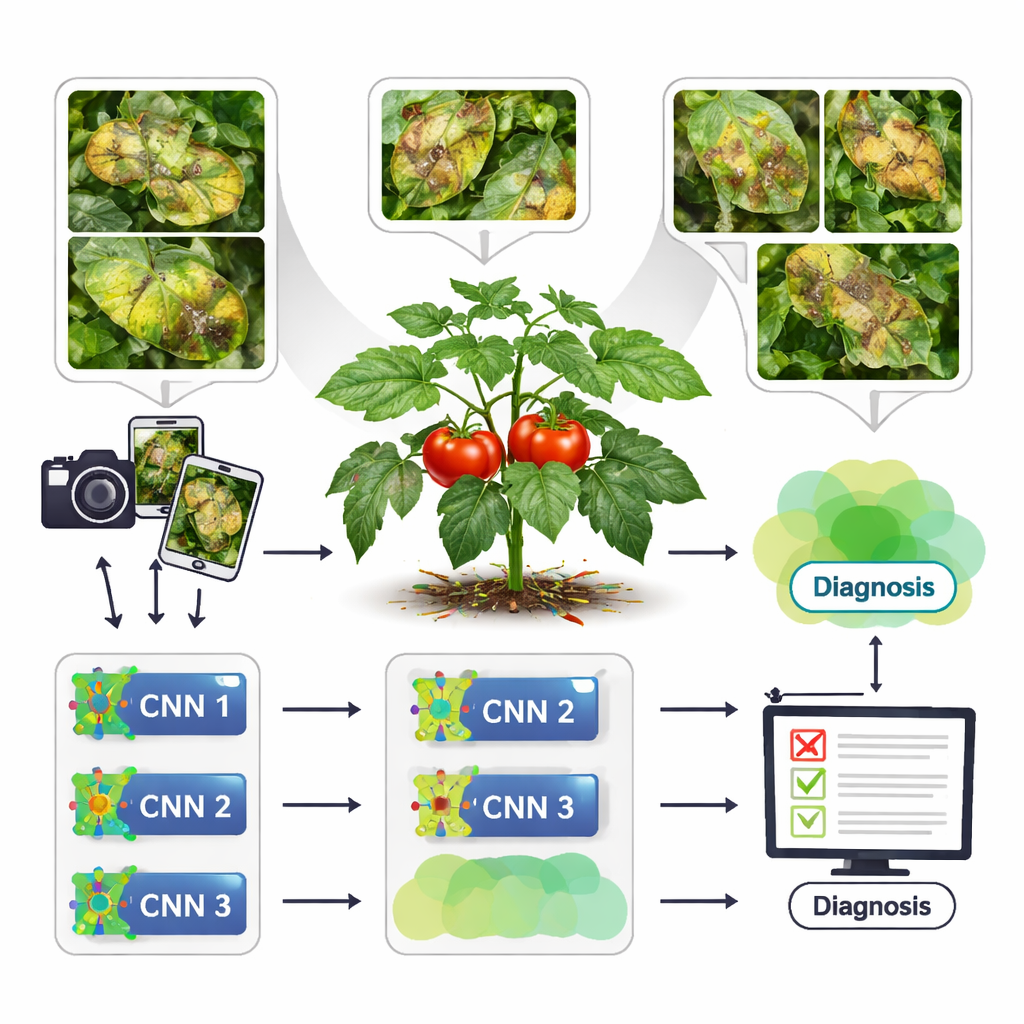
Tomato plants can suffer from many look‑alike problems: fungal blights, bacterial spots, viral infections, insect damage, and nutrient shortages such as too little nitrogen or magnesium. On leaves, these issues often appear as overlapping spots, patches, curls, or color changes that can be confusing even for experts. Traditional computer programs for plant diagnosis usually rely on a single type of neural network and on carefully controlled images. They tend to stumble when photos are taken in shadow or bright sun, with blurry focus, cluttered backgrounds, or when some diseases have far fewer examples than others in the training data.
Blending three “viewpoints” into one judgment
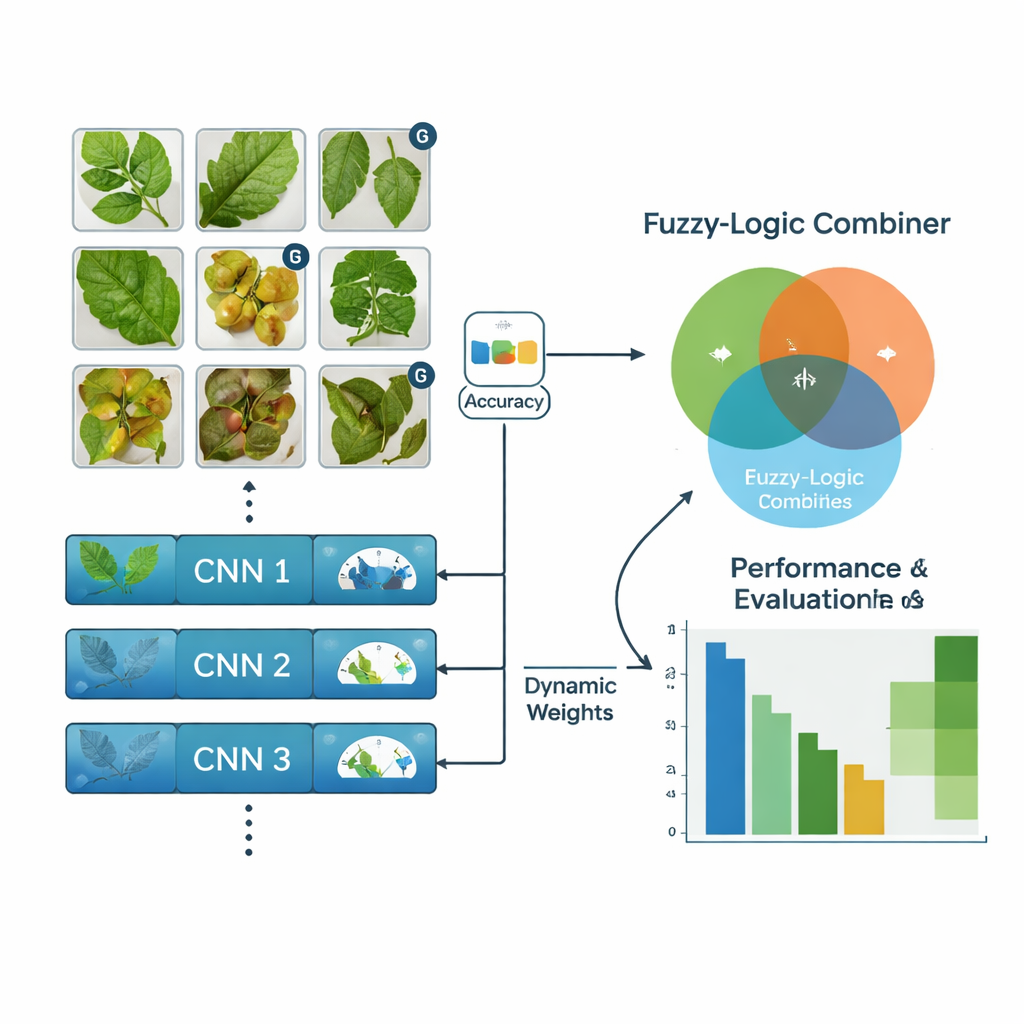
To overcome these limits, the authors build a hybrid system that combines three different deep learning models—ResNet‑50, EfficientNet‑B0, and DenseNet‑121. Each model has its own “view” of the same leaf image: one is very good at capturing fine details across the leaf surface, another at balancing image size and sharpness, and another at reusing useful features to avoid overfitting. Instead of trusting any single model, the system treats them as a panel of experts. For each photo, all three produce their preferred diagnosis and a confidence score. These outputs are then fed into a fuzzy logic module, which does not simply vote but adjusts how much to trust each expert depending both on its overall past accuracy and how sure it is about this particular image.
Making the most of scarce and messy data
A major obstacle in training such systems is that some tomato diseases are rare, so there are far fewer photos of them. The authors tackle this by using a conditional Generative Adversarial Network (C‑GAN), a special kind of image generator that learns to create realistic new leaf photos for specified disease labels, such as “bacterial spot” or “mosaic virus.” Unlike simple tricks like flipping or rotating pictures, the C‑GAN produces fresh examples that mimic real‑world variation in lighting, noise, and resolution. These synthetic images are mixed with standard camera photos from several public datasets, including lab images on plain backgrounds and field photos taken under natural conditions. The result is a much richer and more balanced training set, so the system no longer leans heavily toward common diseases and learns to cope with poor image quality.
How the fuzzy decision layer boosts reliability
Fuzzy logic is the glue that holds the ensemble together. Rather than assigning fixed weights to each neural network, the system uses simple linguistic categories such as “low,” “medium,” and “high” for both model accuracy and confidence. It then applies a compact set of rules—if a model is usually accurate and currently very sure, its vote counts strongly; if it is unsure or historically weaker, its influence is reduced. This dynamic weighting happens for every single image. In difficult cases, where diseases share similar patterns or part of the leaf is hidden, the fuzzy layer prevents an overconfident but unreliable model from dominating the final answer. In tests on the widely used PlantVillage dataset and several field datasets, this approach achieved about 99% accuracy and very low misclassification, clearly outperforming many recent single‑model and static‑ensemble methods.
From lab success to field‑ready helper
For non‑specialists, the key takeaway is that the system can act like a careful second opinion for farmers using smartphones or low‑cost cameras. By intelligently combining three complementary neural networks, enriching rare disease examples with realistic synthetic images, and smoothing out uncertainty through fuzzy logic, the framework can identify tomato leaf problems with remarkable reliability even when images are noisy, compressed, or partly occluded. The authors also show that the final model can run fast enough on modest hardware, making it a practical building block for farm‑side apps or low‑cost devices. In essence, the work demonstrates how layering several AI ideas—deep learning, image generation, and fuzzy reasoning—can turn raw leaf photos into trusted, timely guidance for protecting tomato crops.
Citation: Kumar, S., Sharma, Y.K., Kumar, M. et al. A hybrid deep learning and fuzzy logic framework for robust tomato disease detection and classification. Sci Rep 16, 7002 (2026). https://doi.org/10.1038/s41598-026-36524-z
Keywords: tomato leaf disease, deep learning, fuzzy logic, GAN data augmentation, precision agriculture