Clear Sky Science · en
Energy evolution mechanism of hard roof of working face adjacent to goaf after hydraulic fracturing and application
Why breaking rock on purpose can make mining safer
Deep underground coal mines face a hidden threat: the solid rock roof above tunnels can suddenly snap, releasing stored energy like a giant underground spring. These violent failures can damage equipment, trigger seismic shocks and endanger miners. This study looks at how carefully planned hydraulic fracturing—injecting high‑pressure water to crack rock—can reshape how that energy is stored and released in the roof above a coal face that lies next to an already‑mined void, known as a goaf. The researchers combine theory, computer simulations and real‑world measurements from a Chinese mine to show how targeted cracking can dramatically reduce dangerous stress and seismic activity.
From underground “spring” to controlled settling
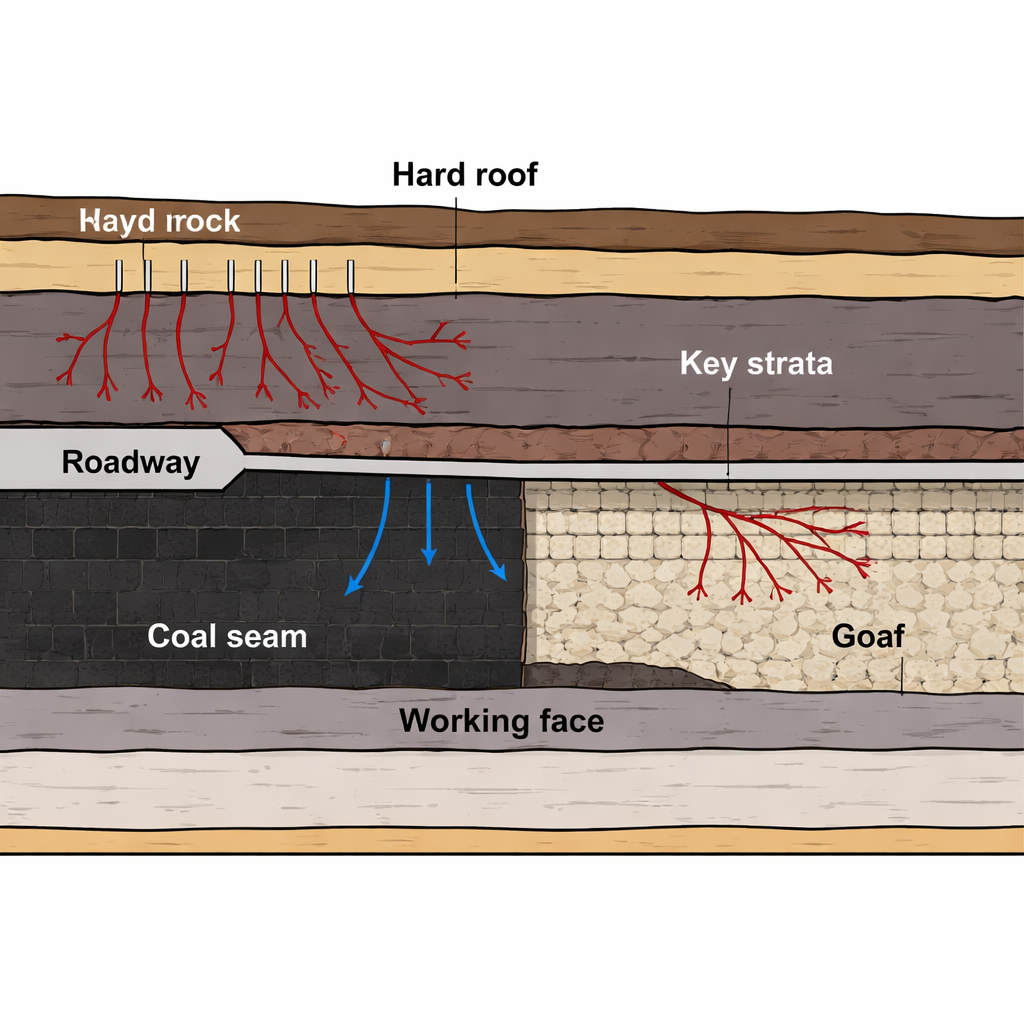
As coal is removed, the rock layers above the working face no longer have solid support and begin to bend and break. A thick, strong “hard roof” layer can act like a long overhanging beam. It bends, stores large amounts of elastic energy and then fails suddenly, sending a burst of stress and shock waves into the mine. When a working face is next to a goaf—an older mined‑out area with its own hanging hard roof—the problem worsens, because movement in one area can transfer energy into the other. The authors use energy formulas to show that if the hard roof stays intact, it acts as an efficient energy storage and transmission system, raising the risk of sudden rock bursts and strong microseismic events.
Turning stored stress into slow, steady movement
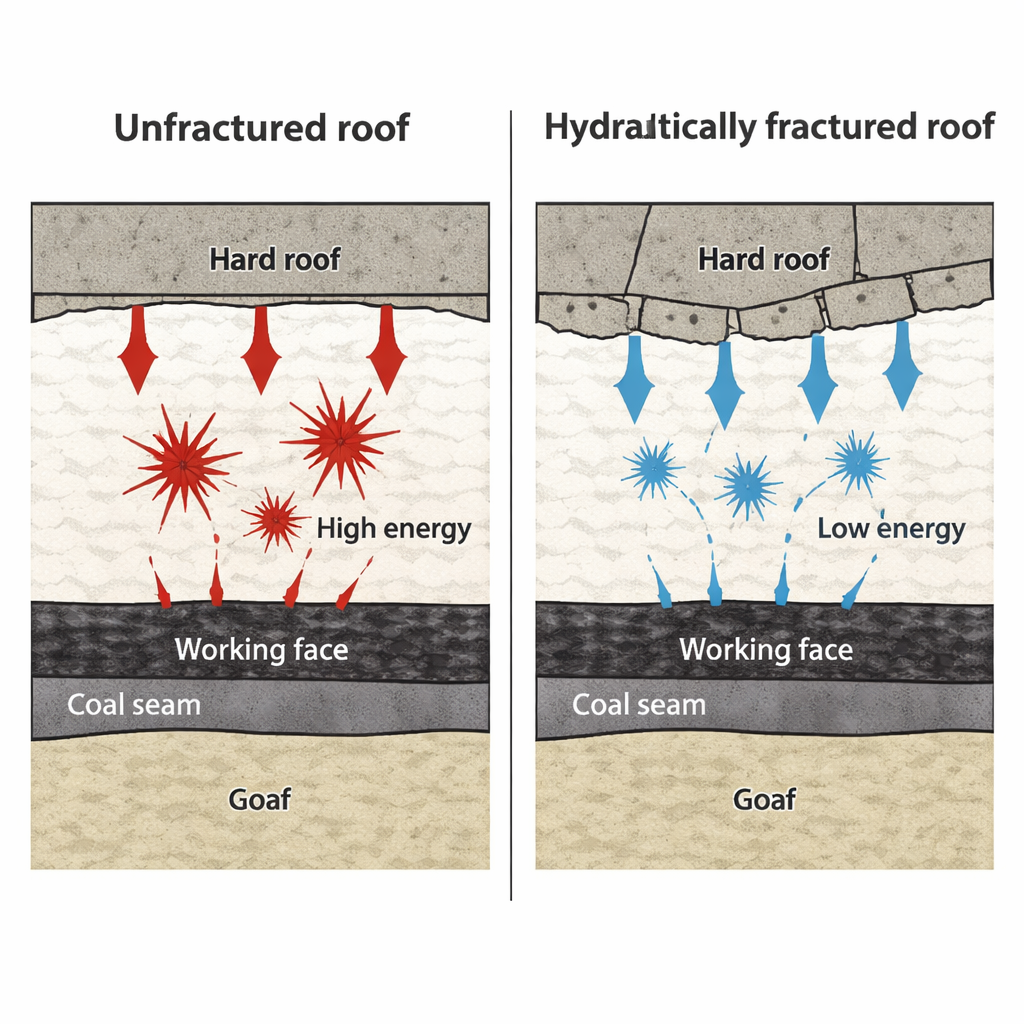
The core idea of this work is to deliberately weaken the hard roof so that it settles in stages instead of snapping all at once. Using long‑hole hydraulic fracturing, engineers inject high‑pressure water into the key rock layer, creating a network of cracks. This breaks the roof into smaller segments that rotate, slip and subside gradually. In energy terms, the roof’s elastic potential energy is converted stepwise into simple gravitational energy as the broken pieces sink. The team’s calculations for the Gaojiapu Coal Mine indicate that, after fracturing, the energy transmitted as dynamic stress toward the coal face can be cut by about 95%, and the extra stress on the face can drop by roughly 80%.
Finding the safest place to crack the roof
Cracking the roof must not undermine the nearby tunnels that carry air and workers. The researchers build a simplified mechanical model of the coal pillars between the working face and the goaf to determine where the rock around the roadway is most vulnerable. By tracking how stress builds and how coal and rock would begin to yield, they calculate the width of the most damaged zone next to the goaf. Taking into account how far a fracture network can spread, they conclude that the ideal fracturing location should lie within about 31 meters of the return air roadway. At this distance, the fractures can break the goaf‑side roof enough to cut off energy transfer, yet still leave the roadway pillars stable.
Testing the idea in virtual and real mines
To check their theory, the authors simulate mining with and without hydraulic fracturing using a particle‑based computer model. In the “unfractured” scenario, the hard roof overhangs far into the goaf before finally breaking, generating large displacements and a concentrated stress zone above the coal seam. In the “fractured” case, pre‑existing cracks cause the key rock layer to move and break earlier, and over a wider area. The simulated fractured roof develops more than twice as many fractures as the intact roof, and the main roof starts to subside almost 50 meters sooner, avoiding a large, stiff overhang. Stress sensors in the model show that peak loads on the working face drop by up to about 18% and reach a stable level more quickly.
Real‑world gains in pressure and seismic safety
Finally, the method is applied to the 3407 working face at Gaojiapu. High‑pressure water is injected through a planned array of long boreholes in front of the mining area. Hydraulic shield pressures—used as a proxy for roof weight and stress—show strong, regular peaks in unfractured sections, but become weaker and less periodic once mining enters the fractured zone. At the same time, microseismic monitoring reveals that while the number of tiny events stays similar, their total daily energy plummets, and the share of high‑energy events drops from nearly one‑quarter to less than five percent. In practical terms, the mine transitions from a “danger” category toward a safer operating state, with less risk of sudden, violent roof failures.
What this means for safer deep mining
For non‑specialists, the key message is that breaking rock in a controlled way can actually make underground mines safer. By using hydraulic fracturing to pre‑crack the hard roof at the right location, engineers can turn a single, dangerous “snap” into a series of smaller, manageable movements. The study shows that doing this next to a mined‑out goaf can sharply reduce both stress on the active coal face and the strength of mining‑induced seismic events. Although the models are simplified and future work will use more detailed three‑dimensional tools, the combined theory, simulations and field data strongly suggest that targeted hydraulic fracturing is a powerful tool for reducing disaster risk in deep coal mining.
Citation: Liu, X., Liu, H., Dong, J. et al. Energy evolution mechanism of hard roof of working face adjacent to goaf after hydraulic fracturing and application. Sci Rep 16, 6055 (2026). https://doi.org/10.1038/s41598-026-36520-3
Keywords: hydraulic fracturing, coal mine safety, rock burst prevention, roof stress, microseismic monitoring