Clear Sky Science · en
Real-time prediction of influenza and respiratory syncytial virus epidemics in primary care using the Gompertz model
Why winter viruses matter for everyday life
Every winter, waves of flu and a lesser-known virus called RSV (respiratory syncytial virus) crowd doctor’s offices and hospital wards. These illnesses are usually short-lived for most people, but they can be deadly for infants, older adults, and those with fragile health, and they place a heavy strain on healthcare systems. This study asks a practical question: can we reliably predict, in real time, when these seasonal epidemics will peak using the day‑to‑day information family doctors already record, and do it with a tool simple enough for routine public health use?
From clinic visits to an epidemic “weather forecast”
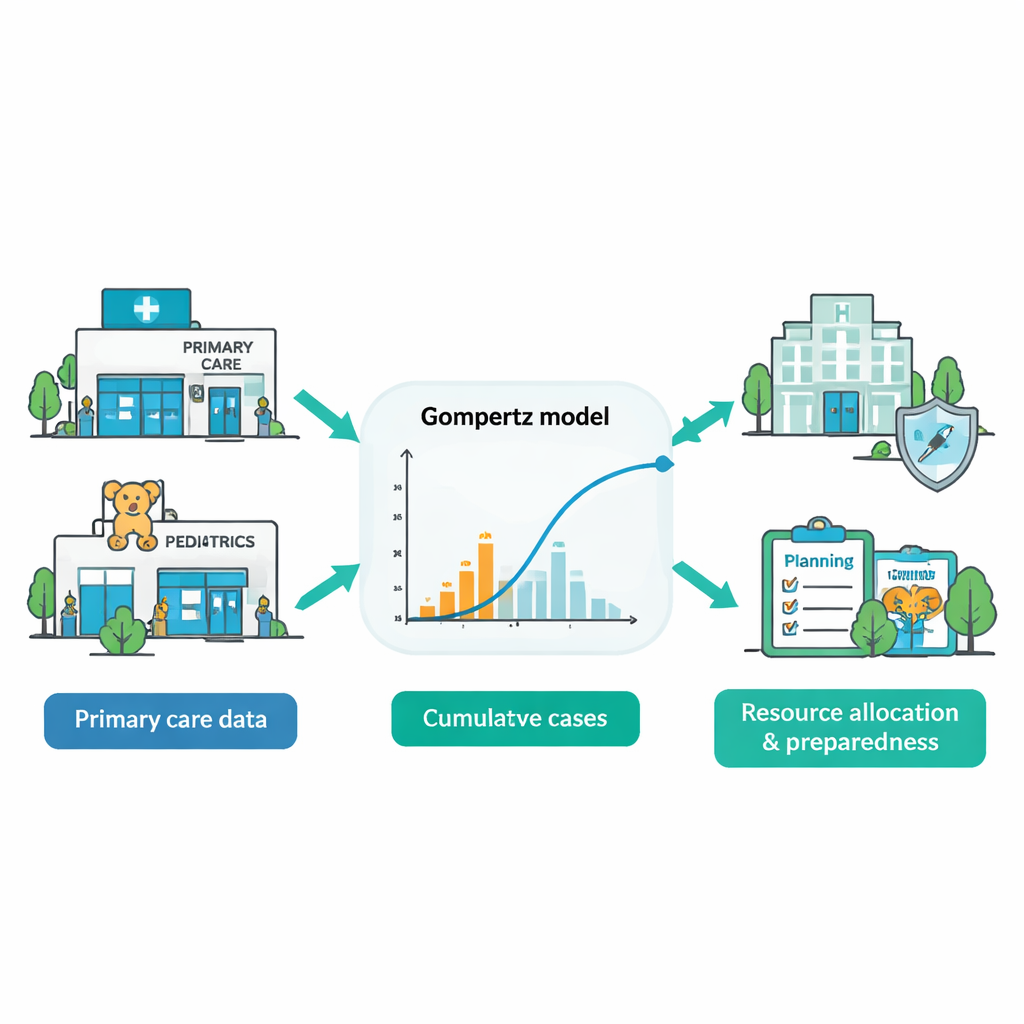
The research team focused on Catalonia, a region of Spain with 7.8 million inhabitants, where most flu and bronchiolitis cases are handled in primary care, not hospitals. They used anonymized daily diagnosis data from all public primary care practices between 2018 and 2024, along with hospital records and rapid test results for RSV. For flu, they could use primary care diagnoses directly. For RSV, things were trickier, because many different viruses can cause bronchiolitis in babies. The authors therefore linked primary care bronchiolitis records with hospital data and rapid antigen tests to estimate what share of bronchiolitis was truly due to RSV, ending up with a cleaned, RSV‑specific time series suitable for modelling.
A simple curve that captures complex outbreaks
Instead of building a highly detailed simulation of how people infect each other, the team chose an empirical growth curve known as the Gompertz model. This model describes how an epidemic rises quickly at first, then slows down as it approaches its maximum number of cases. By fitting this curve to cumulative daily diagnoses, the researchers could estimate three key aspects of each epidemic season: how fast it was growing at the beginning, how many cases it would ultimately generate, and when the peak would occur. Crucially, the model only needs routinely collected diagnoses and does not rely on assumptions about immunity, vaccination, or social behavior, making it easier to adapt when conditions change.
Seeing the peak a month before it hits
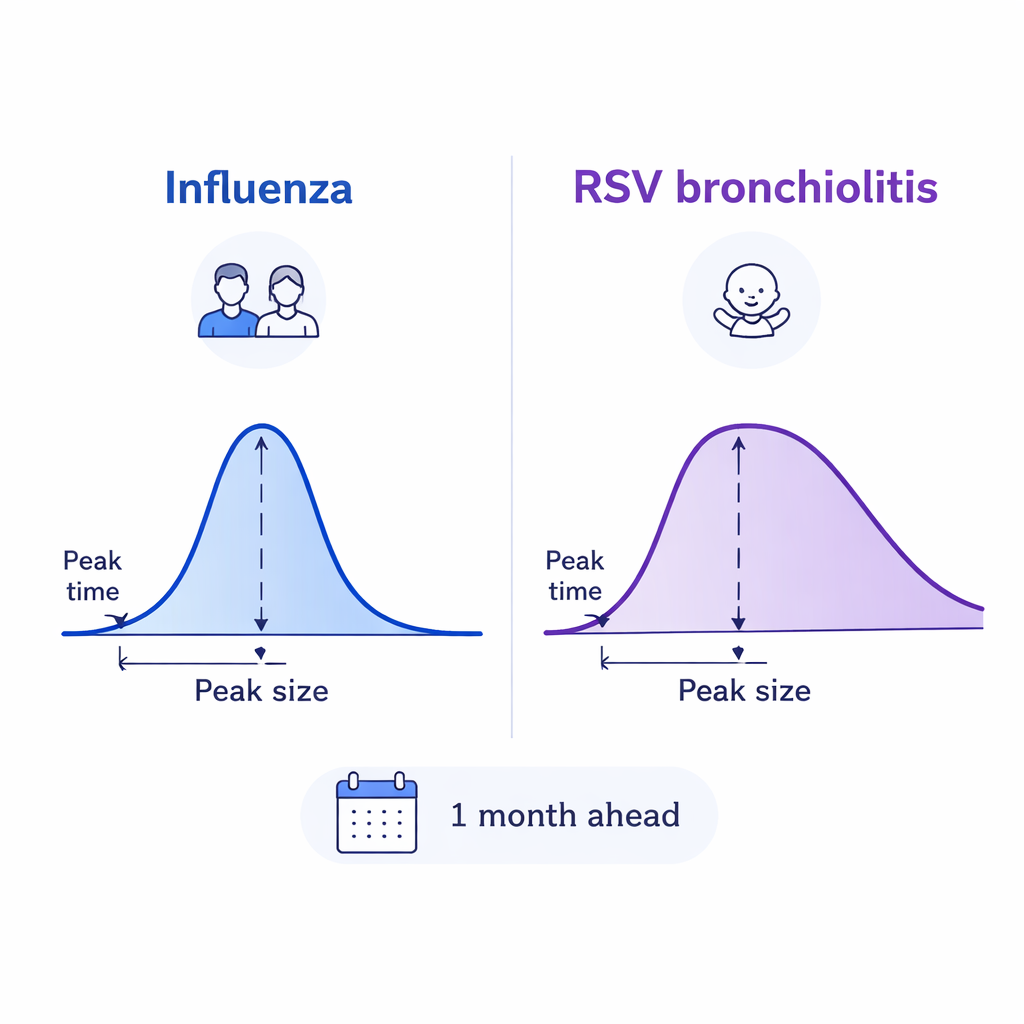
Applying the Gompertz model to several pre‑ and post‑COVID seasons, the authors found that they could usually predict the week of the epidemic peak for both flu and RSV‑bronchiolitis up to about one month in advance, with an uncertainty of just one week and peak size estimates typically within 35 percent. The model’s peak estimates almost always fell inside the statistical confidence ranges, even when individual daily counts were noisy due to reporting delays or sudden spikes. Post‑pandemic seasons, and the RSV season following the introduction of a new protective antibody (nirsevimab), were harder to predict precisely, highlighting how major shifts in virus circulation or prevention can temporarily disrupt established patterns.
Different shapes for flu and RSV waves
The study also reveals that flu and RSV epidemics do not behave the same way. Flu waves tend to rise and fall more sharply, producing a relatively symmetrical curve that plays out over a shorter period. In contrast, RSV‑bronchiolitis epidemics in young children show a steep early rise followed by a long, drawn‑out decline, creating a broader wave. The fitted curves suggest that each RSV case in this age group initially leads to roughly three new infections, compared with about two for flu. These differences matter for planning: RSV seasons can keep pediatric services busy for longer, even when the overall number of cases is similar.
Turning numbers into earlier action
For public health officials, the main takeaway is that a straightforward mathematical curve, fed by up‑to‑date primary care data, can act like a seasonal early‑warning system. By indicating, weeks ahead of time, when a flu or RSV peak is likely to arrive and how intense it may be, the Gompertz‑based approach can guide decisions on staffing, hospital bed capacity, and the timing of vaccination or antibody campaigns. While expert oversight is still needed—especially when new vaccines, public health measures, or pandemics change the rules of the game—the method offers a transparent, adaptable way to turn everyday clinic visits into practical, real‑time forecasts of winter virus pressure.
Citation: Perramon-Malavez, A., Ye, Q., López, D. et al. Real-time prediction of influenza and respiratory syncytial virus epidemics in primary care using the Gompertz model. Sci Rep 16, 5763 (2026). https://doi.org/10.1038/s41598-026-36519-w
Keywords: influenza, RSV bronchiolitis, epidemic forecasting, primary care data, Gompertz model