Clear Sky Science · en
Age-dependent and reversible refractive changes in 0–6 years old children associated with reduced outdoor activity: a six-year community-based study
Why Parents Should Care About This Study
More and more children around the world are becoming nearsighted, often needing glasses at younger and younger ages. This study looked at tens of thousands of children in one Chinese community to ask a simple but important question: does keeping very young children indoors, as happened during COVID-19 lockdowns, change how their eyes develop? The answer can help parents, teachers, and planners protect children’s vision from infancy onward.
A Close Look at Young Children’s Eyes
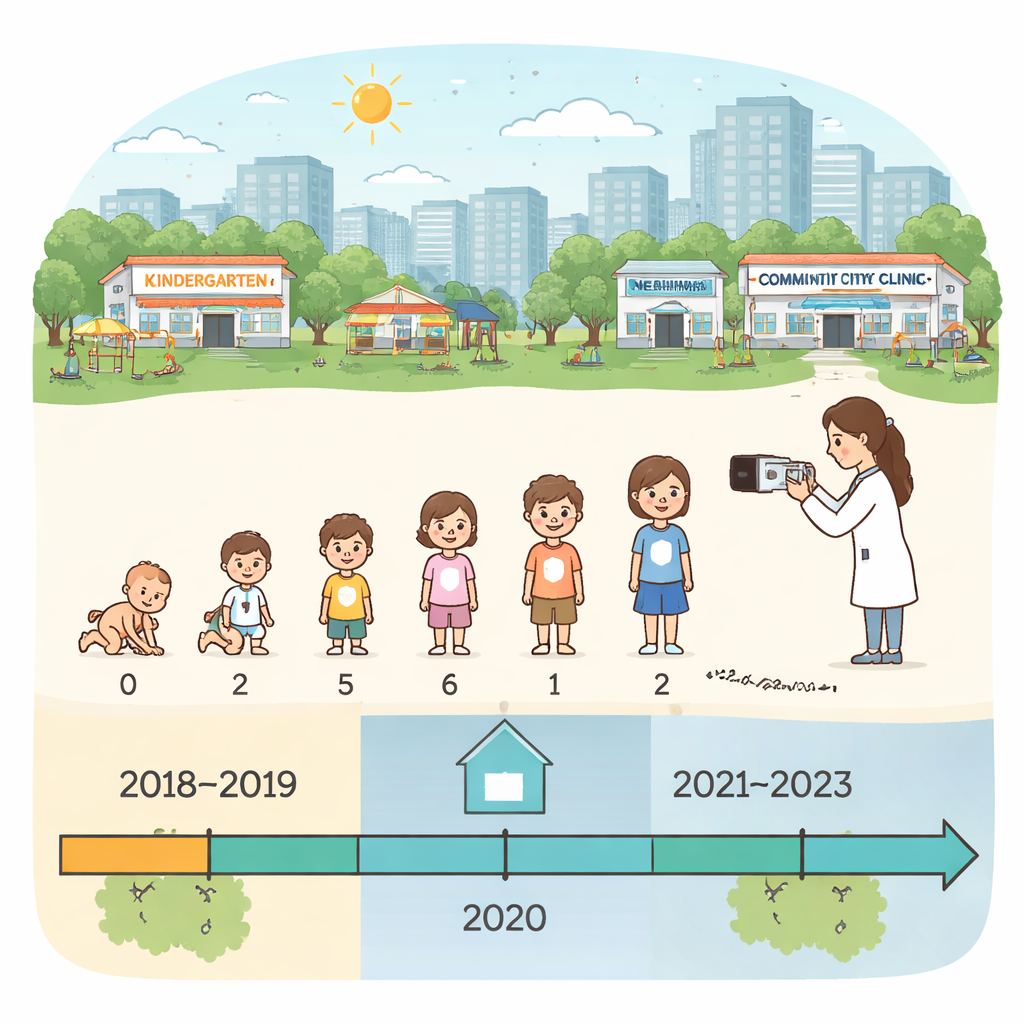
Researchers followed eye check-up data from over 70,000 children aged 0 to 6 years in Guangzhou, China, between 2018 and 2023. Most preschoolers were tested in kindergartens, while babies and toddlers were examined during regular health visits. Using a handheld camera-like device, examiners measured how well each child’s eyes focused light, summarized as a single value that shows whether the eye is mildly farsighted, nearly neutral, or already drifting toward nearsightedness. The team paid special attention to a “grey zone” called premyopia—when a child’s vision is not yet clearly nearsighted but is closer to that state than normal for their age.
What Changed During the Lockdown Year
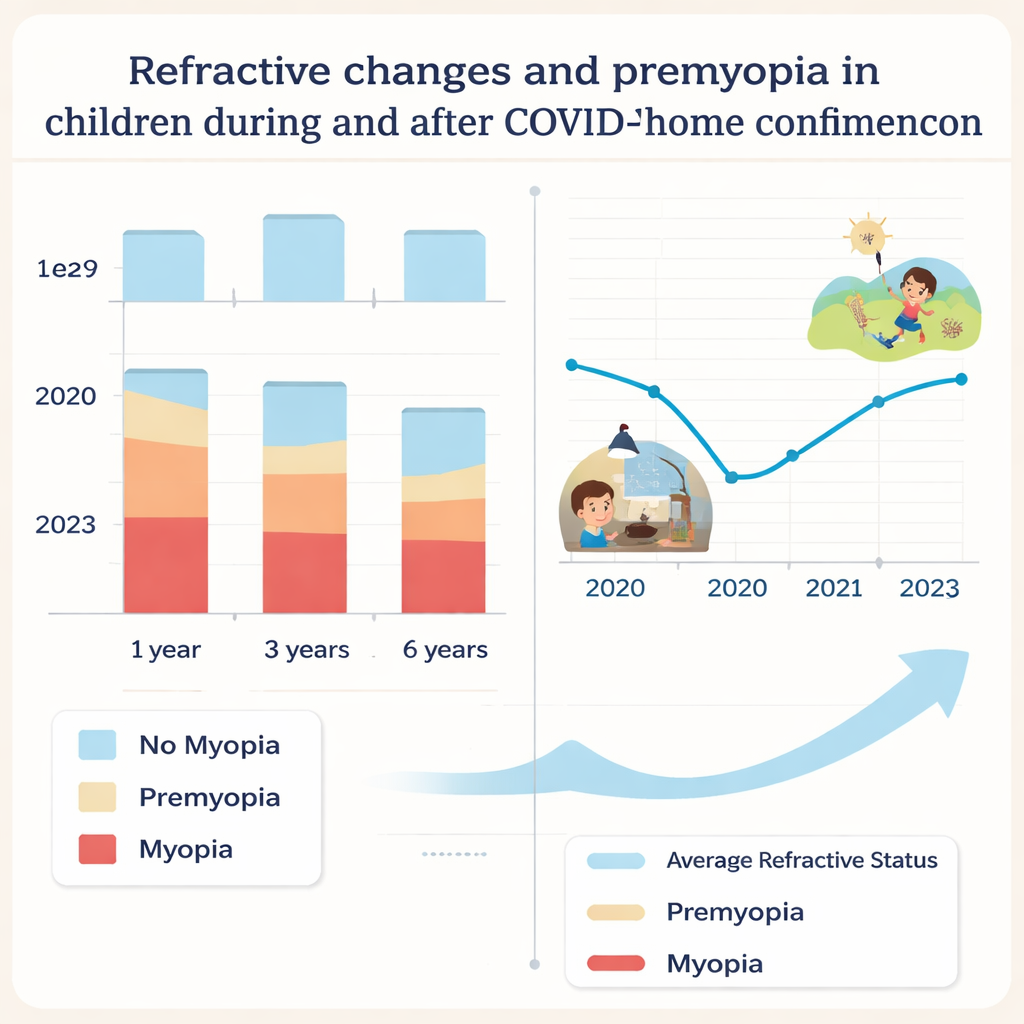
Under normal conditions, young children tend to be slightly farsighted, which provides a healthy “reserve” that helps prevent future myopia. In 2018 and 2019, this reserve was stable across all ages in the study. That pattern broke in 2020, when strict home confinement during COVID-19 sharply reduced outdoor time and reshaped daily life. Across every age group from 1 to 6 years, children’s eyes showed a noticeable shift toward nearsightedness. On average, their focusing measure dropped by about half a diopter compared with the year before—a small number on paper but a strong signal at the population level.
A Surge in Children on the Edge of Nearsightedness
The number of children falling into the premyopia range also spiked in 2020. Among 2- to 6-year-olds, more than 94% were in this higher-risk zone, and even in 1-year-olds the figure reached about 80%. Compared with 2020, children tested in 2018 and 2019 were far less likely to be premyopic, with the odds less than one-third as high. In later years, as life and outdoor activity gradually normalized, average eye measurements shifted back toward healthier levels, suggesting that at least part of the change was temporary rather than permanent eye damage.
Why the Youngest Eyes Are So Sensitive
The most dramatic changes were seen in children under 3 years old, an age when the eyes grow quickly and are especially responsive to the visual world. Even babies, who do not spend much time on schoolwork or screens, showed signs that being indoors with dimmer, more uniform lighting may have nudged their eyes away from the usual growth path. The authors argue that bright, broad outdoor light and frequent chances to look into the distance are likely important not only for schoolchildren but also for infants and toddlers, whose visual systems are still learning how to focus.
Turning Findings into Practical Advice
Although the study could not directly measure each child’s screen time or exact hours outdoors, the timing of the eye changes strongly points to lifestyle shifts during the lockdown—less outdoor play, more time in small indoor spaces—as a major factor. The researchers recommend that city planners, schools, and families treat outdoor time as a basic health need. They suggest designing neighborhoods and kindergartens with safe, well-lit play areas and aiming for at least two hours of outdoor exposure each day, even if that sometimes means balcony time or short walks during special circumstances. For parents, the message is clear: protecting a child’s vision starts very early, and making room for daylight and distance viewing is one of the simplest tools we have to reduce the risk of future myopia.
Citation: Xu, L., Zhang, Y., Yang, C. et al. Age-dependent and reversible refractive changes in 0–6 years old children associated with reduced outdoor activity: a six-year community-based study. Sci Rep 16, 5719 (2026). https://doi.org/10.1038/s41598-026-36515-0
Keywords: childhood myopia, outdoor play, preschool vision, COVID-19 lockdown, eye development