Clear Sky Science · en
Avian neighbours: density patterns of synanthropic birds along a rural–urban landscape gradient in Northern India
Bird life as a window into changing towns
As India’s small towns rapidly expand, they subtly reshape the lives of the birds that share our streets, fields, and rooftops. This study looks at how common “people-loving” birds in two districts of Uttar Pradesh respond as landscapes shift from green countryside to crowded town centers. Understanding where different birds thrive or struggle along this rural–urban gradient can reveal how healthy these environments are—for wildlife and for people who depend on green, livable cities.
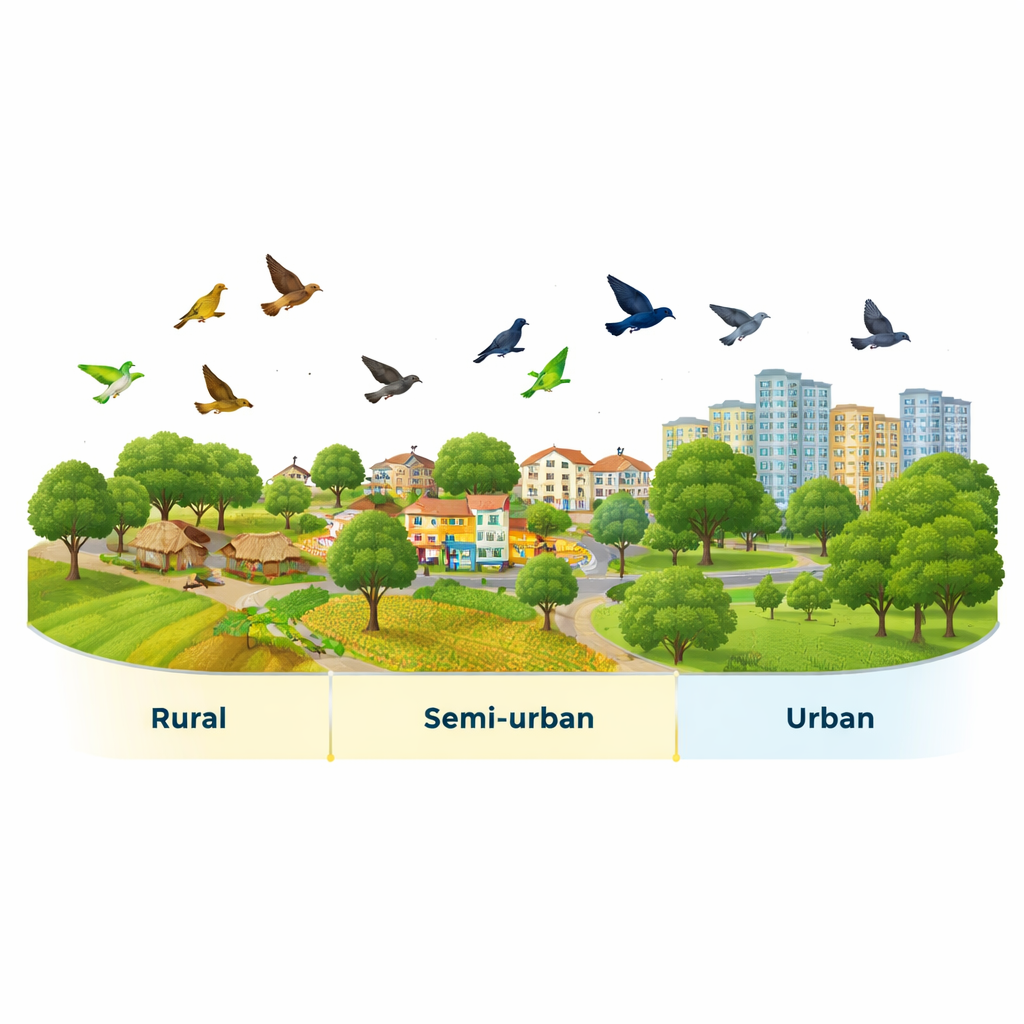
A living gradient from farms to city streets
The researchers worked in Mirzapur and Bhadohi, neighboring districts in northern India that together form a patchwork of croplands, villages, and growing towns. Using satellite-based maps of human settlement, they divided the region into three zones: rural, semi-urban, and urban. In each zone they placed fixed observation points about a kilometer apart and, during the hot summer months, repeatedly counted every bird seen or heard within 100 meters. In total, they recorded more than 27,000 individual birds from 35 species, including familiar neighbours such as house sparrows, mynas, pigeons, crows, parakeets, and bulbuls.
Looking beyond simple bird counts
Counting birds is only part of the story, because some species are easier to spot than others, and weather or air quality can muffle songs or reduce visibility. To avoid being misled by these effects, the team used a statistical approach called hierarchical distance sampling. In simple terms, it separates the true number of birds from how likely observers are to detect them at different distances and under different conditions. They also measured many features of each site—tree and shrub cover, grass, nearby water, crop fields, housing types, roads, vehicles, people, and waste—to see which combinations best explained where each species was most abundant.
Who thrives where along the town–country line?
Most species (about three-quarters) showed clear differences in density from rural to urban areas, and patterns varied by feeding style. Birds that eat fruit tended to be densest in town centers, where planted trees, gardens, and ornamental species provide year-round food. One nectar-feeder, the Purple Sunbird, peaked in semi-urban neighborhoods that mix flowering plants with moderate building density. Some insect-eating birds preferred open farmland and shrub-dominated land, while others were more common in greener parts of the city. Seed-eating birds were often more numerous in rural croplands and fallow fields, but classic “town birds” such as the house sparrow and rock pigeon flourished around houses and built structures, including thatched roofs and concrete buildings.
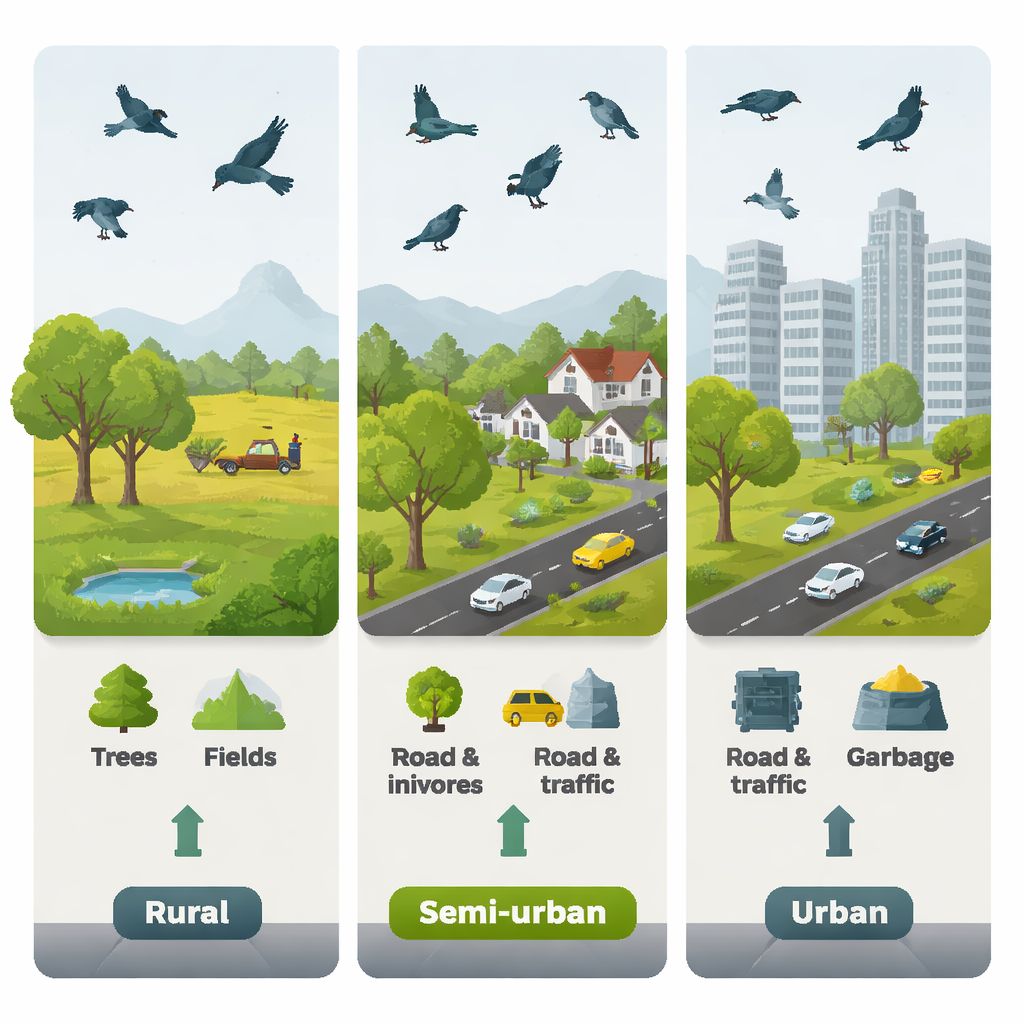
Habitat features, human activity, and air quality
Across this landscape, bird numbers were tightly linked to local habitat and human pressure. Tree-rich patches and roadside avenue trees supported canopy nesters like parakeets and hornbills, which were surprisingly dense in some urban areas where mature trees remain. Shrubby and grassy areas favored small insectivores and ground nesters. Roads, traffic, and garbage dumps created winners and losers: scavengers such as crows benefited from waste, while some species declined near busy roads or with more vehicles and people. Weather and air quality also mattered. Many species became harder to detect as temperatures rose or air quality worsened, hinting at physiological stress or reduced activity during heat waves and pollution episodes.
What this means for planning greener towns
For residents and planners in fast-growing Indian towns, this study delivers a clear message: everyday birds are sensitive gauges of how we shape our surroundings. Semi-urban fringes and smaller cities still hold a relatively rich mix of habitats, but increasing heat, loss of mature trees, and spreading concrete could quickly erode that diversity. By protecting and planting native trees, maintaining shrubby patches and open green spaces, keeping some cropland and wetlands within the urban matrix, and managing traffic and waste, local authorities can help ensure that both common and more specialized birds continue to thrive. In doing so, they also support cleaner air, cooler neighborhoods, and healthier environments for people.
Citation: Gautam, A., Singh, A. & Kalle, R. Avian neighbours: density patterns of synanthropic birds along a rural–urban landscape gradient in Northern India. Sci Rep 16, 6879 (2026). https://doi.org/10.1038/s41598-026-36510-5
Keywords: urban birds, rural–urban gradient, synanthropic species, habitat heterogeneity, Indian small cities