Clear Sky Science · en
In vitro effects of Bacillus velezensis strain Mandacaium against Xanthomonas citri pv. glycines: genomic and metabolomic insights
Friendly Microbes That Help Protect Soybeans
Soybeans are a cornerstone of global food and animal feed, but they are constantly threatened by diseases that can wipe out large portions of a harvest. This study explores an unusual ally in the fight against one of these diseases: a helpful bacterium living in the food of stingless bee larvae. By uncovering how this microbe harms a major soybean pathogen without hurting the plants themselves, the work points toward safer, greener alternatives to chemical pesticides.
Why Soybean Disease Is a Big Deal
One of the most damaging soybean diseases is bacterial pustule, caused by the bacterium Xanthomonas citri pv. glycines. In bad years and in warm, humid regions, this disease can cut yields by 20 percent or more, making it harder to meet global demand for soy-based foods, oils, and animal feed. Farmers typically turn to chemical pesticides to fight such threats, but heavy use of these products can pollute soil and water, harm non-target organisms, and drive the evolution of pesticide-resistant strains. That combination of crop losses and side effects has spurred a search for new, more sustainable ways to manage plant diseases.
Bee Nests as Hidden Reservoirs of Helpful Bacteria
Stingless bees raise their young in small waxy cells filled with a rich larval food that also serves as a bustling habitat for microbes. In these crowded, nutrient-rich conditions, microorganisms compete fiercely, often by producing chemical weapons that suppress rivals. The researchers sampled bacteria from the larval food of two stingless bee species and tested the liquid surrounding each bacterial culture for the ability to slow or stop growth of the soybean pathogen in laboratory dishes. Out of ten candidates, one stood out: a strain later named Bacillus velezensis strain mandacaium, whose culture liquid formed a clear “halo” where the pathogen could not grow. 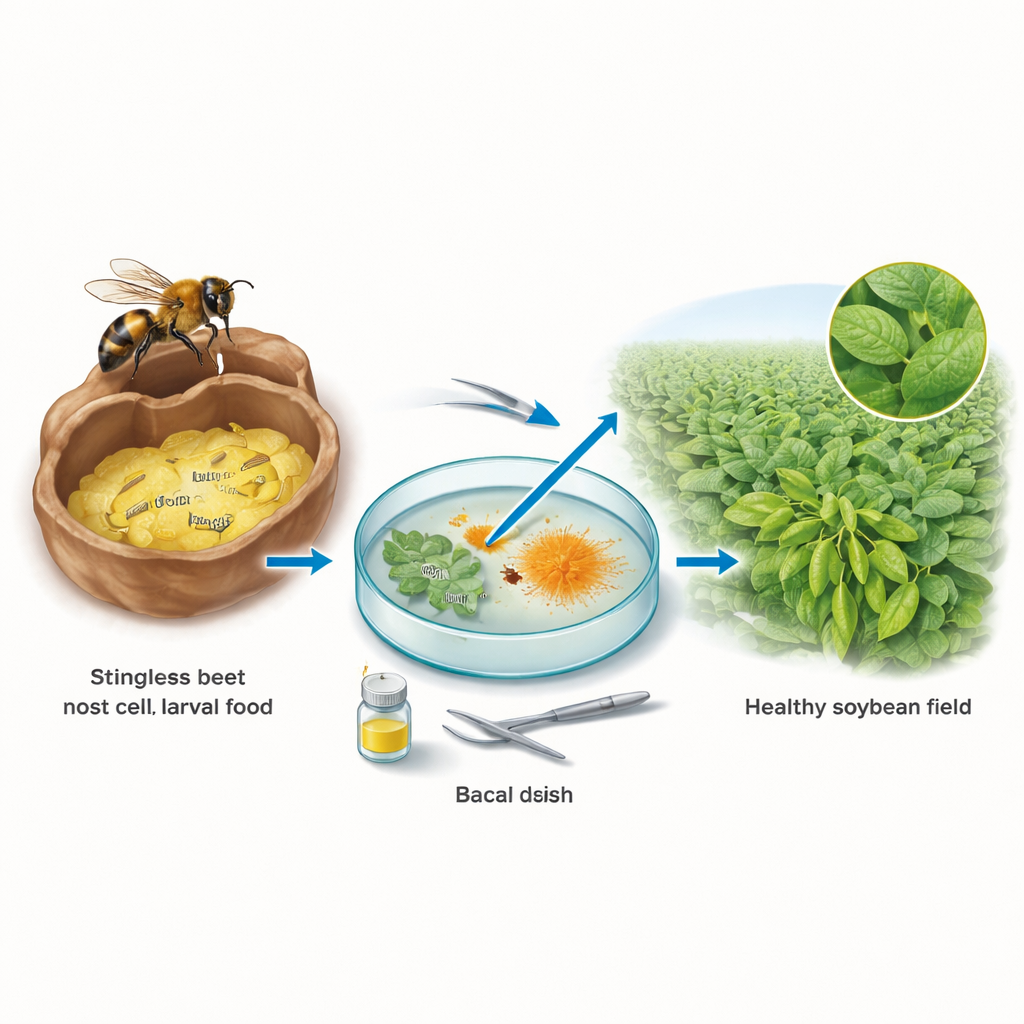
Zeroing In on the Active Ingredients
To figure out what in the culture liquid was doing the damage, the team separated it into a protein-rich portion and a smaller-molecule “metabolic” portion. Only the metabolic portion blocked the soybean pathogen, pointing to relatively small, non-protein compounds as the active agents. Further solvent-based separation showed that the strongest activity resided in the ethyl acetate extract, which inhibited the pathogen at very low concentrations. Importantly, when soybean seeds were soaked in the active liquid, they germinated just as well as seeds treated with plain water, suggesting that the bacterial products are not immediately toxic to the crop under the tested conditions.
What the Chemistry and Genes Reveal
Using advanced liquid chromatography and mass spectrometry, the researchers profiled the compounds in the most active extract. They tentatively identified at least fifteen different molecules, many belonging to a family called diketopiperazines—small ring-shaped compounds known from other microbes to have antibacterial properties. Several larger, more complex molecules also appeared but could not be fully identified with the available data. In parallel, whole-genome sequencing of the mandacaium strain revealed a roughly 4-million-base-pair genome containing thirteen clusters of genes linked to the production of secondary metabolites, including well-known antibacterial lipopeptides and polyketides. Although these larger molecules were not detected in the tested extract, their gene blueprints suggest the bacterium has additional chemical tools that may be activated under different growth conditions. 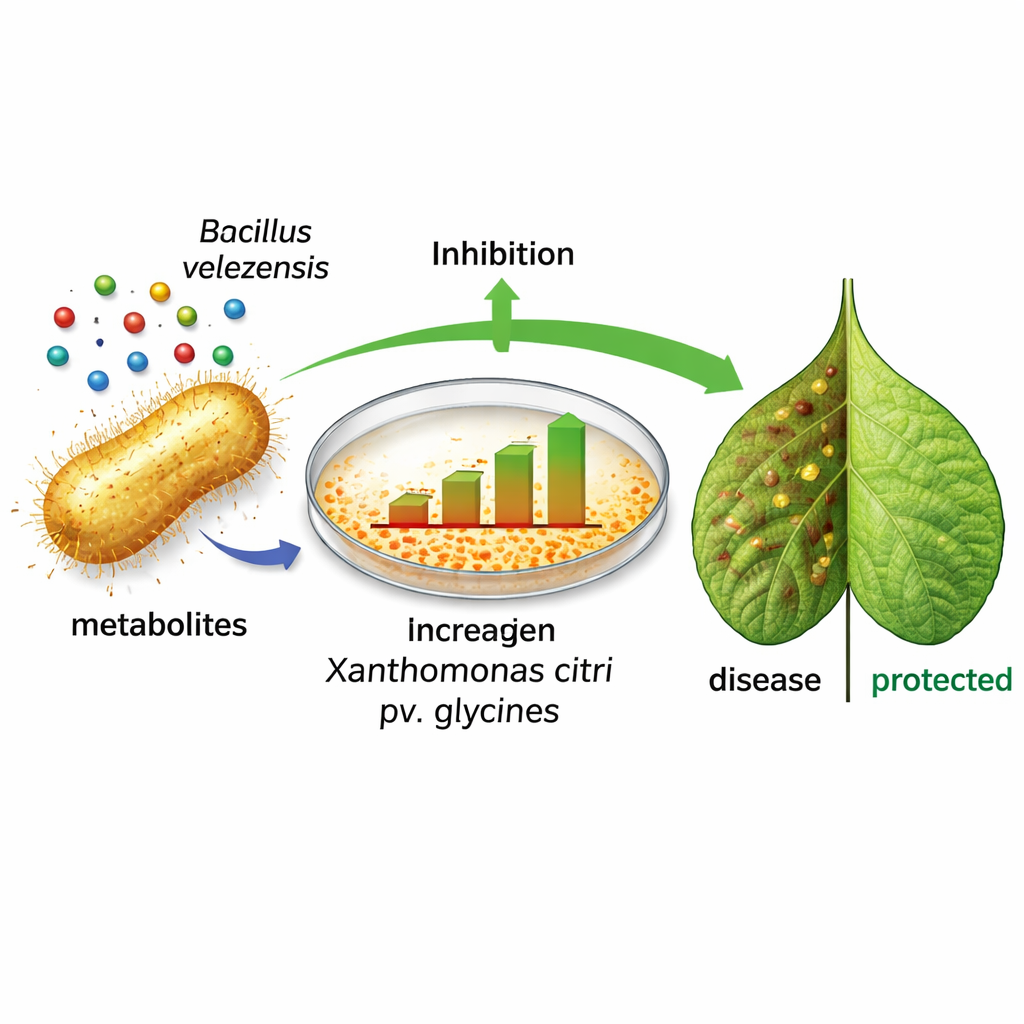
From Lab Bench to Field Possibilities
Beyond simply cataloging compounds, the team explored how metabolite-producing genes and antibiotic-resistance genes are connected in the bacterium’s genetic network, as a first step in assessing risks and benefits for agricultural use. The overall picture is of a strain that shares a core genome with other beneficial Bacillus velezensis strains but also carries its own unique features. Because the active substances work in laboratory tests without stunting soybean seed germination, they could eventually be formulated as “biopesticide” products—purified microbial chemicals that protect plants while reducing dependence on conventional pesticides. However, the findings so far are limited to in vitro experiments; the real test will be future greenhouse and field trials to see how well these bee-associated bacterial metabolites perform, and how safe they are, in complex farm environments.
What This Means for Sustainable Farming
In simple terms, this study shows that a bacterium borrowed from the nursery of stingless bees can make natural chemicals that stop a major soybean disease organism in its tracks, without immediately harming soybean seeds. By combining chemical analysis with genome sequencing, the researchers both pinpointed the types of molecules involved and mapped the bacterium’s broader potential to produce useful compounds. While more work is needed before any product reaches farmers’ hands, the results strengthen the case that nature’s own microbial chemists can help secure crop yields and lessen our reliance on synthetic pesticides.
Citation: Correa, J.L., Santos, A.C.C., Cerqueira, R.C. et al. In vitro effects of Bacillus velezensis strain Mandacaium against Xanthomonas citri pv. glycines: genomic and metabolomic insights. Sci Rep 16, 5555 (2026). https://doi.org/10.1038/s41598-026-36508-z
Keywords: soybean disease control, biopesticides, Bacillus velezensis, stingless bees, sustainable agriculture