Clear Sky Science · en
Prediction of the displacements of the pile tops and ground surface around piles based on machine learning algorithms
Why tiny shifts underground matter
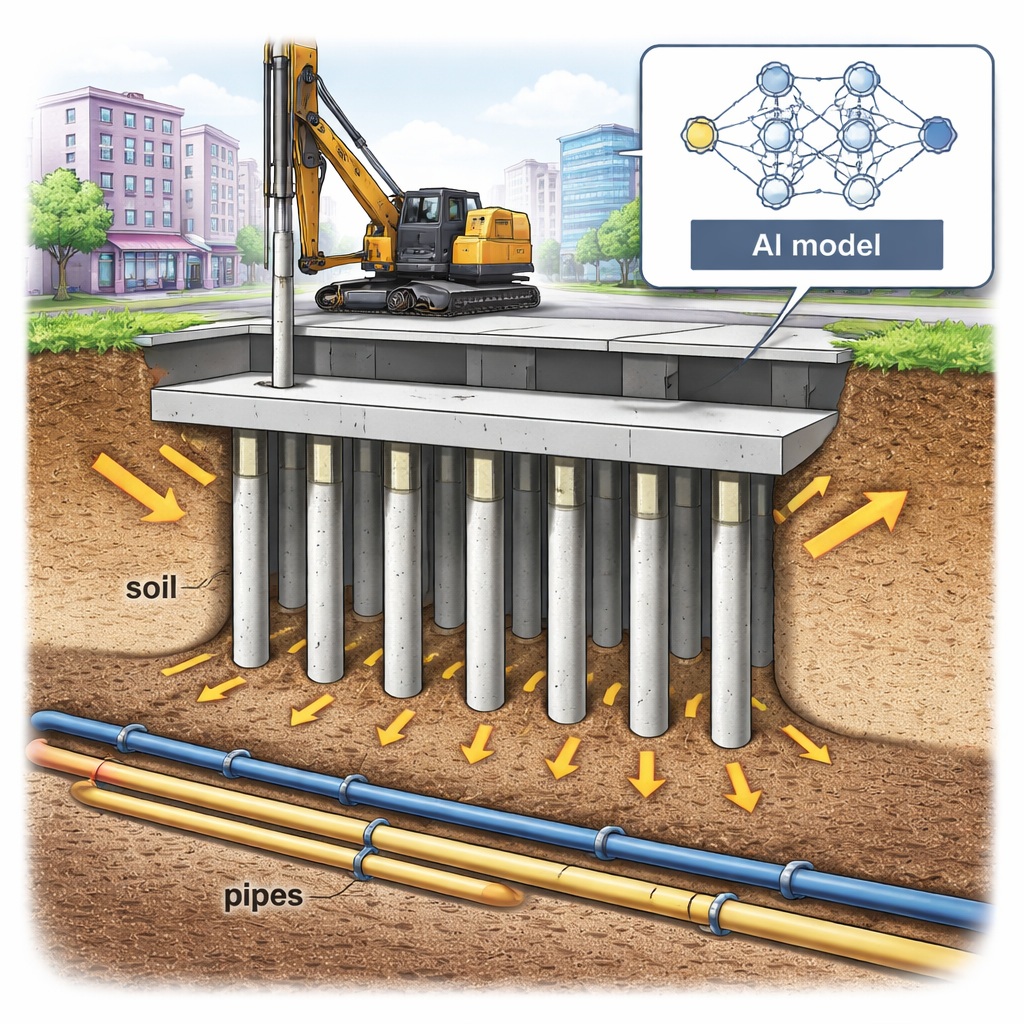
When new subway lines or overpasses are built, thousands of deep concrete piles are pushed into the ground to hold up the structures. This squeezing of the surrounding soil can nudge nearby piles, roads, buildings and buried pipes by just a few millimeters—but even such small movements can crack concrete or bend utility lines. The study behind this article explores how modern machine-learning tools can predict these underground shifts more accurately than traditional formulas, helping engineers design safer foundations in crowded cities.
How piling up concrete reshapes the soil
During construction, long hollow concrete piles are pressed into soft ground instead of being hammered, a common method for urban projects such as Bogotá’s Metro Line 1 in Colombia. As each pile is jacked in, the soil has to move somewhere: it gets squeezed sideways and upward, pushing on neighboring piles and the ground surface. In severe cases this can lead to broken piles, road heave, or damage to nearby pipelines that may sit only a few tens of centimeters away. Engineers have long used simplified theories that treat each pile as an expanding cylinder in the soil to estimate these effects, but those methods struggle to capture the messy reality of layered soils, complex pile layouts and construction sequences.
Teaching computers to read the ground’s response
The researchers turned to machine learning, a branch of artificial intelligence in which computers learn patterns from data rather than relying solely on hand-written equations. They collected hundreds of measurements of horizontal displacement at the tops of piles and at monitoring points around them from the Bogotá project. For each measurement they also recorded a set of influential factors, including how wet and dense the soil was, how stiff it was, how far a point lay from the center of the pile group, at what angle around the group it sat, and how much time had passed since piling stopped and the soil had time to settle.
Putting different learning machines to the test
Several types of algorithms were compared. A classic neural network known as a back-propagation (BP) network served as a baseline. The team then strengthened it using an approach called AdaBoost, which combines many weak predictors into a more accurate “committee”, creating an AdaBoost-BP model. They also tested deep neural networks with multiple hidden layers, random forests made from many decision trees, and a popular boosted tree method called XGBoost. All models were tuned and checked using cross-validation, a procedure that repeatedly trains on part of the data and tests on the rest to avoid overfitting. For both small and large datasets, the boosted and deep-learning models clearly outperformed the basic BP network, with deep neural networks in particular matching the field measurements much more closely.
What really controls ground movement
With accurate models in hand, the authors probed which factors mattered most. Using SHAP analysis, a technique that explains complex models by assigning each input a contribution to the prediction, they found that simple geometry dominates: the horizontal distance from the center of the pile group and the direction around it are the top drivers of displacement. Points closer to the center tend to move more, and movement patterns vary around the compass because the rows of piles are not perfectly symmetrical. Time since piling stops also plays a major role, reflecting slow readjustment and creep of the soil. Among soil properties, water content, relative density and internal friction angle (a measure related to how well grains lock together) have the strongest influence, while other parameters such as cohesion and overall unit weight matter less.
New tools for safer underground construction
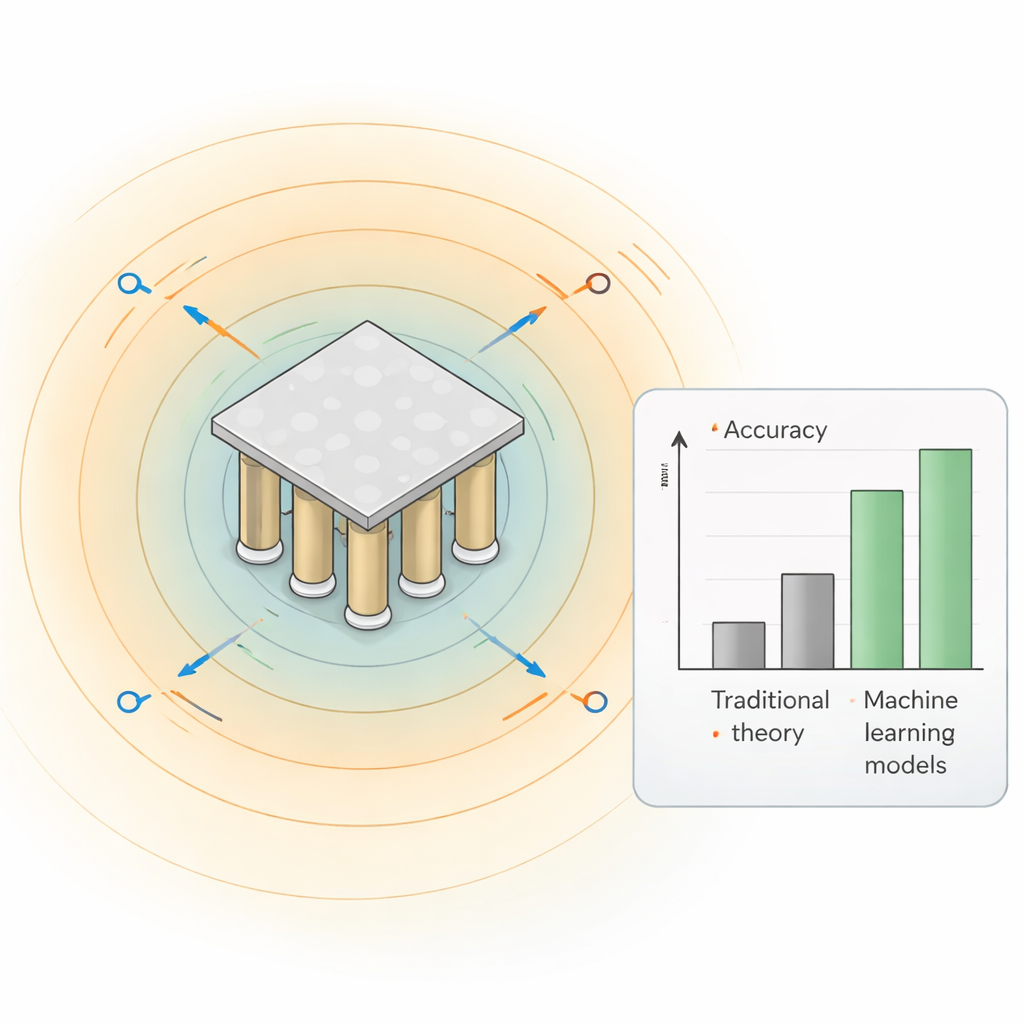
By comparing their data-driven predictions to the traditional cylindrical expansion theory, the authors showed that machine-learning models, especially deep neural networks, can forecast horizontal displacements at pile tops and ground surface points far more accurately. For future projects—such as additional metro lines—the approach could be used during design to test different pile layouts, spacings and construction sequences on a computer before any soil is disturbed, reducing the risk to nearby buildings and pipelines. In short, by letting computers learn directly from detailed field measurements, engineers gain a sharper picture of how the ground will respond, making it easier to keep vital urban infrastructure stable and intact.
Citation: Li, P., Guo, S., Liang, M. et al. Prediction of the displacements of the pile tops and ground surface around piles based on machine learning algorithms. Sci Rep 16, 6057 (2026). https://doi.org/10.1038/s41598-026-36502-5
Keywords: pile foundations, soil displacement, machine learning, underground infrastructure, metro construction