Clear Sky Science · en
Integrating physics and machine learning for unified seismic forward modeling and reservoir property inversion
Peering into Oil and Gas Reservoirs from Afar
We can never drill everywhere beneath the Earth, so oil and gas companies rely on sound waves to “see” underground. This study shows how combining physics with modern machine learning can turn those echoes into a more faithful picture of what really lies in the rocks: how porous they are, how much clay they contain, and whether their pores are filled with water, oil, or gas. The work offers a blueprint for making better use of seismic surveys, reducing drilling risk, and clarifying what machine learning can—and cannot—reliably tell us about hidden reservoirs.
From Rock Grains to Seismic Echoes
Seismic surveys work a bit like medical ultrasounds: sound waves are sent into the ground and the reflected signals are recorded at the surface. But there is a big gap between what is measured (wiggly traces of reflected waves) and what geologists want to know (the tiny pores and fluids inside rocks hundreds or thousands of meters down). The authors propose a unified framework that links three scales: microscopic properties of the rock (porosity, clay content, water or hydrocarbons), intermediate “elastic” properties that control how sound travels (two wave speeds and density), and large-scale seismic records. 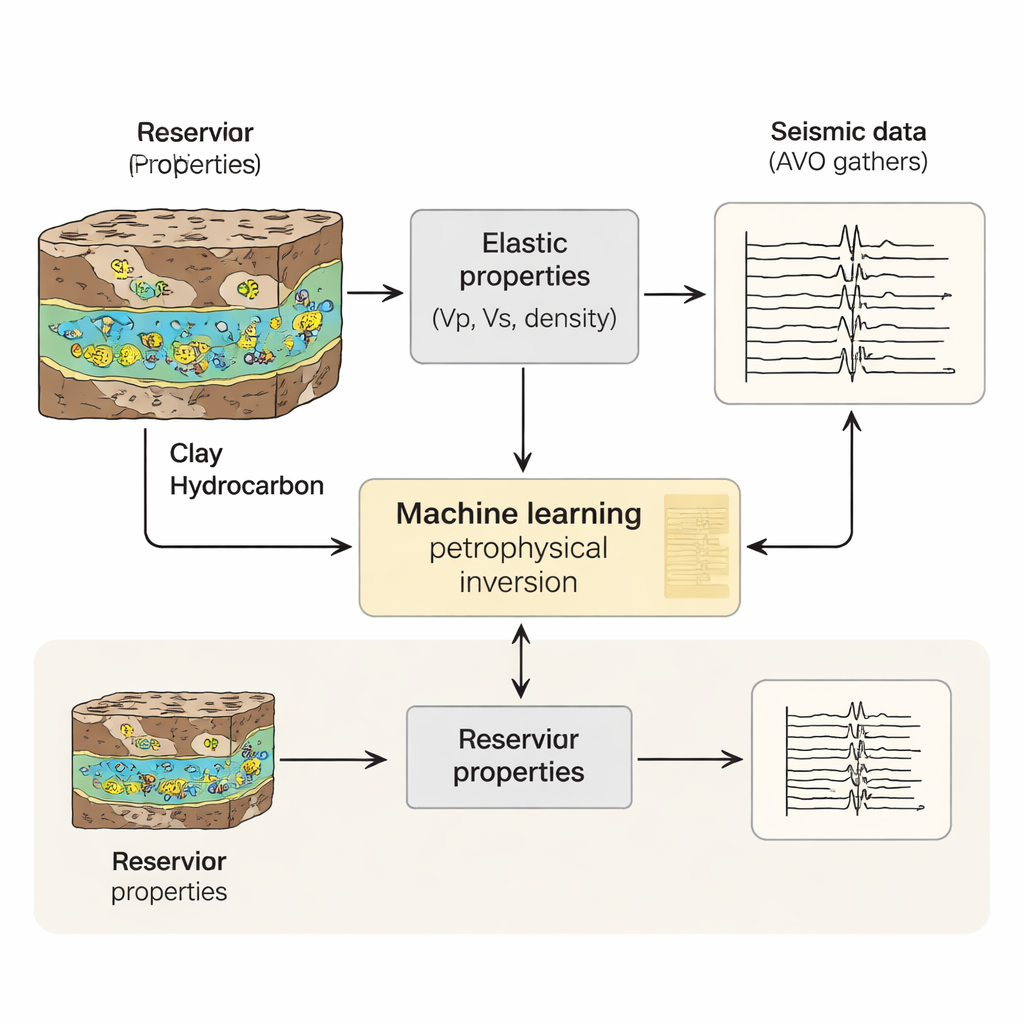
Letting Physics Generate the Training Data
Instead of starting with messy field data, the team built a clean virtual laboratory. They used a well-established rock physics recipe, the Raymer–Dvorkin–Voigt model, to calculate how different combinations of porosity, clay volume, and water saturation change seismic wave speeds and density. They systematically sampled a wide range of realistic rock and fluid conditions for both oil and gas reservoirs, creating three-dimensional grids of synthetic examples. These elastic properties then fed into two types of seismic simulators: an exact approach based on the Zoeppritz equations, and a more practical one that mimics real surveys by convolving the rock contrasts with a seismic wavelet. This allowed them to explore how layer thickness and wavelet frequency blur or “tune” the reflections and how that blurring hides fine details about the reservoir.
Machine Learning Learns the Rock–Seismic Link
Once this digital Earth was built, the authors turned the problem around. Using the synthetic elastic properties as inputs and the known rock properties as targets, they trained several machine-learning models, including random forests and neural networks, to perform “petrophysical inversion”: predicting porosity, clay, and water saturation from elastic data. They deliberately injected realistic noise and smoothing into the inputs to mimic the imperfections of real seismic inversion. 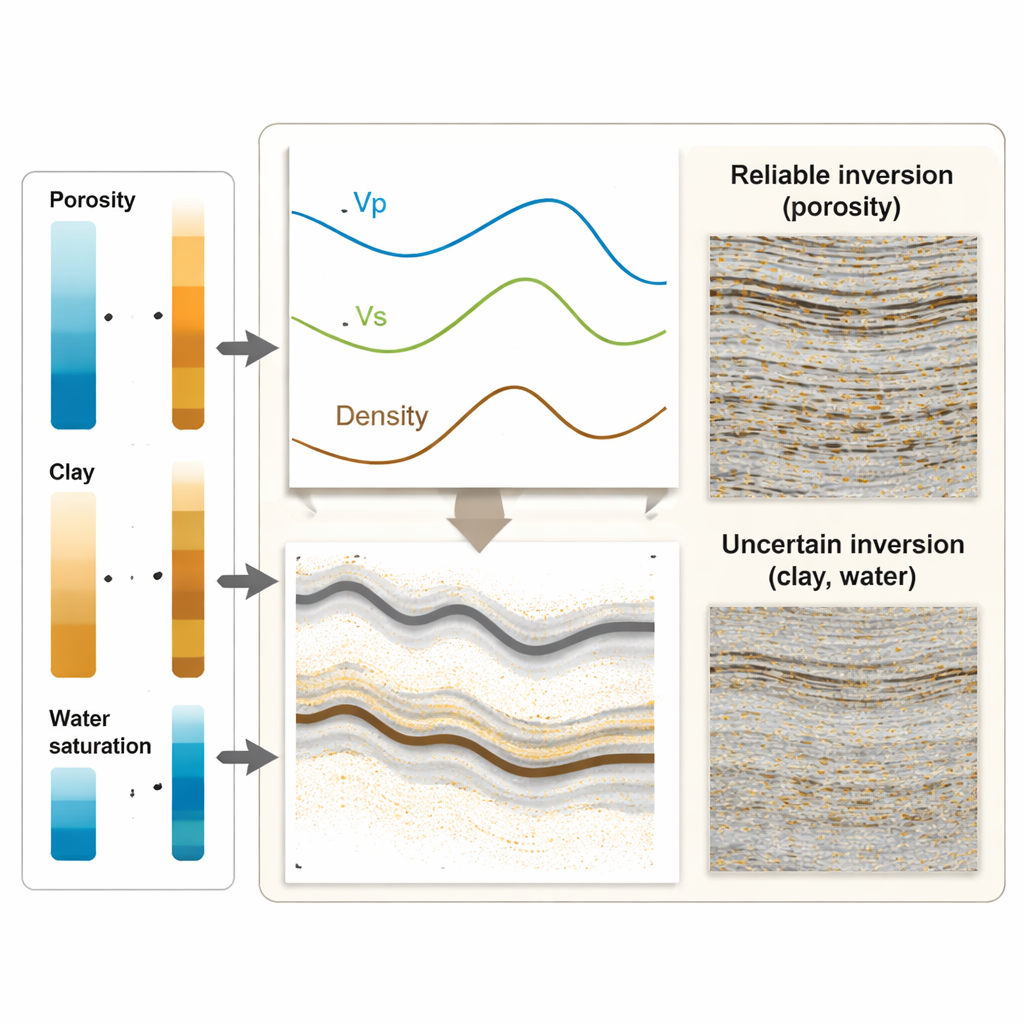
Testing the Framework on a Classic Layered Reservoir
To make the results more concrete, the study applied the full forward-and-inverse chain to a standard three-layer “sandwich” model: shale above and below a sand reservoir that might contain oil, gas, or water. By varying porosity, fluid type, and saturation, and then running the synthetic seismic and machine-learning inversions, the authors showed how porosity strongly controls the strength of the seismic response, while fluid effects are much more subtle and easily confused. The framework also made it possible to quantify uncertainty in a controlled way, showing, for example, that even small initial errors or modest seismic noise can greatly erode confidence in clay and water-saturation estimates, while porosity estimates remain comparatively stable.
What This Means for Real-World Exploration
For non-specialists, the take-home message is both encouraging and cautionary. The encouraging part is that by combining solid physics with machine learning, we can build a consistent chain from what we measure at the surface to what we care about in the reservoir, and we can rigorously test how reliable different predictions are. The cautionary part is that not all properties are equally “visible” to seismic waves: porosity usually is, but clay content and water versus hydrocarbon are much harder to pin down from seismic data alone. The authors argue that the future lies in hybrid approaches—such as physics-informed and explainable AI—that let machine learning flexibly fit complex patterns while still honoring basic physical laws and making its decisions more transparent to geoscientists.
Citation: Zayier, Y., Yalikun, Y., Cheng, Y. et al. Integrating physics and machine learning for unified seismic forward modeling and reservoir property inversion. Sci Rep 16, 5932 (2026). https://doi.org/10.1038/s41598-026-36501-6
Keywords: seismic inversion, rock physics, machine learning, reservoir characterization, porosity