Clear Sky Science · en
Functional and cognitive correlates of typing speed in a large U.S. panel study
Why Your Typing Speed Says More Than You Think
Most of us tap out messages and emails all day without thinking about how fast we type. This study suggests that our typing speed may quietly mirror how well our minds and bodies are working. By looking at a simple one-sentence typing test taken by over ten thousand U.S. adults, researchers explored whether this everyday skill can offer clues about memory, thinking ability, health problems, and how easily people manage daily tasks.
A One-Sentence Test With Big Ambitions
The researchers worked with the Understanding America Study, a large national panel of adults who regularly complete online surveys. Instead of using long and demanding typing exams, they gave participants a very brief task: type a single sentence (a “pangram” containing every letter of the alphabet) as quickly and accurately as possible, on either a computer or a smartphone. They then combined speed and accuracy into a single score called adjusted words per minute, treating this as each person’s typing speed. Because people could choose their own device, the team was able to compare computer and smartphone typists separately, reflecting how we actually communicate in daily life.
How Stable Is Typing Skill Over Time?
A crucial question was whether such a short test gives reliable results. To find out, more than 3,500 participants repeated the typing test on the same device about two years later. The scores were strikingly stable: computer users showed very high consistency, and smartphone users showed somewhat lower but still strong stability. This level of repeatability suggests that a quick one-sentence test is not just capturing random variation or momentary distraction, but a relatively enduring aspect of people’s performance.
Typing, Thinking, and Everyday Tasks
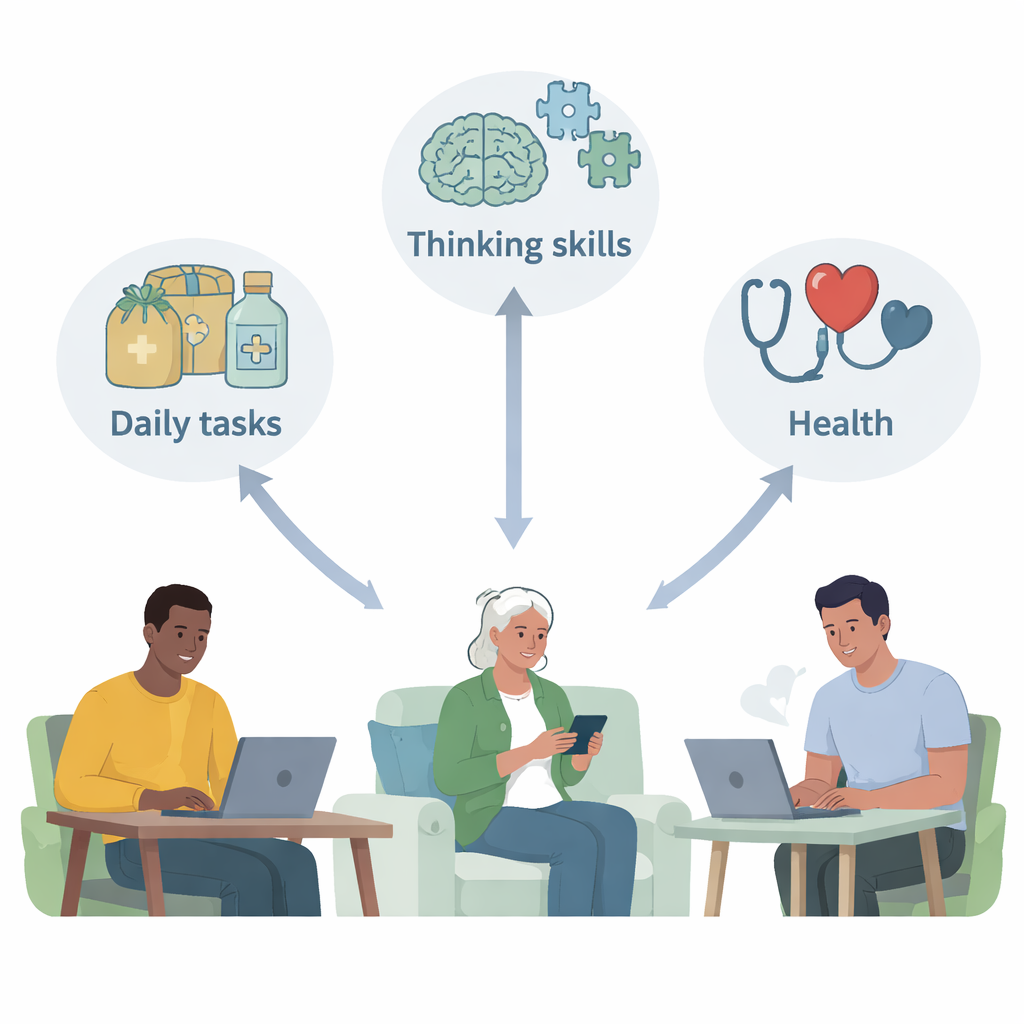
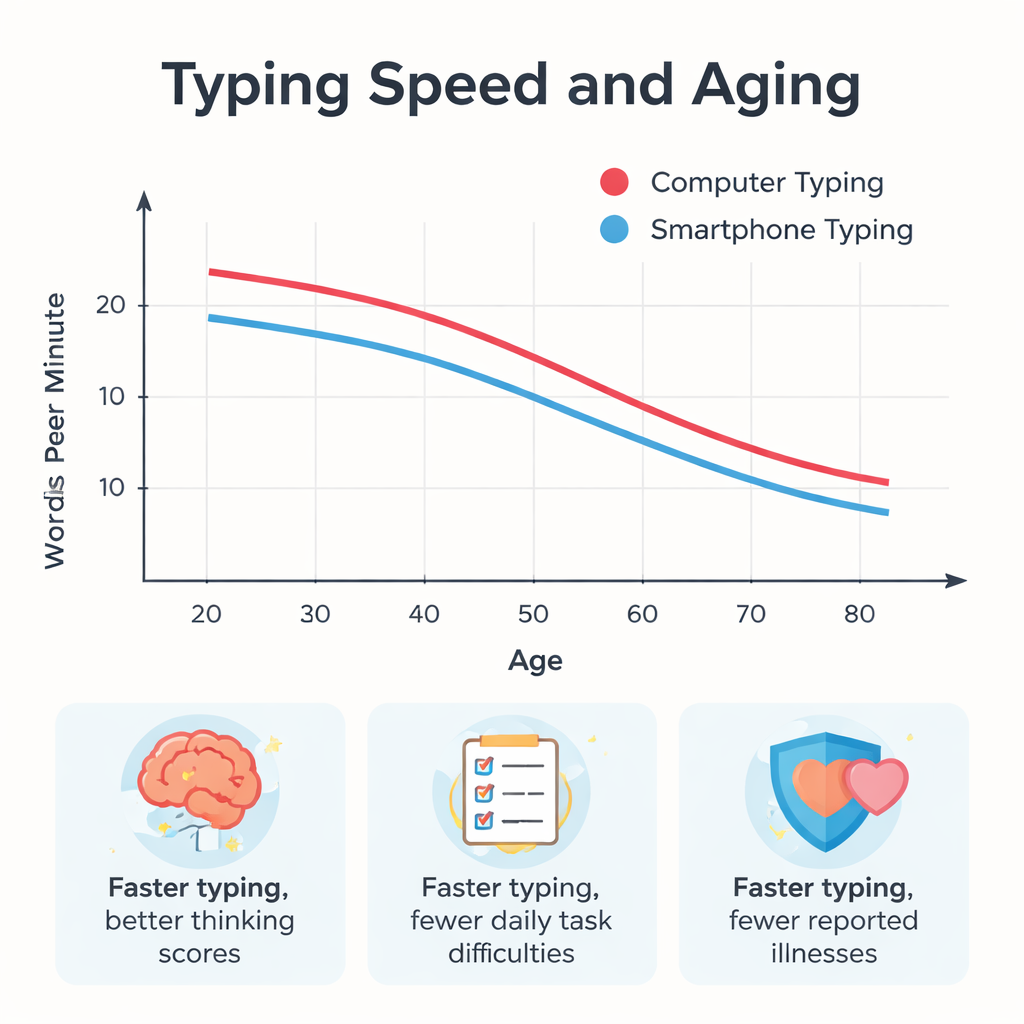
The team then asked whether faster typing went hand-in-hand with better functioning in everyday life. Participants also completed a broad range of thinking tests that measured speed of processing, attention, memory, reasoning, and word knowledge. They answered questions about basic self-care (such as dressing or bathing), more complex chores (shopping, handling money, managing medications), and whether a doctor had ever diagnosed them with conditions like diabetes, arthritis, stroke, or heart disease. Faster typists, on both computers and smartphones, tended to score higher on nearly all thinking tests, especially tasks that depended on quick visual processing. They also reported fewer difficulties with daily activities and were less likely to say they had several common chronic illnesses. These links were generally modest but consistent and pointed in the expected direction.
Age, Devices, and the Bigger Picture
Typing speed was closely tied to age: on average, younger adults typed faster than older adults, and this pattern appeared for both computers and smartphones. Computer users were typically older, more educated, and higher income, while smartphone users were younger and more often lower income or from racial and ethnic minority groups. When the researchers took these demographic differences into account, the connections between typing speed, thinking tests, daily activities, and health grew weaker but did not disappear. This suggests that typing speed partly reflects broader life advantages such as education and technology experience, yet still contains its own meaningful signal about how people are doing.
What It Means for Everyday Life and Future Research
The study concludes that a single-sentence typing test can offer a quick, low-burden snapshot of people’s cognitive and functional health. In a world where so many essential services—from medical portals to job applications—require typing, being slow on the keyboard may translate into real obstacles in daily life. For researchers and public health monitors, typing speed could serve as a simple “digital vital sign” that helps flag individuals or groups who might struggle with online tasks or be at higher risk for certain health problems. While it cannot replace medical exams or detailed cognitive testing, this brief measure appears to be a practical addition to the toolkit for understanding how well people cope in an increasingly digital society.
Citation: Hernandez, R., Schneider, S., Gatz, M. et al. Functional and cognitive correlates of typing speed in a large U.S. panel study. Sci Rep 16, 5900 (2026). https://doi.org/10.1038/s41598-026-36500-7
Keywords: typing speed, digital biomarker, cognitive function, aging, daily living activities