Clear Sky Science · en
Fifty years of seismicity of Mt. Vesuvius
Why the Quiet Volcano Still Matters
Mt. Vesuvius looms over one of the most densely populated regions in Europe, yet it has not erupted since 1944. To many residents and visitors, it may seem dormant and harmless. This study shows that, beneath this outward calm, the volcano is constantly cracking and shifting in small ways that only sensitive instruments can detect. By tracking tens of thousands of tiny earthquakes over the last 50 years, scientists are piecing together how the inside of Vesuvius works today—and how to better watch for signs of future trouble.
Listening to a Restless Giant
Since the 1970s, Italian scientists have built and steadily expanded a dedicated network of seismic stations around Vesuvius. These instruments record every detectable shake, from faint pops deep underground to the strongest tremor since the 1944 eruption, a modest magnitude 3.6 quake in 1999. Early on, the network was sparse and relatively insensitive, so only larger events were logged. Over time, especially after 2010, new broadband stations were added close to the summit crater, dramatically improving the ability to pinpoint where earthquakes start and how strong they are. The result is a detailed, decades-long record of the volcano’s hidden activity. 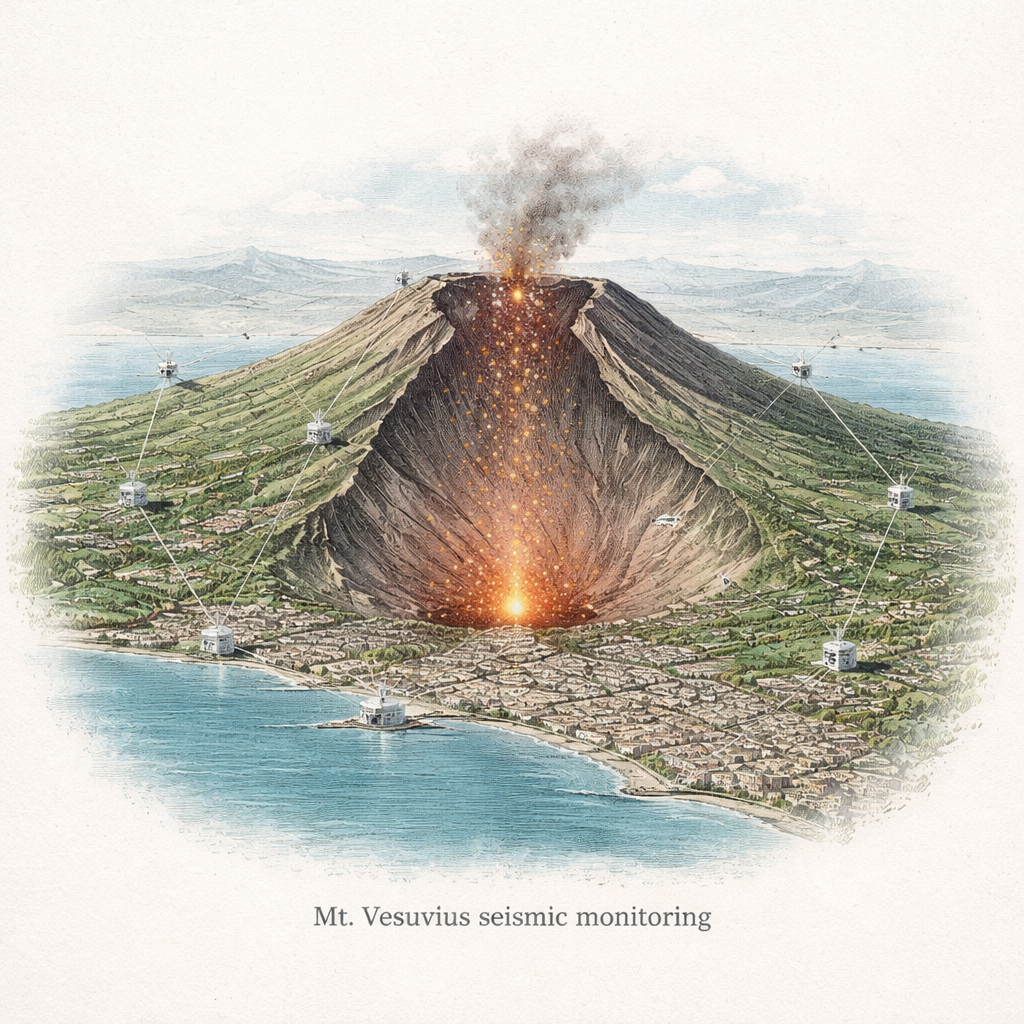
Patterns in Fifty Years of Quakes
Looking across this record, the team finds that Vesuvius has remained in a low-energy state: hundreds to a little over a thousand small earthquakes per year, most of them too weak for people to feel. Four brief periods of heightened activity, particularly between the late 1970s and 2000, stood out in the earlier data. These bursts involved somewhat stronger and deeper events and once raised fears that the volcano might be reawakening. But the activity soon dropped back to background levels. When scientists plotted the locations of more than 10,000 well-determined earthquakes from 1999 onward, they found that almost all of them fall within a narrow cylinder beneath the central cone, a vertical column just a few hundred meters wide that extends several kilometers down.
Shallow Cracks vs. Deep Plumbing
By examining how earthquake frequency changes with magnitude and depth, the researchers identified two main zones of activity separated by a clear gap near sea level. Above this gap, within about 2 kilometers of the surface, most quakes are small and clustered inside the cone. Their statistical behavior suggests ordinary brittle cracking of rock, likely driven by the slow sagging and gravitational instability of the volcano’s steep flanks rather than by rising magma. Below sea level, another group of earthquakes occurs within older, denser rock. Here, the way earthquake sizes are distributed—and the presence of occasional low-frequency, tremor-like events—points to a different regime influenced by hot fluids or partially molten material moving at depth. 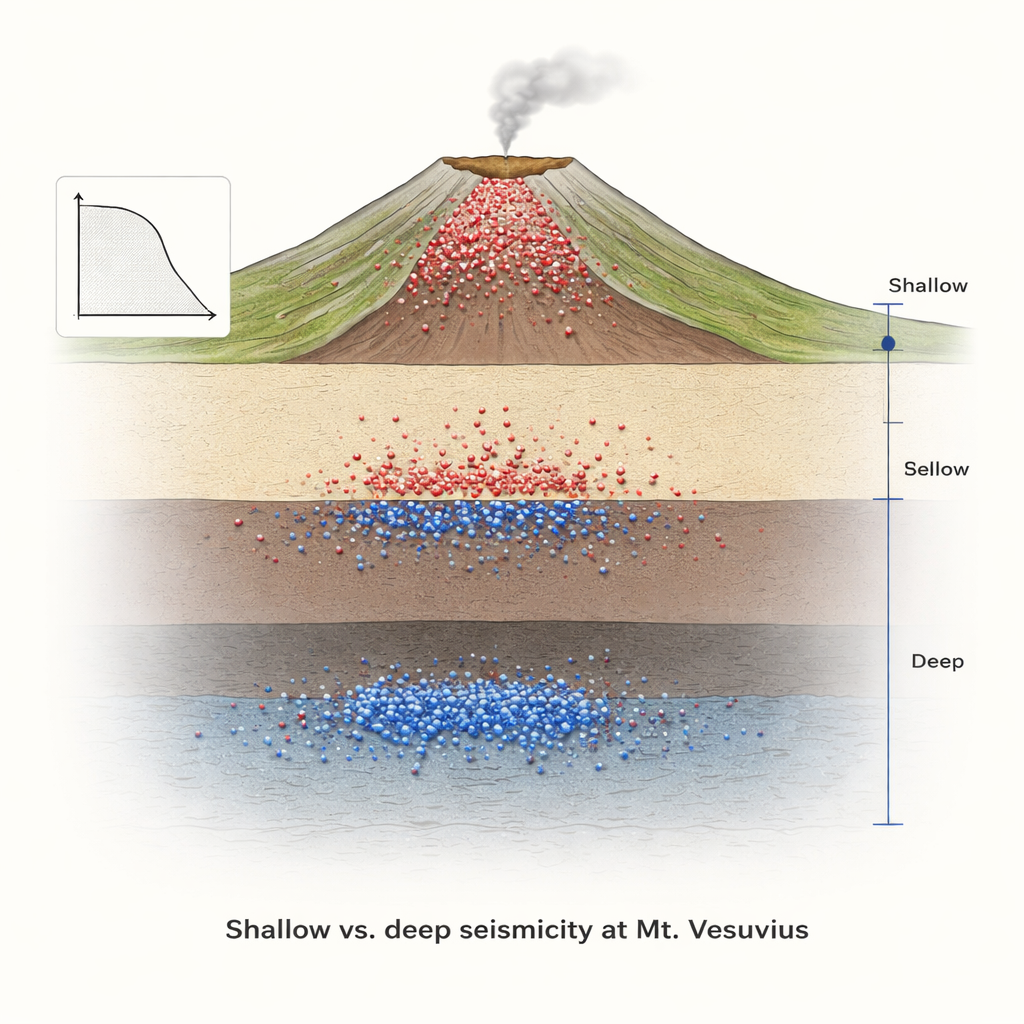
Seeing More By Hearing Better
A crucial part of the story is not just what the volcano is doing, but how well we can hear it. As more and better stations were installed, especially around 2010–2014, the minimum size of earthquakes that could be reliably detected dropped sharply. After 2015, nearly 80 percent of the events seen at the summit station could also be precisely located in three dimensions. This means that apparent increases in earthquake counts in recent years mostly reflect improved “ears” rather than a more agitated volcano. The authors carefully correct for these changing detection limits so that they can compare different periods fairly and avoid mistaking technical advances for real changes in volcanic behavior.
What It Means for People Living Nearby
For residents around Vesuvius, the main message is cautiously reassuring. The volcano has been seismically quiet in the sense that it produces many small quakes and no large ones, and this pattern has persisted for decades. The data reveal a stable distinction between shallow cracking in the cone and deeper processes in the hotter interior, but no clear sign of rising pressure that would herald an imminent eruption. At the same time, the study highlights how essential dense, modern monitoring is in such a high-risk area. By lowering the threshold of what can be detected and understanding which parts of the volcano are moving and why, scientists are better equipped to recognize when the current calm gives way to truly worrisome change.
Citation: Dalla Via, G., Tramelli, A., Lo Bascio, D. et al. Fifty years of seismicity of Mt. Vesuvius. Sci Rep 16, 5973 (2026). https://doi.org/10.1038/s41598-026-36499-x
Keywords: Mt. Vesuvius, volcano monitoring, seismicity, earthquake swarms, volcanic risk