Clear Sky Science · en
Analysis of the determinants of farm power mechanization in Misrak Bedawacho District, Hadiya Zone, Central Ethiopia
Why Farm Machines Matter for Rural Families
Across much of rural Africa, growing enough food still depends on people’s muscles and the strength of animals. This article looks closely at one farming district in Central Ethiopia—Misrak Bedawacho—to ask a simple but powerful question: what really decides whether small farmers can move from hoes and oxen to tractors and other machines? Understanding the answer matters not only for the farmers themselves, but also for anyone concerned with food prices, rural poverty, and how a rapidly growing population will be fed.
A District Caught Between Old and New
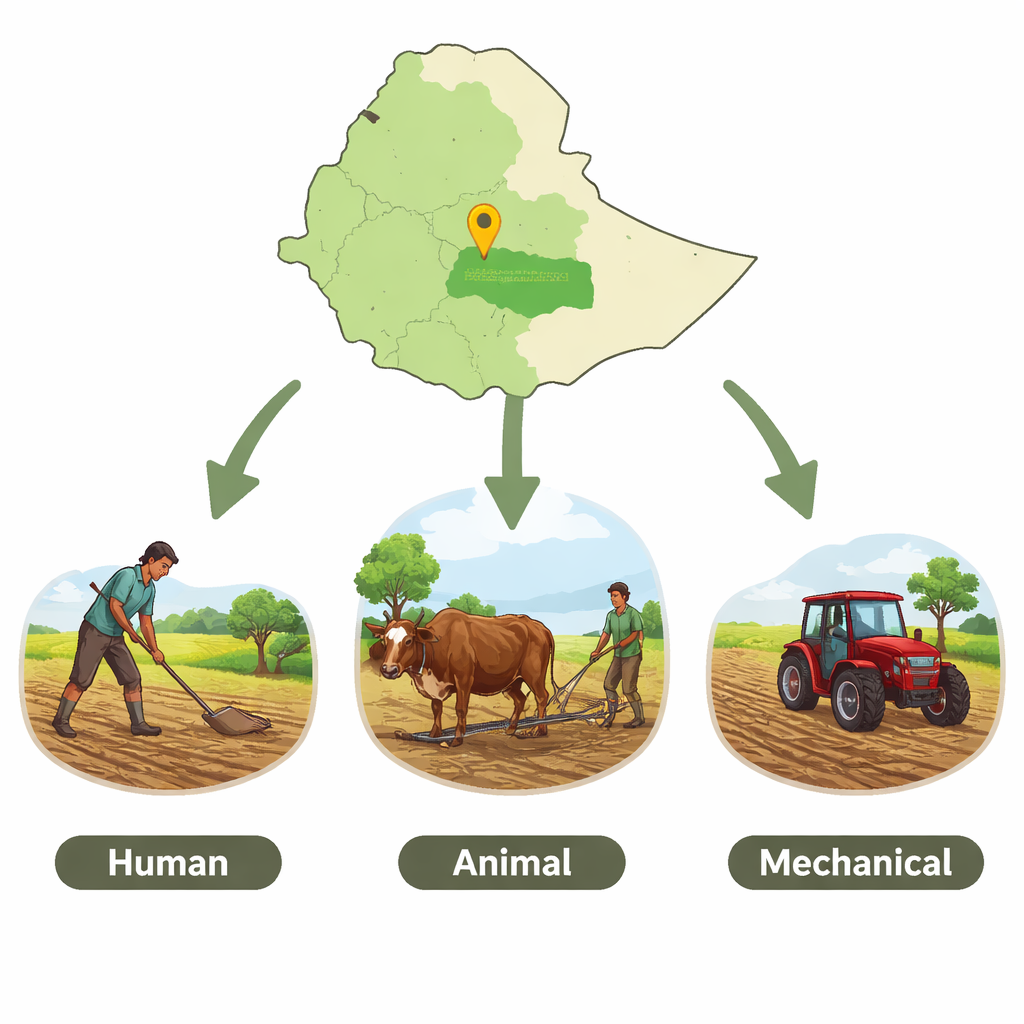
Misrak Bedawacho is a largely farming district in the Hadiya Zone of Central Ethiopia. Most people there grow wheat, maize, barley, and teff on small plots averaging just 1.75 hectares, relying on seasonal rains. Like many rural areas, the district’s fields are mainly worked with human labor and oxen. National programs have introduced modern tools such as combine harvesters, but only a fraction of farmers can actually use them. Against a backdrop of rising food demand, rural out-migration, and government efforts to modernize agriculture, the district offers a revealing snapshot of how slowly and unevenly machines are spreading across African farms.
How the Researchers Took the Pulse of Local Farming
To understand what holds back or encourages the use of machines, the researchers surveyed 245 farm households selected from five local communities. They gathered detailed information on each family’s land size, income, education, access to credit, training, type of farm power, and the shape and location of their fields. They then used a statistical technique called binary logistic regression to see which of these factors truly make a difference in whether a household uses mechanical power at all. Alongside the numbers, they held interviews and group discussions with farmers and extension workers to capture practical experiences and local perceptions.
Still Working Mostly by Hand and with Animals
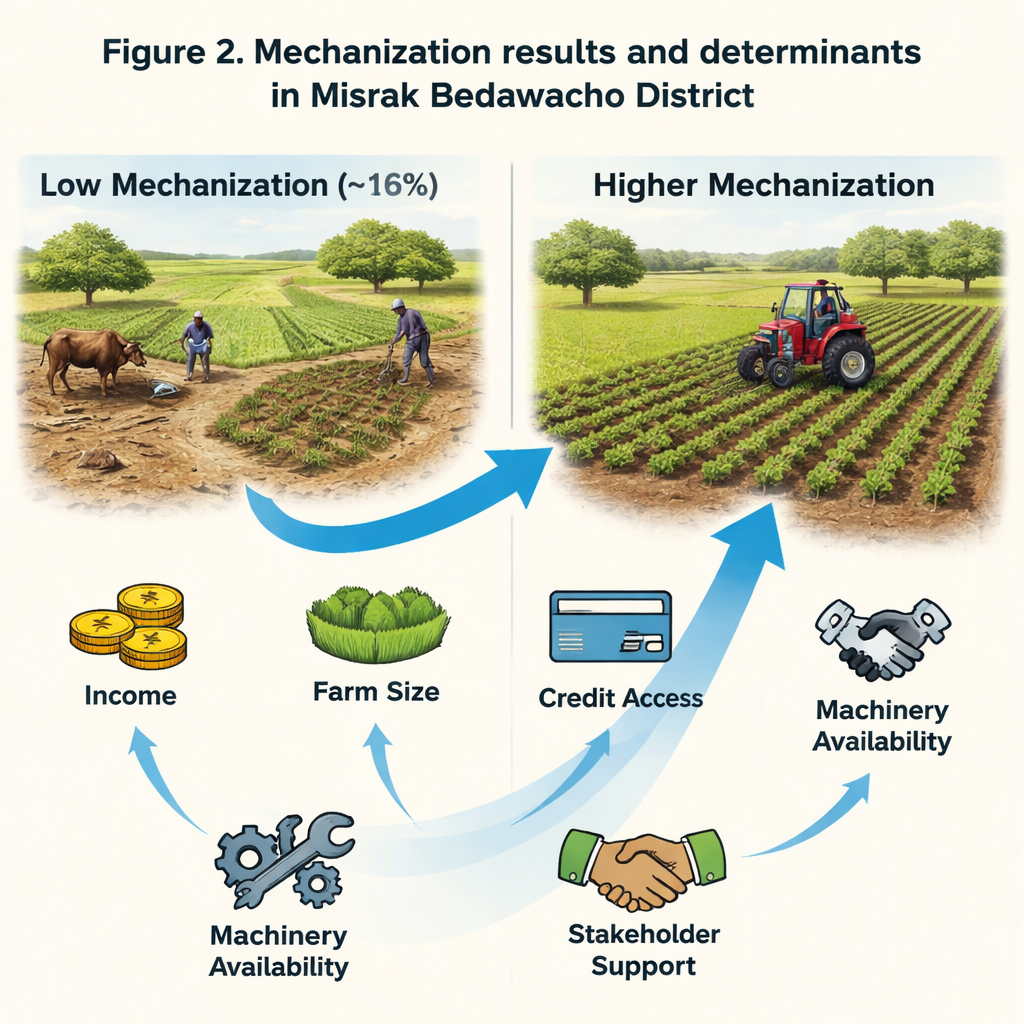
The study found that agriculture in Misrak Bedawacho remains firmly rooted in traditional power sources. Oxen were the main workhorses, used by about half of the farmers and accounting for the largest share of power applied to the land. Human labor came next, used by roughly one-third of households. Only about one in six farmers reported using mechanical power such as tractors or motorized equipment. When these contributions were converted into an overall “mechanization index,” the district scored just 15.96 percent—evidence that true machine-based farming is still rare and that oxen and people bear most of the burden of plowing and other heavy tasks.
Money, Land, and Support—Not Age or Schooling—Drive Change
The heart of the analysis shows that it is not who the farmers are, but what they have access to, that determines whether they adopt machines. Larger farm size strongly increased the likelihood of using mechanical power, because bigger fields make the cost of hiring or owning machines worthwhile. Higher farm income had a positive effect too, helping families afford rental fees, fuel, and repairs. Access to credit made an especially big difference, as did simply having machines available in the area. Farmers with more years of experience, fields on gentler terrain, and support from government offices, cooperatives, or other organizations were also more likely to use machines. In contrast, age, gender, education level, and family size were not statistically important once economic and institutional factors were considered.
From Findings to Practical Steps on the Ground
Interviews with local experts and farmers underscored the same message: machines are scarce, costly, and hard to maintain. Spare parts are difficult to find, mechanics are few, and credit schemes often do not reach smallholders. But where farmers have been able to use machinery, they report clear benefits—more timely planting and harvesting, higher yields, and less backbreaking work. Based on these insights, the authors recommend expanding rural machinery rental centers, promoting cooperative ownership so neighbors can share equipment, improving rural roads and spare-parts supply, and offering hands-on training in operation and maintenance. Strengthening credit programs tailored to small farmers is seen as crucial.
What This Means for Food and Rural Futures
For a lay reader, the main takeaway is straightforward: in Misrak Bedawacho, farmers do not avoid machines because they are too old, too uneducated, or set in their ways. They avoid them because machines are expensive, hard to reach, and poorly supported. Where land is larger, incomes a bit higher, credit and machines available, and institutions responsive, farmers are eager to mechanize. The study suggests that if policies focus on these practical barriers—rather than trying to change farmers themselves—mechanization can spread, easing labor shortages, boosting harvests, and helping rural communities move toward a more secure and modern agricultural future.
Citation: Yohannes, D., Kolhe, K.P., Dananto, M. et al. Analysis of the determinants of farm power mechanization in Misrak Bedawacho District, Hadiya Zone, Central Ethiopia. Sci Rep 16, 5589 (2026). https://doi.org/10.1038/s41598-026-36496-0
Keywords: farm mechanization, smallholder farmers, Ethiopia, agricultural productivity, rural development