Clear Sky Science · en
Modelling selective heating in microwave-heated packed-bed reactors
Turning Trash into Fuel with Clean Heat
Plastic waste is piling up worldwide, and many recycling methods still leave a large share of plastics burned or dumped. One promising route is to turn waste plastics into useful oils and gases through heating them in the absence of oxygen, a process called pyrolysis. This paper explores how to design a new kind of electrically powered reactor that uses microwaves and smart heat‑absorbing particles to warm plastics more evenly and efficiently—paving the way for cleaner, more controllable plastic‑to‑fuel technologies.
Why Microwaves Can Heat Plastics Better
Conventional pyrolysis usually heats plastic from the outside in, like roasting a potato in an oven. The outer layers get very hot while the inside lags behind, which can cause unwanted by‑products such as char and heavy, poorly cracked oils. Microwaves, by contrast, can deliver energy directly into the bulk of a material, often heating it from the inside out. But there is a catch: most common plastics barely absorb microwaves, which is why a plastic container in a kitchen microwave often stays cool while the food warms. To get around this, engineers mix in special particles called susceptors—materials that soak up microwave energy and turn it into heat. Silicon carbide (SiC) is a leading candidate: it absorbs microwaves strongly, conducts heat well, and remains stable at high temperatures, making it an ideal internal “heater” inside a plastic waste bed.
A Reactor Built Around Moving Hot Pebbles
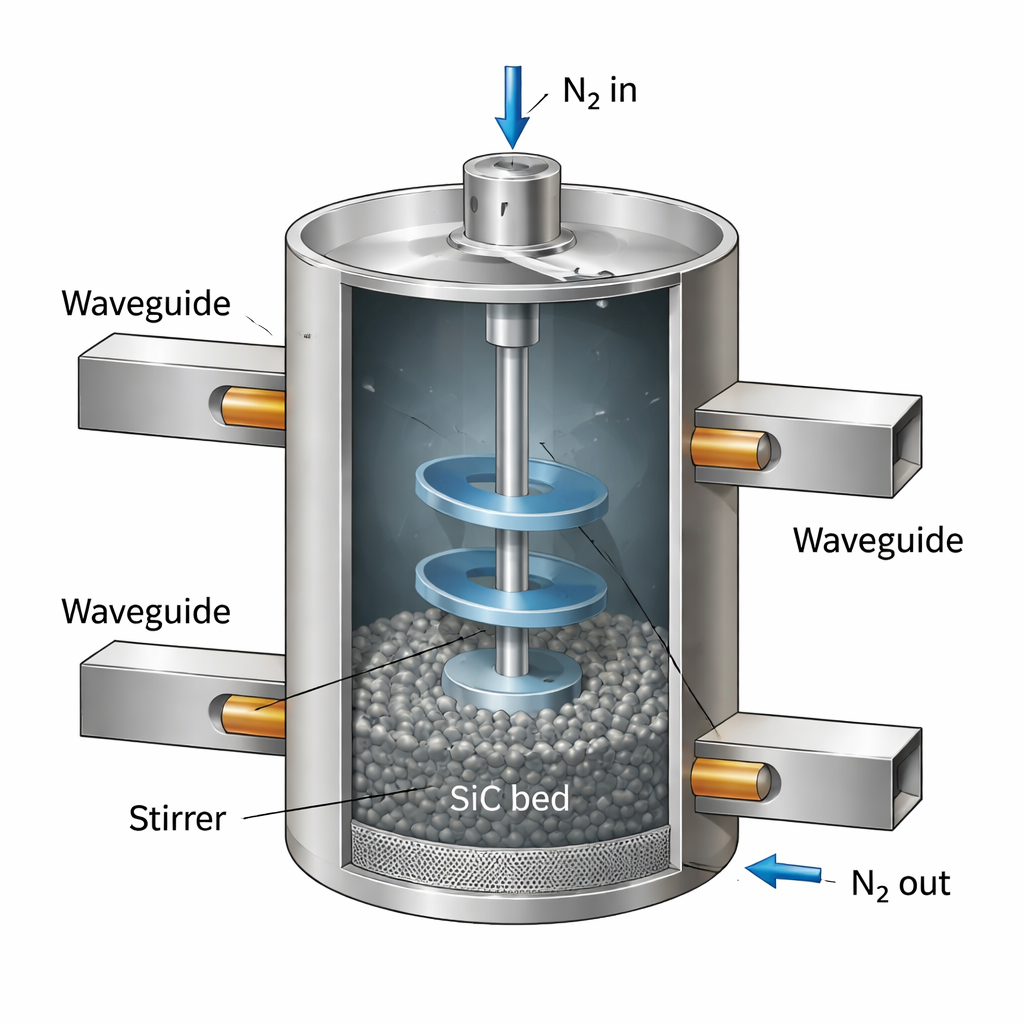
The reactor design studied here fills much of a metal vessel with a bed of SiC spheres, like a column of very hard marbles. Three side‑mounted microwave channels feed energy into this packed bed, while nitrogen gas flows through to keep oxygen out and carry hot products away. Instead of using a solid SiC block with channels—too prone to clogging with mixed, dirty plastics—the authors focus on a stirred packed bed. A rotating shaft drives a helical stirrer that continually moves the SiC particles, helping to even out hot and cold spots created by the complex microwave field. Computer simulations of the particle motion were used to tune the spacing between stirrer blades and the vessel wall, finding a “sweet spot” where mixing is strong but the electric field near metal parts stays low enough to avoid dangerous arcing.
From Billions of Details to a Practical Digital Twin
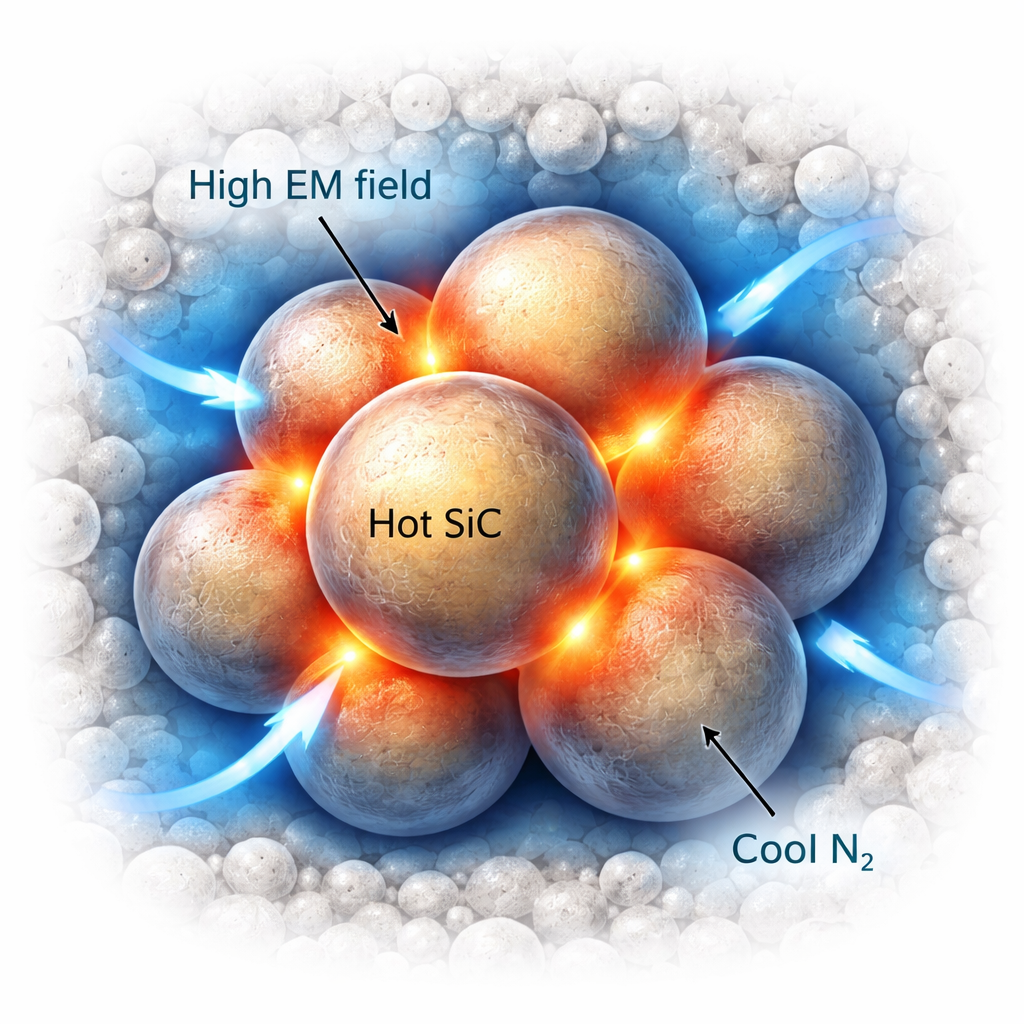
Capturing what happens inside such a reactor is far from simple. The microwaves interact with thousands of SiC spheres and the gas between them; heat flows between particles and gas; and the nitrogen weaves through the porous bed in a turbulent way. Simulating every single grain in full detail would overwhelm even powerful computers. Instead, the authors developed a multistep strategy. They first generated realistic 3D packings of SiC spheres using a granular simulation method, then “repaired” the slightly overlapping particles so they could be used in a physics solver. Next, they ran detailed microwave simulations on small representative chunks of this bed and asked: what single, averaged electrical property would make a uniform material absorb and store microwave energy in the same way as this complex mixture? Using an automated optimization loop linking Python scripts and commercial simulation software, they adjusted this “effective permittivity” across temperatures from room conditions up to 800 °C, building a library of temperature‑dependent properties that encode the fine‑scale physics into a simpler form.
Following the Heat and the Flow
Armed with these effective properties, the team built a full reactor‑scale “digital twin” that couples three interacting pieces of physics: microwave fields, nitrogen flow, and heat transfer between the solid SiC bed and the gas. Microwaves were treated as depositing energy only in the solid fraction, mimicking the real behavior where the SiC grains heat and then warm the surrounding gas by convection. The gas flow through the packed bed was described using a porous‑media model that accounts for resistance to flow and extra drag at higher speeds, while heat transfer used a dual‑temperature approach that tracks solid and gas temperatures separately. The simulation cycled repeatedly: microwaves heated the medium, updated temperatures changed how well it absorbed microwaves, and the process continued until temperatures settled into a steady pattern.
What the Simulations Reveal for Future Reactors
Under a total microwave input of 10 kilowatts and a realistic nitrogen flow rate, the model predicts that the SiC bed and the gas can reach temperatures around 650–690 °C—high enough for plastic pyrolysis—without runaway heating. About 70% of the input microwave power ends up as heat in the bed, with the rest reflected, suggesting that better tuning of the microwave feeding network could improve efficiency. The reactor walls stay cooler but still hot enough to require careful material choice and thermal management. Importantly, the study does not yet include actual plastics or chemical reactions; instead, it provides a robust, reusable framework for exploring how to shape the bed, choose particle properties, and select operating conditions so that future designs can add plastic, char formation, and reaction chemistry on top of a well‑understood thermal backbone. For non‑specialists, the key message is that with smart modelling, engineers can design microwave reactors that heat plastic waste more uniformly and efficiently, opening a path toward cleaner, electrically powered recycling technologies.
Citation: Niño, C.G. Modelling selective heating in microwave-heated packed-bed reactors. Sci Rep 16, 5636 (2026). https://doi.org/10.1038/s41598-026-36495-1
Keywords: microwave pyrolysis, plastic waste, silicon carbide, packed-bed reactor, multiphysics simulation