Clear Sky Science · en
The influence of sex on shoulder and hip joint resting position and mobility in elite golfers
Why Golfers’ Hips and Shoulders Matter
Anyone who has tried to hit a golf ball farther knows the swing is about more than just arm strength. This study looks inside that motion, asking how years of practice reshape the hips and shoulders of elite male and female golfers—and how those subtle changes in joint position and flexibility can help or hurt clubhead speed. The findings suggest that men and women may rely on different physical “setups” to generate power, pointing toward training programs tailored by sex rather than one-size-fits-all advice.
How the Body Adapts to a One-Sided Sport
Golf is a highly one-sided sport: right-handed players repeat the same swing thousands of times with the same lead and trail sides. Over years, this can nudge bones and joints into slightly new resting positions. Other sports, like baseball and tennis, show similar patterns, where the dominant shoulder or hip twists or tilts in a consistent direction. In some cases these changes boost performance; in others they raise injury risk. Yet, until now, it has been unclear whether comparable long-term adaptations occur in golfers’ hips and shoulders, and whether these changes differ between men and women or relate directly to how fast they can swing the club.
Measuring Hidden Angles in Elite Golfers
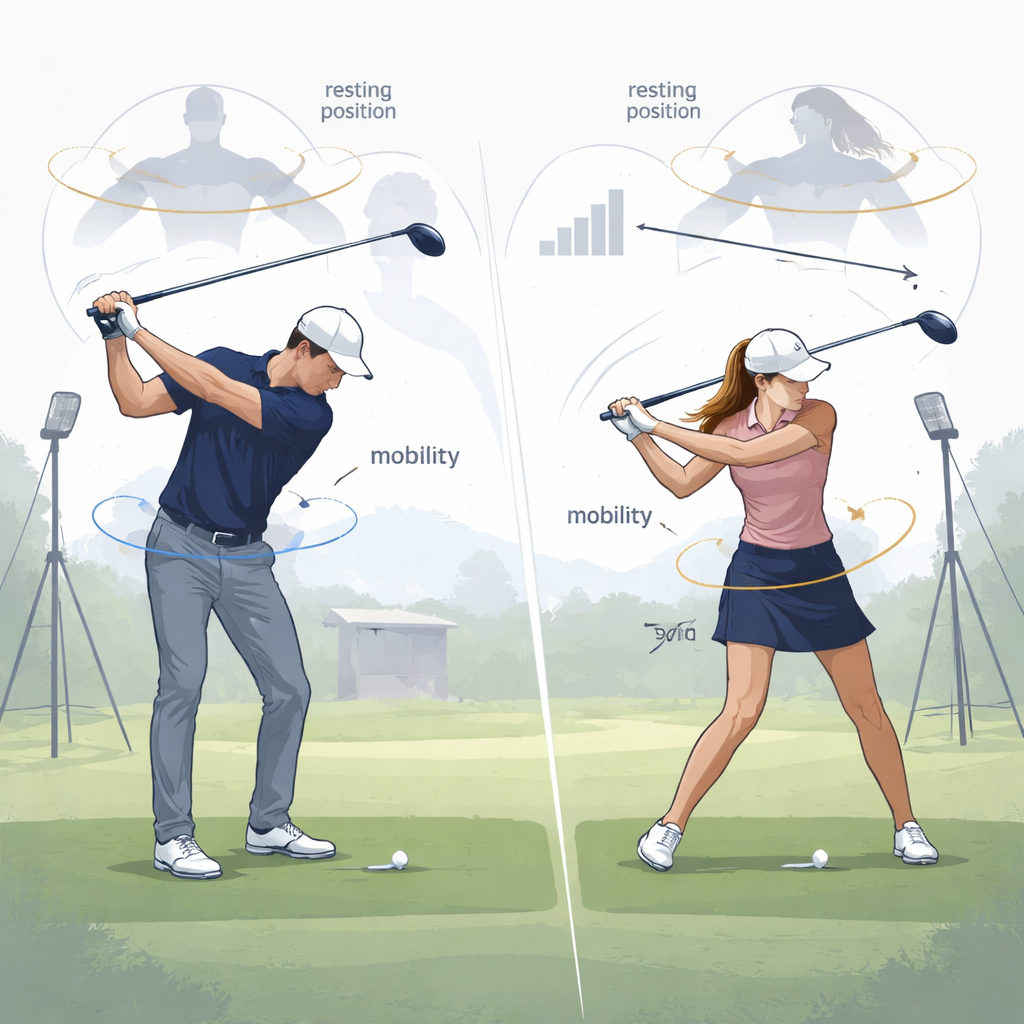
To explore this, researchers studied 24 elite university golfers—12 men and 12 women—who all played right-handed and had very low handicaps. They used motion-capture cameras and a well-known movement test to measure two things. First, they recorded each player’s natural, relaxed joint position while sitting or lying down, capturing the basic orientation of the shoulder and hip joints at rest. Second, they tested how far the joints could move during specific actions, such as reaching both hands behind the back to touch the spine, or lifting a straight leg while lying on the floor. These tests produced a “dynamic” range of motion score for each shoulder and hip. Finally, the golfers performed multiple full swings with a 7-iron so the team could track clubhead velocity, a key indicator of performance.
What the Study Found About Men and Women
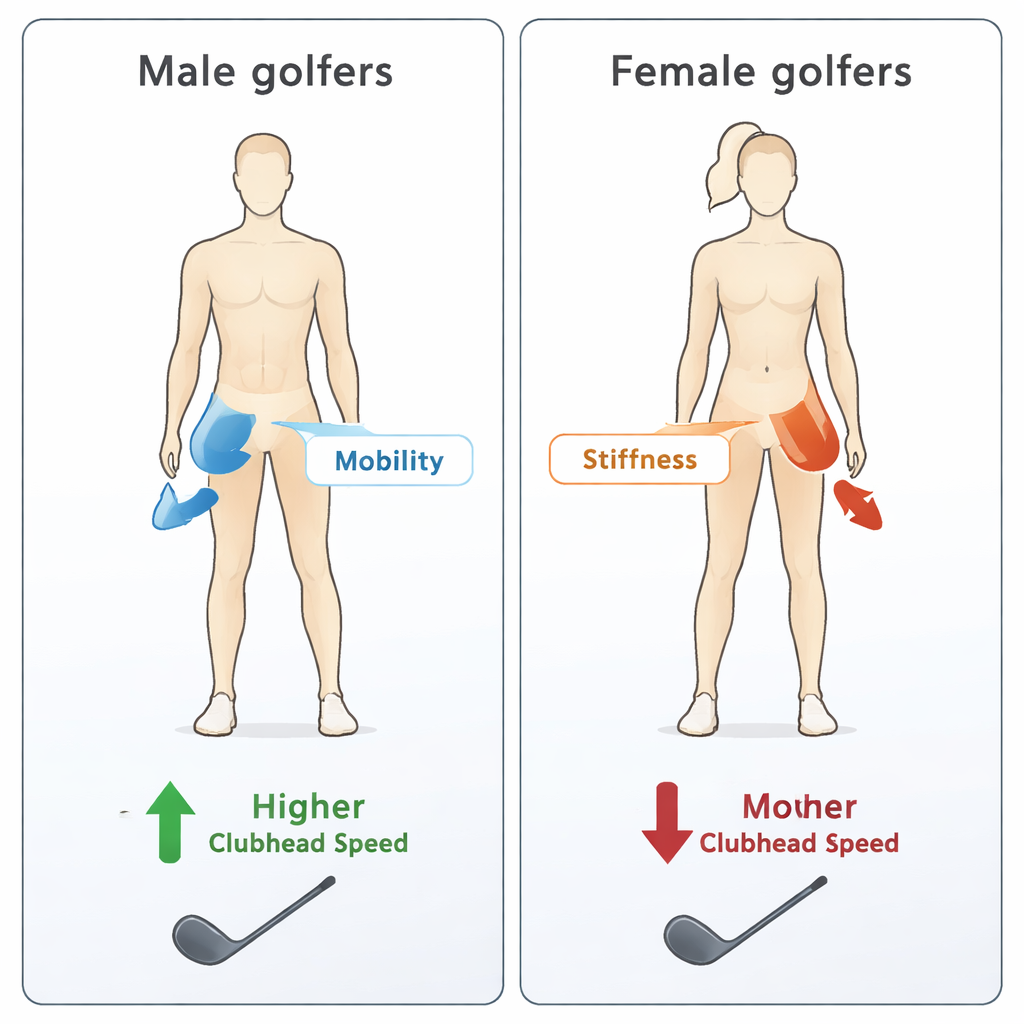
When all golfers were combined, the resting angles of the shoulders and hips did not strongly predict how far those joints could move or how fast the club traveled. But once the researchers separated men and women, clear patterns emerged. In male golfers, more mobility in the lead (left) hip was linked to higher clubhead speed—a moderate, positive relationship. In women, the pattern went in the opposite direction: greater lead-hip mobility was actually associated with lower clubhead speed. Men also tended to stand with their lead hip rotated more inward at rest, and their trail (right) shoulder showed signs of rotational adaptation that echoed what has been observed in overhead sports like baseball.
Different Paths to Power
These sex-based differences suggest that men and women may achieve powerful swings in different ways. For men, the data point toward a strategy that depends on a highly mobile lead hip capable of rapid rotation, helping them whip the club through impact. For women, who generally have more joint flexibility to begin with, extra mobility in the lead hip may translate into less stiffness in the muscles and tendons. That reduced stiffness can limit how much elastic energy is stored and released during the swing, potentially lowering clubhead speed. In this view, many elite female golfers may benefit more from improved hip stability and controlled stiffness than from further stretching or mobility work.
What This Means for Golfers and Coaches
Put simply, the study concludes that long-term golf training reshapes the hips and shoulders of elite players, and these changes are not the same for men and women. Male golfers seem to gain speed from a more mobile lead hip, while female golfers may perform better when that hip is slightly stiffer and more stable. For coaches, trainers, and medical staff, this means that screening tests and conditioning programs should be sex-specific: men might focus on safely maintaining or improving hip rotation, whereas women might emphasize strength, control, and balanced stiffness around the hip and shoulder joints. Tailoring training in this way could help maximize distance while also lowering the risk of overuse injuries.
Citation: Hsu, CY., Tang, WT., Peng, YC. et al. The influence of sex on shoulder and hip joint resting position and mobility in elite golfers. Sci Rep 16, 6139 (2026). https://doi.org/10.1038/s41598-026-36493-3
Keywords: golf biomechanics, hip mobility, shoulder mobility, sex differences, clubhead speed