Clear Sky Science · en
Quantum superposition in ultra-high mobility 2D photo-transport
Why this strange electron behavior matters
When we shrink electronics down to ultra-clean, ultra-cold sheets only one atom thick in behavior, electrons stop acting like tiny billiard balls and start behaving like waves. In this work, the author shows that under microwave light and weak magnetic fields, these electron waves can organize into exotic "Schrödinger cat"–like states. These states dramatically change how easily current flows, causing a near-total drop in resistance and shifting key resonances to unexpected positions. Beyond explaining puzzling experiments, this behavior hints that such flat electron systems could serve as a new platform for quantum technologies.
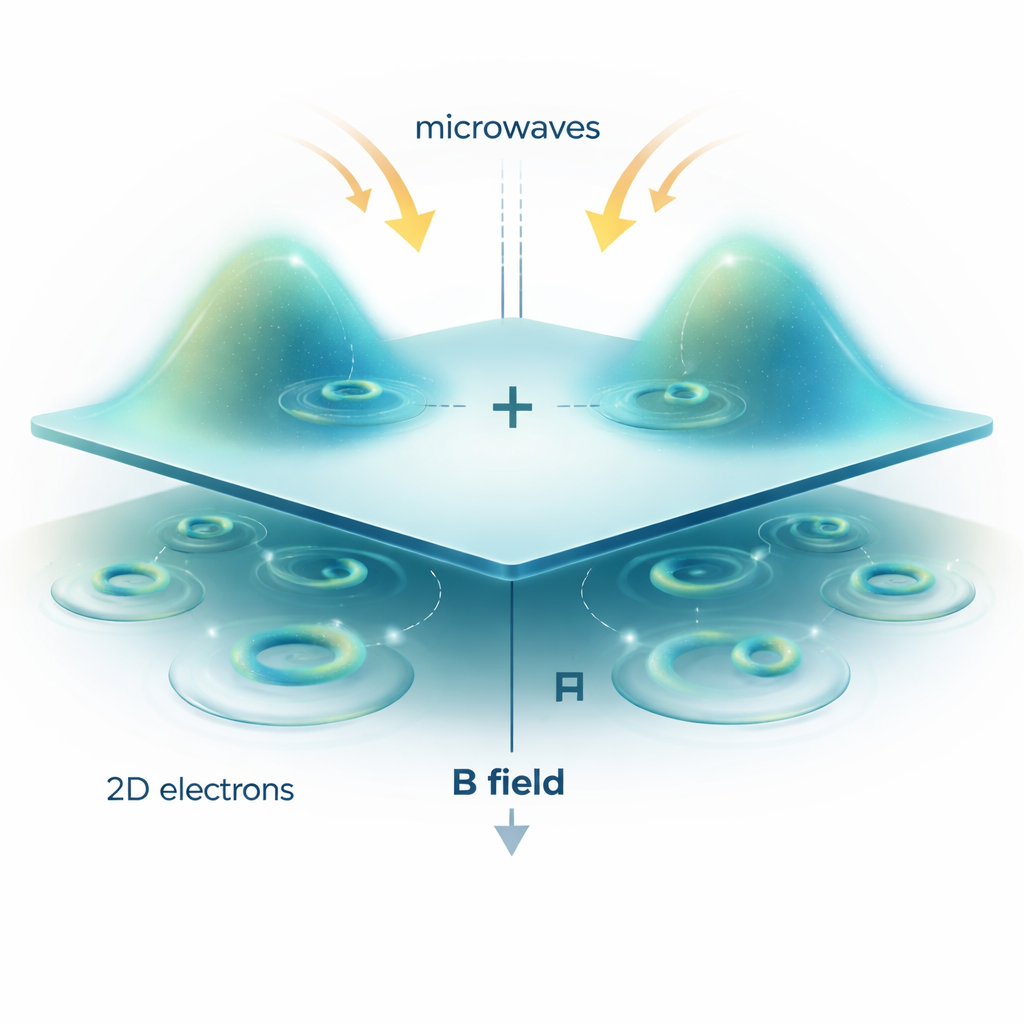
Electrons as gentle waves in a flat world
The study focuses on two-dimensional electron systems (2DES), where electrons are confined to move in a very thin layer inside semiconductor structures. At low temperatures (about half a degree above absolute zero) and with extremely high mobility—that is, electrons move with very little friction—these systems respond in unusual ways to microwaves and magnetic fields. Earlier experiments had already revealed microwave-induced resistance oscillations and even "zero-resistance" states, where current flows with almost no energy loss. But in the newest, ultraclean samples, researchers observed two striking surprises: a giant drop in resistance at low magnetic field, and a sharp resonance peak that appears not at the expected cyclotron frequency, but at exactly twice that value.
From simple waves to quantum "cat" states
To explain these anomalies, the author builds on the idea of coherent states—smooth, minimum-uncertainty wave packets originally introduced to describe the quantum version of a vibrating spring of light or matter. In a weak magnetic field, the electron orbits in the 2D layer can be described by such coherent states. When conditions are right in a very pure sample, these states can combine into superpositions: effectively, one electron wave packet being in two opposite positions at once. When two such packets with equal size and opposite phase are added, one obtains what are known as Schrödinger cat states, with two types: "even" and "odd." In both cases, the whole superposition oscillates back and forth, but as a combined object it wiggles at twice the basic orbital frequency.
Constructive waves, destructive waves, and vanishing resistance
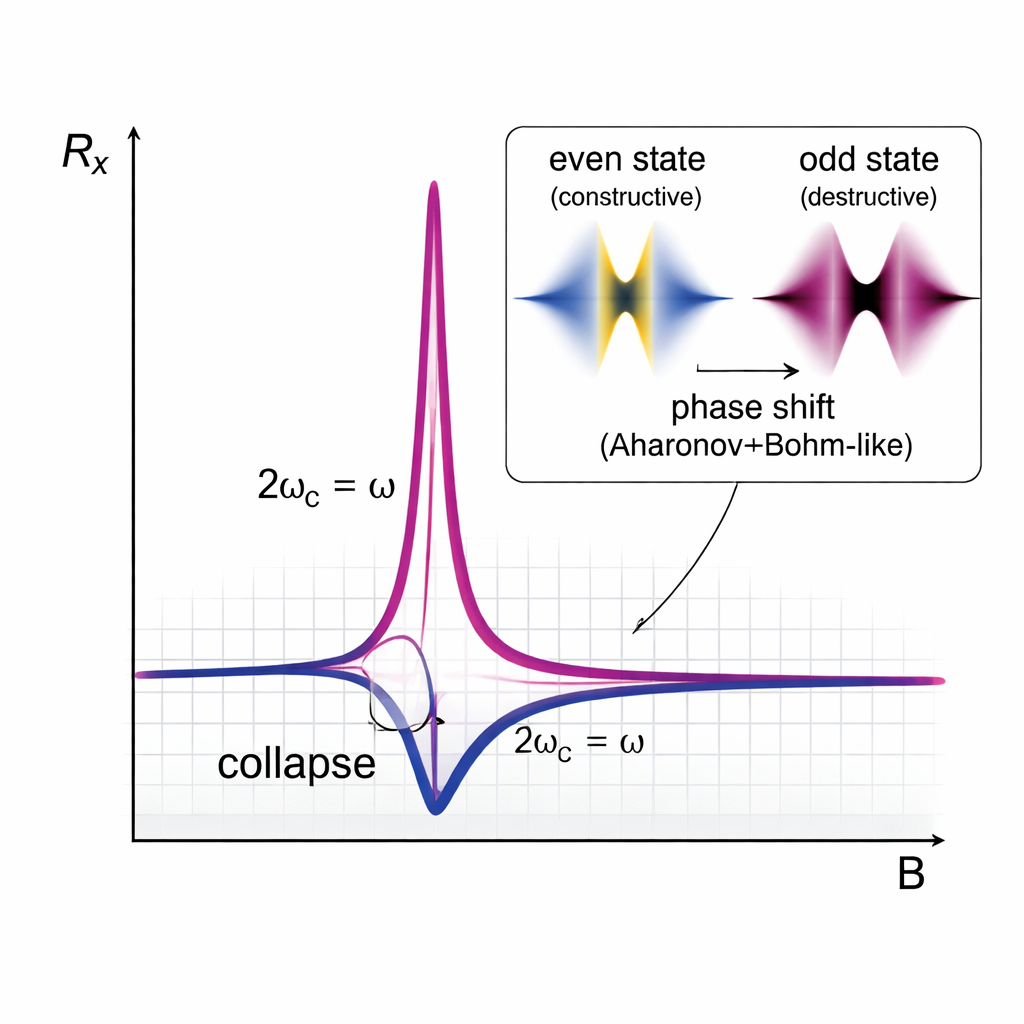
The key difference between even and odd cat states lies in how their wave patterns interfere. For even states, when the two wave packets overlap, they reinforce each other at the center, creating a sharp peak in the probability of finding an electron—this is constructive interference. For odd states, the opposite happens: the waves cancel out at the center, leaving a hole in the probability distribution—destructive interference. The author calculates how electrons in these states scatter off charged impurities, which is what normally gives rise to electrical resistance. The math shows that when odd cat states are involved, the relevant scattering processes are effectively blocked: a crucial integral that measures scattering strength becomes zero. As a result, the flow of electrons encounters far less resistance, naturally explaining the observed near-collapse of magnetoresistance in ultraclean samples.
Hidden rhythms and shifted peaks
Because cat states oscillate as a whole at twice the usual frequency, they respond differently to microwaves. The model shows that the overall amplitude of the resistance signal becomes resonant when the microwave frequency matches twice the cyclotron frequency rather than the usual single value, shifting the main resonance peak to the second harmonic. At the same time, the positions of the smaller resistance oscillations as the magnetic field is varied remain tied to the original frequency, just as in lower-quality samples. To link even and odd cat states, the author invokes a geometric phase effect reminiscent of the Aharonov–Bohm phenomenon: as the wave packets move around in the magnetic environment, they pick up a relative phase of π, periodically converting even states into odd ones and back again. The theory is further extended to more complex "three-component" cat states, which would push the resonance peak to three times the basic frequency, a prediction for even cleaner samples.
Outlook for quantum devices
In plain terms, this work shows that when electrons in an ultra-clean, flat semiconductor are cold enough and gently driven by microwaves, they can organize into quantum superpositions that strongly suppress scattering and shift the natural resonance of the system. These Schrödinger cat–like states offer a unified way to understand puzzling measurements of resistance in ultrahigh-mobility samples. More importantly, they suggest that such two-dimensional electron systems behave like controllable collective wave modes—bosonic-like excitations—that might someday be harnessed for quantum information processing, much as light fields and trapped ions are used today.
Citation: Iñarrea, J. Quantum superposition in ultra-high mobility 2D photo-transport. Sci Rep 16, 5669 (2026). https://doi.org/10.1038/s41598-026-36491-5
Keywords: Schrödinger cat states, two-dimensional electron systems, magnetoresistance, microwave-induced resistance oscillations, quantum computing platforms