Clear Sky Science · en
Intuitionistic fuzzy approach based on correlation coefficient and signless Laplacian energy with applications
Choosing Wisely When Information Is Fuzzy
Big decisions—such as investing in an electric car, a new technology, or a public project—are rarely made with perfect information. Experts may only be partly sure, may disagree, or may hesitate because the future is uncertain. This article presents a mathematical toolbox designed to capture that hesitation and disagreement more faithfully, so that groups can make choices that are both transparent and robust when the facts are fuzzy.
Why Ordinary Averages Fall Short
Most decision methods assume that each option can be scored cleanly on a scale, then averaged or weighted to produce a ranking. In reality, experts often think in terms like “almost good,” “probably not,” or “I’m not sure.” Traditional fuzzy logic allows people to say how strongly something belongs to a category, but it does not clearly express non‑acceptance and doubt at the same time. The authors build on a richer idea called an “intuitionistic fuzzy graph,” where every connection carries three pieces of information: how much experts support it, how much they oppose it, and how unsure they are. This gives a more lifelike picture of messy human judgments.
Blending Structure and Similarity
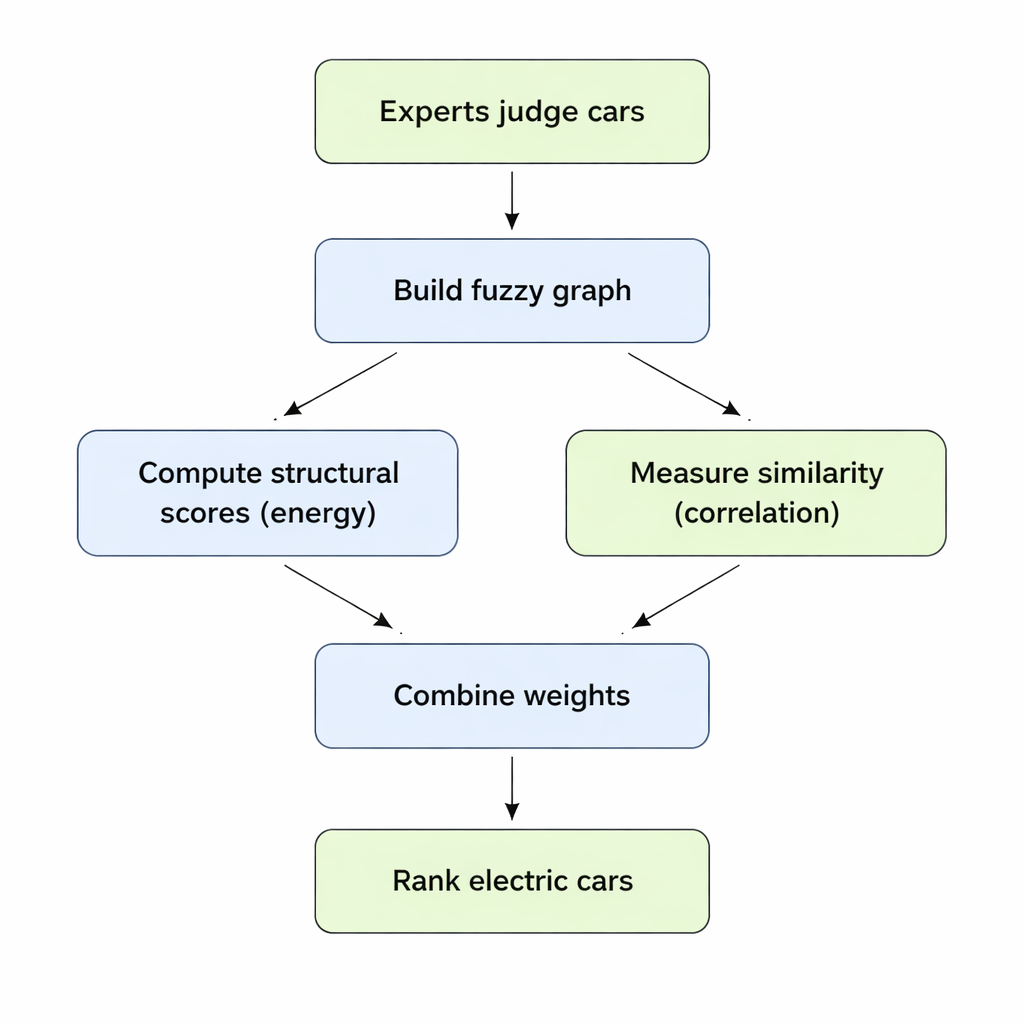
Once expert opinions are encoded in this graph form, the question becomes how to turn that structure into a fair ranking of options. The paper combines two complementary lenses. The first lens looks at the shape of the graph itself using a quantity called “signless Laplacian energy,” which can be thought of as a structural score: options that sit in stronger, more supportive patterns in the network receive more weight. The second lens examines how alike different options are, using a correlation‑style measure that tells us when alternatives are judged in similar ways. By merging these two views—structure and similarity—the framework avoids leaning too heavily on either raw averages or purely statistical comparisons.
From Expert Opinions to Final Rankings
The authors describe a step‑by‑step process for using their method in group decision‑making. Experts first rate each option (such as several electric car models) against key factors like driving range, safety, and price, using intuitionistic fuzzy numbers that encode support, opposition, and hesitation. These judgments form a network for each factor, from which structural energy scores are computed. The energy values are then turned into objective weights for the criteria, reducing the need for ad‑hoc, subjective importance ratings. Separately, correlation measures capture how similarly each pair of options is perceived. The method blends these ingredients into overall scores through two slightly different procedures, both designed to be mathematically consistent but conceptually simple: one aggregates values into a single fuzzy score per option, and the other relies more directly on similarity to ideal and non‑ideal reference points.
Putting the Method to Work for Electric Cars
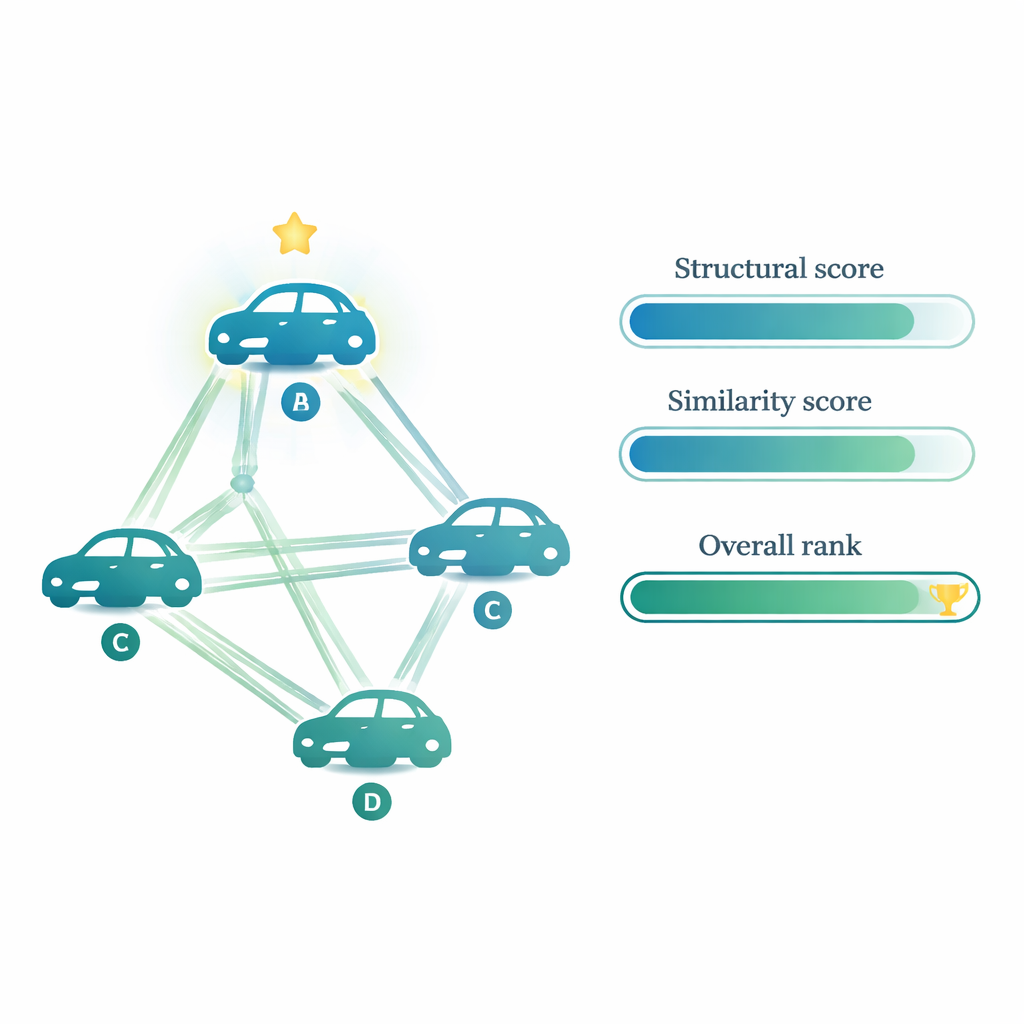
To show how the framework behaves in practice, the authors apply it to a stylized investment decision among four electric cars. Experts evaluate each model on range, safety features, and price, under uncertainty. The method then calculates structural energies for each criterion network, derives criterion weights, measures how similar the cars are to one another, and finally ranks them. Both procedures arrive at the same ordering: one car (labeled A) consistently comes out on top, while another (D) ranks last. Importantly, this ranking remains stable even when the balance between structural and correlation information is shifted within reasonable limits, suggesting that the outcome is not overly sensitive to tuning knobs in the model.
What This Means for Real‑World Choices
In plain terms, the study offers a way to turn fuzzy, hesitant expert opinions into clear, defensible rankings of competing options. By explicitly modeling support, opposition, and uncertainty, and by combining a view of how options are wired together with a view of how similar they are, the method yields decisions that are less arbitrary and more robust. While the paper’s example focuses on choosing an electric car, the same ideas could guide choices in areas like sustainable energy projects, financial products, or public infrastructure—anywhere groups must decide under uncertainty and want their reasoning to be both systematic and transparent.
Citation: Atheeque, A.M., Basha, S.S. Intuitionistic fuzzy approach based on correlation coefficient and signless Laplacian energy with applications. Sci Rep 16, 6315 (2026). https://doi.org/10.1038/s41598-026-36485-3
Keywords: decision-making under uncertainty, fuzzy graphs, electric vehicle selection, group decision methods, correlation and energy measures