Clear Sky Science · en
The oleaginous yeast Cutaneotrichosporon oleaginosum modifies corn stover alkali lignin
Turning Plant Waste into Useful Resources
Every year, agriculture leaves behind huge piles of stalks, leaves, and other tough plant scraps that are hard to recycle. Much of this material is made of lignin, a stubborn, wood-like substance that resists decay. If we could coax microbes to convert lignin into valuable products, we could turn farm waste into fuels, plastics, and specialty chemicals. This study explores an unusual helper for that job: an oil-producing yeast that appears to chemically reshape lignin, hinting at new ways to make bio-based products more sustainable. 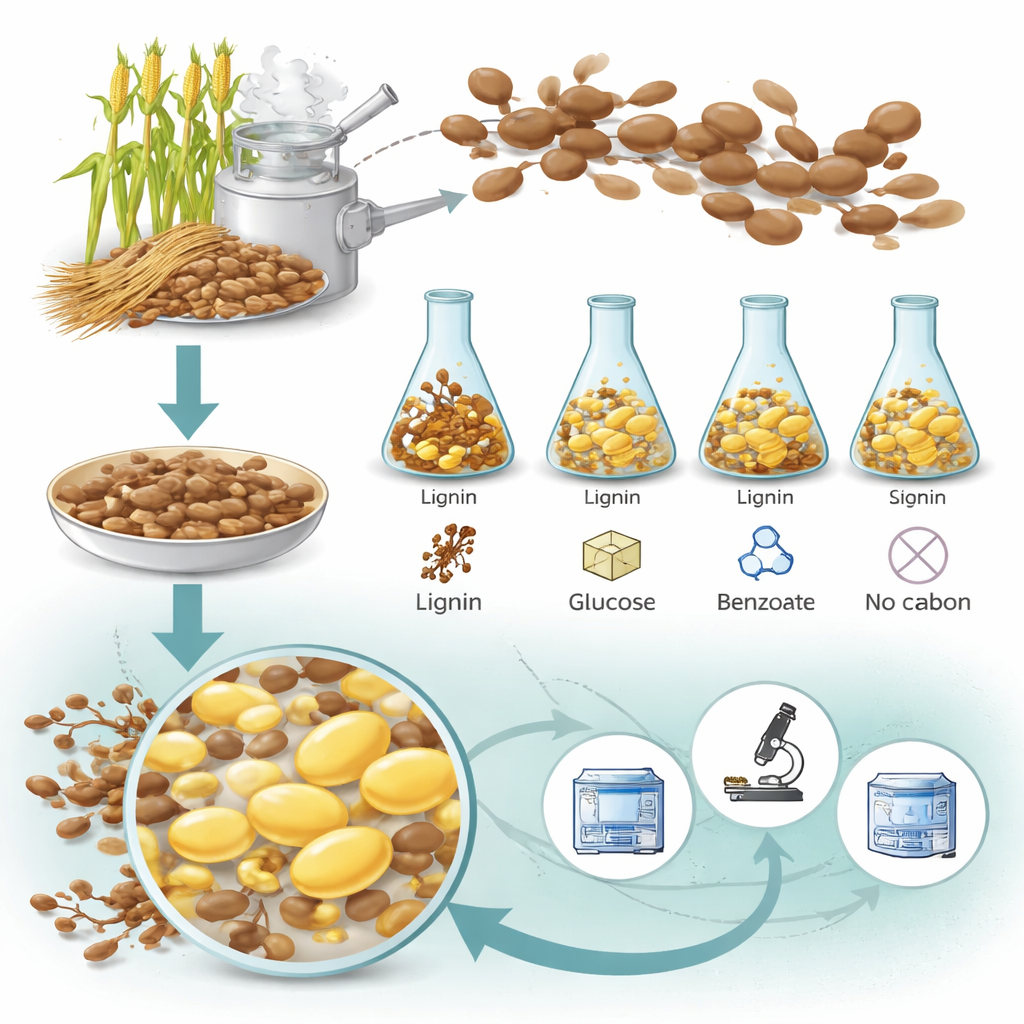
A Tough Nut in Plant Matter
Lignin is the natural glue that reinforces plant cell walls and makes stems and wood rigid. It also locks away a rich store of carbon in the form of aromatic rings—the same type of structures found in many industrial chemicals and fuels. While certain bacteria and filamentous (thread-like) fungi are known experts at breaking down lignin, yeasts have been largely overlooked. Yet yeasts are common in soil and rotting plant material, and some, including Cutaneotrichosporon oleaginosum, can accumulate large amounts of oils that could replace palm oil or petroleum-derived ingredients. The big question tackled here is whether this yeast can do more than merely survive around lignin—can it actually modify or partially digest it?
Growing Yeast on a Diet of Lignin
The researchers started with lignin extracted from corn stover, the leftover stalks and leaves from corn harvests that had already gone through a mild chemical pretreatment. They then grew the yeast under four conditions: with lignin as the only added carbon source, with sugar (glucose), with a simple aromatic compound (benzoate), or with no added carbon at all. By tracking cell growth, lignin content in the broth, and the yeast’s oil (lipid) levels, they found that the yeast did not grow well on lignin alone—its growth resembled the “no carbon” control. However, the amount of lignin in the broth dropped by about 10 percent over several days, signaling that the yeast was altering or consuming some of the lignin, even if it could not use it efficiently to build new cells.
Seeing Lignin Change at the Molecular Level
To find out what actually changed in the lignin, the team used a sophisticated form of nuclear magnetic resonance (NMR) spectroscopy that reveals how the building blocks in lignin are connected. They discovered that certain types of lignin units—especially so-called H-type units and specific linkages that tie the polymer together—were greatly reduced after the yeast grew in the lignin-containing medium. New chemical signals appeared that are consistent with bonds being broken and new functional groups forming. In simple terms, the yeast seems to selectively nick and rearrange parts of the lignin backbone. High-resolution fluorescence microscopy added another clue: when lignin was present, yeast cells glowed more brightly and showed altered internal structures, with fluorescence spread throughout the cell and along its outer envelope, suggesting that lignin pieces might be sticking to the cell surface or even entering the cell. 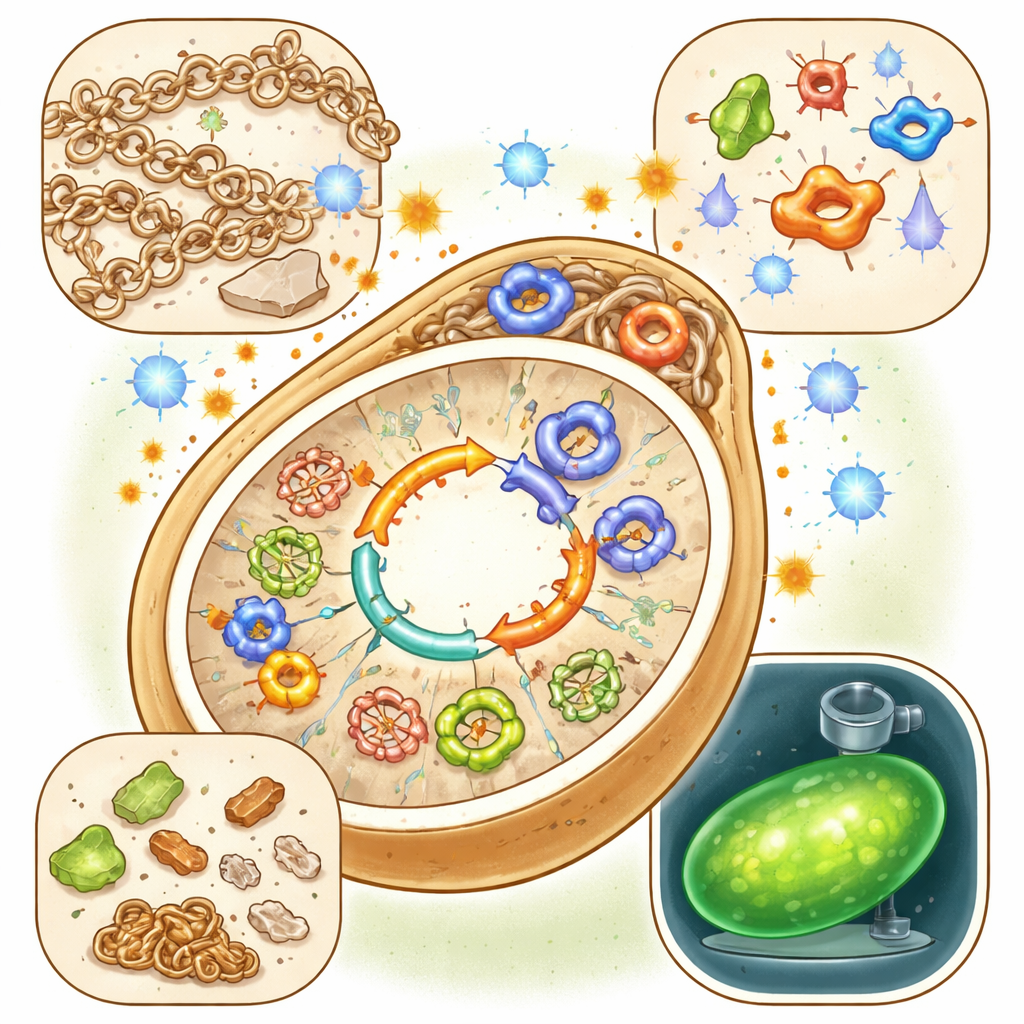
Inside the Yeast’s Molecular Toolset
To understand how the yeast accomplishes this chemical makeover, the researchers cataloged thousands of proteins present outside and inside the cells when grown on lignin versus sugar or no carbon. They saw clear shifts in protein expression. In the lignin condition, enzymes associated with oxidative chemistry—such as laccases, quinone oxidoreductases, ferric reductases, and oxidases that generate hydrogen peroxide—were more abundant. Together, these proteins can produce reactive oxygen species, highly reactive forms of oxygen that act like microscopic blowtorches, attacking the lignin polymer from the outside. The yeast also boosted a variety of transporters and internal enzymes known from other fungi to funnel small aromatic molecules into central metabolic pathways, ultimately feeding into energy-generating cycles instead of sugar-based routes like glycolysis.
Implications for Greener Biorefineries
Although this yeast cannot yet thrive on lignin as its main food source, the study shows that it can meaningfully reshape lignin’s structure and switch on a specialized toolkit for handling lignin-derived aromatics. For a layperson, this means the yeast can begin to “chew” on one of nature’s hardest materials and dispose of some of the resulting byproducts. These insights open the door to engineering yeasts that combine strong lignin-modifying abilities with high oil production, creating new biofactories that turn plant waste into fuels, lubricants, and chemical ingredients. The work also highlights how much remains to be learned about yeast–lignin interactions, and points to future experiments to confirm lignin uptake, track intermediate molecules, and fine-tune the oxidative chemistry that powers this microscopic recycling system.
Citation: Gluth, A., Pu, Y., Hu, D. et al. The oleaginous yeast Cutaneotrichosporon oleaginosum modifies corn stover alkali lignin. Sci Rep 16, 5656 (2026). https://doi.org/10.1038/s41598-026-36483-5
Keywords: lignin degradation, oleaginous yeast, corn stover, bio-based fuels, microbial bioconversion