Clear Sky Science · en
The effectiveness of the basal expansion plate in comparison with the traditional expansion plate during the slow maxillary expansion: a randomized clinical trial
Why widening the upper jaw matters
Many children have a narrow upper jaw, which can cause their back teeth to bite the wrong way, crowd the front teeth, and even affect breathing. Dentists often widen the upper jaw using removable plates, but this can sometimes tip the teeth outward and thin the supporting bone. This study tested a new type of plate, designed to spread the jaw more gently and safely, and asked a simple question: can we widen a child’s smile without sacrificing the bone that holds the teeth?
A new twist on a familiar plate
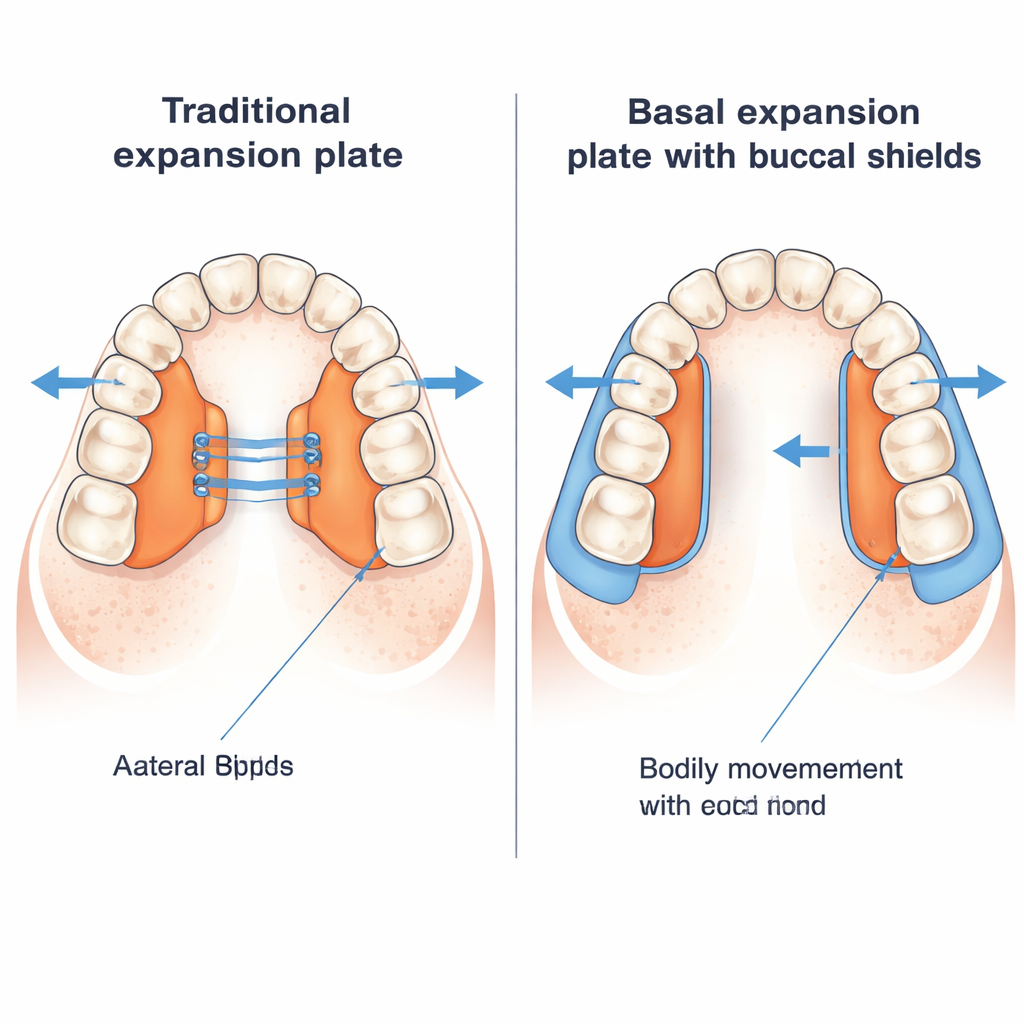
Traditional expansion plates use a small screw in an acrylic base to slowly push the upper teeth and jaw outward. The new device, called the Basal Expansion Plate, keeps the same basic idea but adds two “buccal shields” — smooth acrylic flanges that sit inside the cheeks. These shields are meant to harness natural muscle tension to encourage the whole tooth, including its root and the surrounding bone, to move together instead of simply tipping the crown outward. The researchers wanted to see whether this design could preserve or even build bone along the outer side of the upper teeth.
How the study was carried out
The trial included 40 children between 8 and 12 years old with a constricted upper jaw but otherwise similar bite problems. They were randomly assigned to one of two groups: 20 wore the new Basal Expansion Plate and 20 wore the standard traditional plate. Both groups followed the same slow expansion schedule, turning the screw a quarter turn once per week over about six months and wearing the plate 15 to 16 hours a day. Before and after treatment, the team took X‑rays from the front and side, as well as precise plaster models of the teeth, to measure jaw width, tooth position, and the height and thickness of the supporting bone.
What changed in teeth and bone
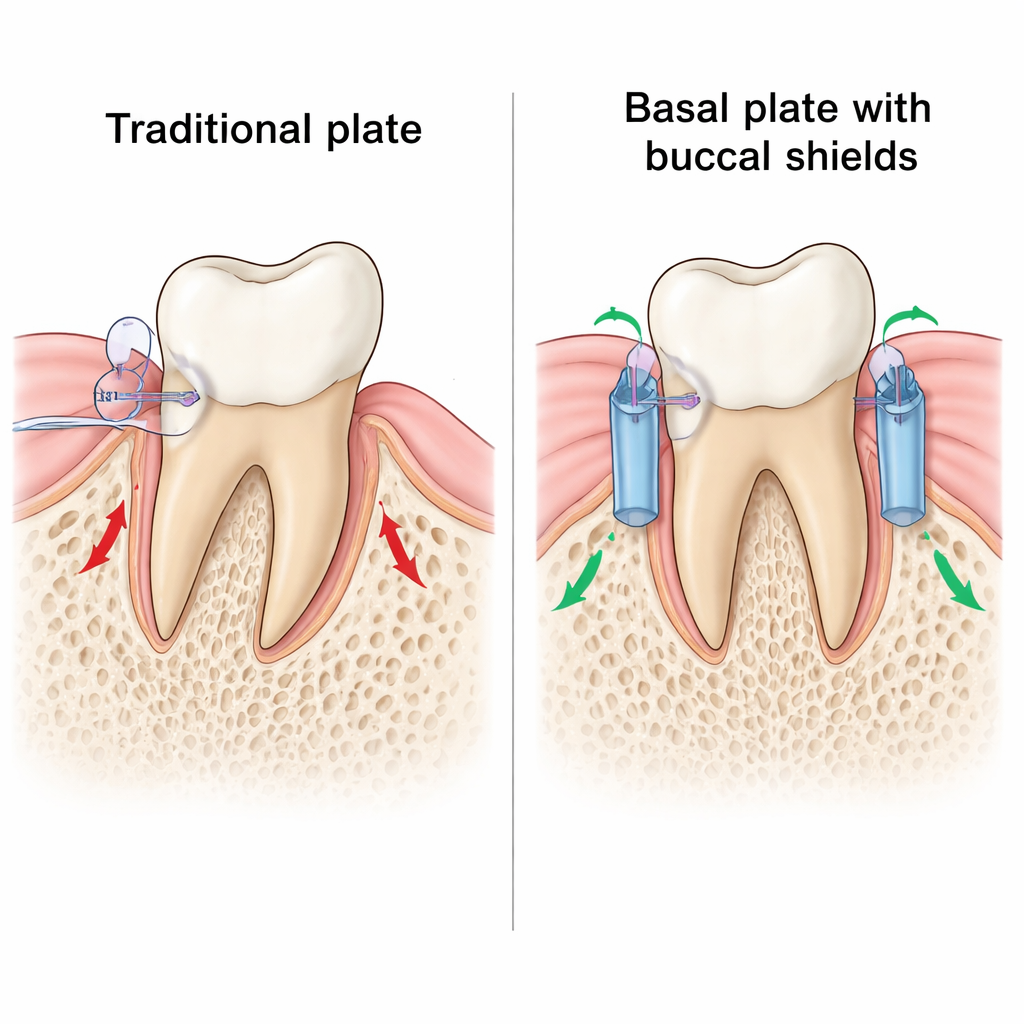
Both types of plates succeeded in widening the dental arch: the distance between canines and between molars increased in both groups, and the base of the upper jaw grew wider. However, the way the teeth moved was strikingly different. With the Basal Expansion Plate, the roots and crowns of the teeth shifted outward together, a pattern called bodily movement. In contrast, the traditional plate produced more tipping, where the tooth crowns leaned outward while the roots stayed closer to their original position. Measurements around the first molars showed that root spacing increased with the new plate but actually decreased with the traditional one, signaling more stable, bone‑friendly movement in the modified design.
Protecting the bone that holds the teeth
The bone along the outer (cheek) side of the upper teeth is especially vulnerable when teeth are tipped outward. In this study, the height of that bone, known as the alveolar process, rose on both sides of the jaw in children using the Basal Expansion Plate. In those wearing the traditional plate, it actually decreased, suggesting some bone loss. Overall alveolar width also increased with the new plate but shrank with the standard design. The researchers link these differences to the buccal shields, which likely create gentle, continuous tension on the bone covering, stimulating new bone formation as the teeth move. Importantly, no soft‑tissue injuries such as ulcers were seen in either group, and vertical facial growth patterns remained generally stable.
What this means for children’s orthodontic care
For families and clinicians, the study’s message is clear: not all jaw‑widening plates behave the same way. The Basal Expansion Plate appears to widen the upper jaw while moving teeth more safely within the bone, reducing the risk that the outer bone edge will shrink away. That could mean better long‑term stability and a healthier foundation for the teeth. Although the study was relatively small and followed patients only for six months, it suggests that a simple design change — adding buccal shields to a familiar plate — may offer a gentler, more bone‑preserving way to give growing children the space they need for a balanced bite and broader smile.
Citation: Ibraheem, S.A., Youssef, M. The effectiveness of the basal expansion plate in comparison with the traditional expansion plate during the slow maxillary expansion: a randomized clinical trial. Sci Rep 16, 5899 (2026). https://doi.org/10.1038/s41598-026-36482-6
Keywords: orthodontic expansion, basal expansion plate, maxillary constriction, buccal shields, pediatric dentistry