Clear Sky Science · en
Revolutionizing hyper spectral image denoising: a squeezenet paradigm
Sharper Pictures Beyond the Rainbow
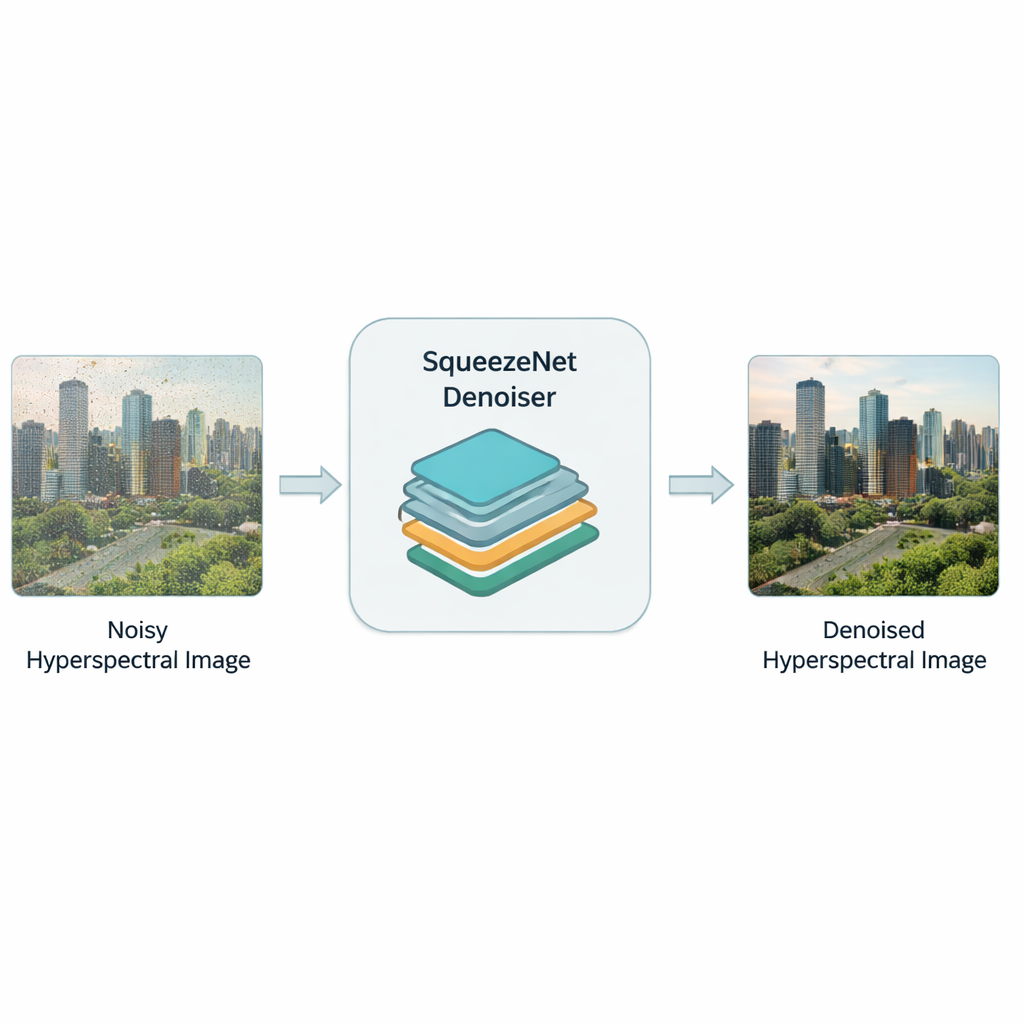
When satellites, drones, or lab cameras look at the world in hundreds of colors instead of just red, green, and blue, they capture hidden details about crops, pollution, buildings, and even art. But these rich "hyperspectral" images are easily spoiled by noise from the atmosphere and electronics, much like static on an old TV. This paper introduces a compact artificial-intelligence model that cleans up those images more effectively and efficiently, helping scientists and engineers trust what they see in this invisible spectrum.
Why So Many Colors Matter
Ordinary photos use three color channels, but hyperspectral images split light into dozens of narrow bands, some beyond what our eyes can see. Each pixel carries a tiny spectrum that reveals material properties—for example, whether a field holds healthy plants, dry soil, or polluted water. However, collecting such detailed data is hard. Sensors mounted on aircraft, satellites, or microscopes operate in changing light and temperature, and the signal they receive is often weak. As a result, several forms of noise creep in, including random speckles, bright or dark stripes, dead pixels, and sudden impulses. These distortions not only make images look grainy, they also mislead automated systems that rely on accurate spectral fingerprints.
Limits of Traditional Cleanup Methods
For years, researchers adapted tools from everyday photography to clean hyperspectral images, treating each wavelength band like a separate gray-scale picture. While this helps to reduce grain, it largely ignores how the many bands relate to one another, and can bend or blur the underlying spectra that scientists care about. More advanced deep-learning methods have appeared, but many are heavy, slow, or tuned for a single type of noise at a time. That makes them difficult to run on resource-limited platforms, such as small satellites or airborne systems, and less reliable when confronted with messy, real-world mixtures of noise.
A Lean Neural Network with a New Training Habit
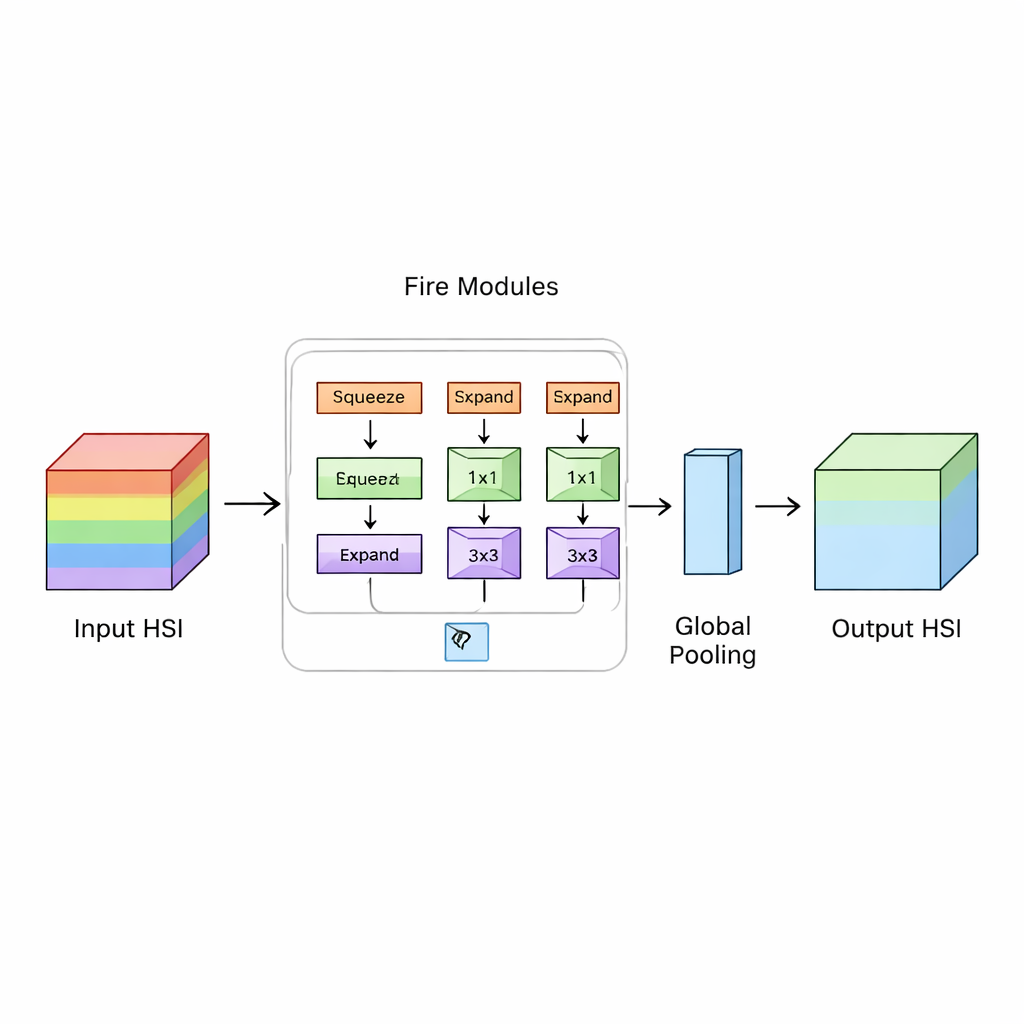
The authors propose using SqueezeNet, a lightweight deep neural network, as the engine for hyperspectral denoising. SqueezeNet is built from repeating "fire blocks" that first compress incoming information (the "squeeze" step) and then expand it through a pair of small filters that emphasize both local details and broader context. In this study, noisy hyperspectral images from the Harvard dataset serve as input, and the model learns to separate true scene structure from noise across all bands at once. Unlike bulkier networks and transformers, this architecture packs its knowledge into less than a megabyte of parameters, enabling quick processing and low power consumption without sacrificing accuracy.
Learning from Easy Noise to Hard Noise
A key innovation is how the network is trained. Instead of throwing every kind of distortion at the model from day one, the authors adopt an incremental "curriculum" strategy. The system first learns to correct simple random (Gaussian) noise at fixed strengths, then tackles a wider range of random noise levels, and finally confronts complex mixtures that include stripes, dead lines, and impulsive spikes. This staged exposure helps the network avoid poor solutions and stabilizes its learning, much like a student mastering basic exercises before facing tricky exam problems. The model’s performance is judged using four standard measures that check not just how sharp the images look, but also how faithfully their spectral signatures are preserved.
Cleaner Data, Better Decisions
Across a variety of noise conditions, the SqueezeNet-based model consistently delivers cleaner hyperspectral images than several leading classical and deep-learning methods. It achieves higher scores for sharpness and structural similarity, while producing smaller spectral errors, and does so at a fraction of the computational cost. For non-experts, this means that instruments watching Earth’s surface, industrial processes, or microscopic samples can send back more reliable information in real time, even from hardware with limited processing power. By marrying a compact network design with a smart training schedule, this work points toward faster, more accurate hyperspectral imaging that can be more widely deployed in environmental monitoring, agriculture, remote sensing, and beyond.
Citation: Nachimuthu, N., Murugesan, R., Dharmalingam, M. et al. Revolutionizing hyper spectral image denoising: a squeezenet paradigm. Sci Rep 16, 7419 (2026). https://doi.org/10.1038/s41598-026-36479-1
Keywords: hyperspectral imaging, image denoising, deep learning, remote sensing, SqueezeNet