Clear Sky Science · en
Identification of TMEM59L as a potential diagnosis, prognosis and immunotherapy biomarker for colon adenocarcinoma
Why This Matters for Patients and Families
Colon cancer is one of the most common cancers worldwide, and catching it early—or knowing how aggressive it is likely to be—can make the difference between life and death. This study explores a little-known molecule called TMEM59L and asks whether it could help doctors diagnose colon adenocarcinoma, predict how patients will fare, and even estimate who might benefit from modern immunotherapy drugs. For people worried about colon cancer, it offers a glimpse of how a simple blood test and tissue analysis might one day guide more personalized care.
A New Clue Hidden in Tissues and Blood
TMEM59L is a protein normally found in nerve cells, and scientists still know relatively little about what it does. By combining large genetic databases with real patient samples, the researchers discovered a striking pattern in colon adenocarcinoma. Inside tumor tissue, TMEM59L levels were lower than in nearby healthy colon, yet tumors with relatively higher TMEM59L tended to be more advanced and more dangerous. In blood, the pattern flipped: people with colon cancer had more TMEM59L in their serum than healthy volunteers. This unusual tissue–blood contrast suggests that TMEM59L could serve as a circulating signal that something is wrong in the colon, while its level inside the tumor hints at how aggressive the cancer may be. 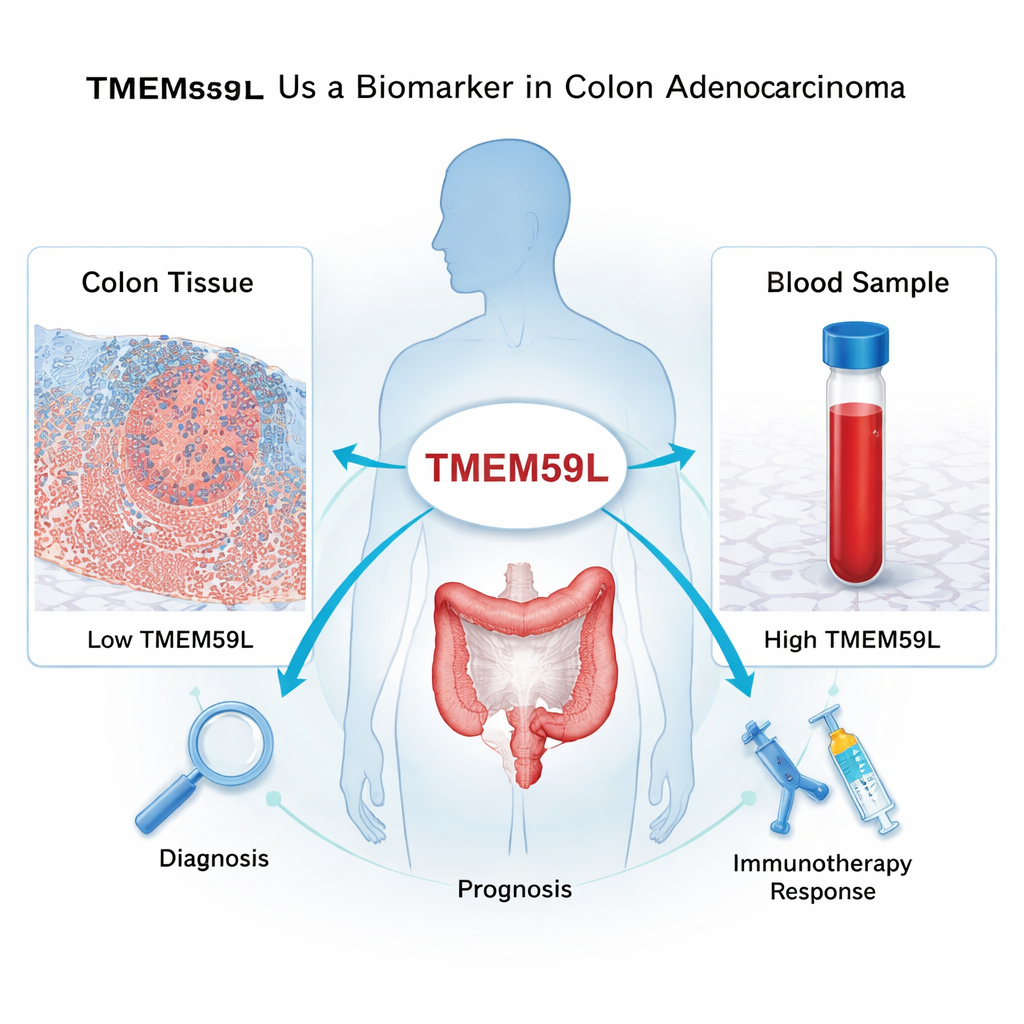
Reading the Cancer’s Future
To see whether TMEM59L actually tracks with patient outcomes, the team analyzed data from hundreds of people with colon adenocarcinoma. They split patients into high- and low-TMEM59L groups and followed their survival. Those with higher TMEM59L in their tumors were more likely to have spread to lymph nodes or distant organs and faced worse overall, disease-specific, and progression-free survival. Even after accounting for age and standard staging information, TMEM59L remained closely tied to more severe disease. The researchers then built a simple prediction chart, or nomogram, that combined TMEM59L levels with standard clinical factors to estimate a person’s chance of surviving one, three, or five years, potentially giving doctors a practical tool for risk assessment.
How TMEM59L May Help Tumors Grow and Spread
Looking under the hood, the scientists examined which genes tend to move in step with TMEM59L. They found that tumors with higher TMEM59L showed activity in pathways that control cell growth, tissue remodeling, and communication between cancer cells and their surroundings—systems commonly hijacked during cancer progression. In lab-grown colon cancer cells, artificially boosting TMEM59L made the cells divide more rapidly, move more easily, and invade through barriers. It also pushed the cells toward a state called epithelial–mesenchymal transition, in which they lose tight connections to neighbors and gain features that help them migrate and seed new tumors. Together, these findings paint TMEM59L as an active contributor to a more mobile, invasive cancer. 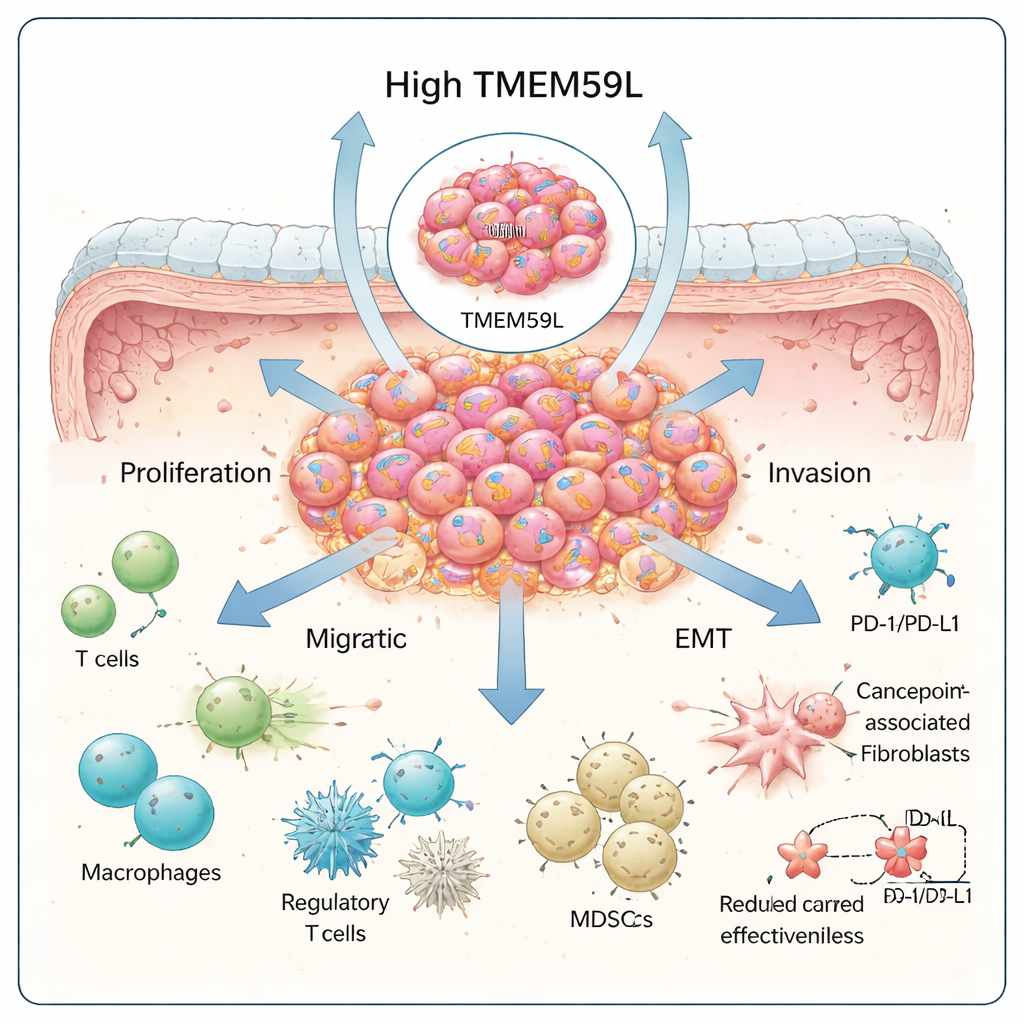
Shaping the Tumor’s Immune Neighborhood
Cancer does not grow in isolation; it is surrounded by immune cells and support cells that can either attack or assist it. The study showed that tumors with higher TMEM59L were linked to greater infiltration by many types of immune cells, as well as by cancer-associated fibroblasts, a kind of scaffolding cell that can shield tumors and dampen immune attacks. At the same time, TMEM59L levels rose alongside the activity of immune “brakes” known as checkpoint molecules, which cancers exploit to turn off immune responses. When the authors used a computer model to predict how patients might respond to checkpoint-blocking drugs, those with high TMEM59L in their tumors were less likely to be classified as responders, suggesting that TMEM59L may be a marker of an immunologically busy but ultimately suppressed tumor microenvironment.
What This Could Mean for Future Care
For non-specialists, the key message is that TMEM59L may act as both a warning light and a weather report for colon adenocarcinoma. A relatively simple blood test might help flag people who should undergo more detailed screening, while measuring TMEM59L in tumor tissue could help doctors judge how advanced and aggressive a cancer is and how likely it is to respond to immunotherapy. The work is still early, and larger studies and clinical trials are needed. But if confirmed, TMEM59L could become part of multi-marker panels that improve early detection, guide treatment choices, and ultimately personalize care for patients facing colon cancer.
Citation: Wang, W., Jia, W., Du, Y. et al. Identification of TMEM59L as a potential diagnosis, prognosis and immunotherapy biomarker for colon adenocarcinoma. Sci Rep 16, 5765 (2026). https://doi.org/10.1038/s41598-026-36478-2
Keywords: colon cancer, biomarkers, immunotherapy, tumor microenvironment, epithelial–mesenchymal transition