Clear Sky Science · en
Enhanced paddy leaf disease detection using novel dual metaheuristic loss functions in generative adversarial networks with identity block preservation for thermal image augmentation
Why Rice Leaves and Heat Cameras Matter
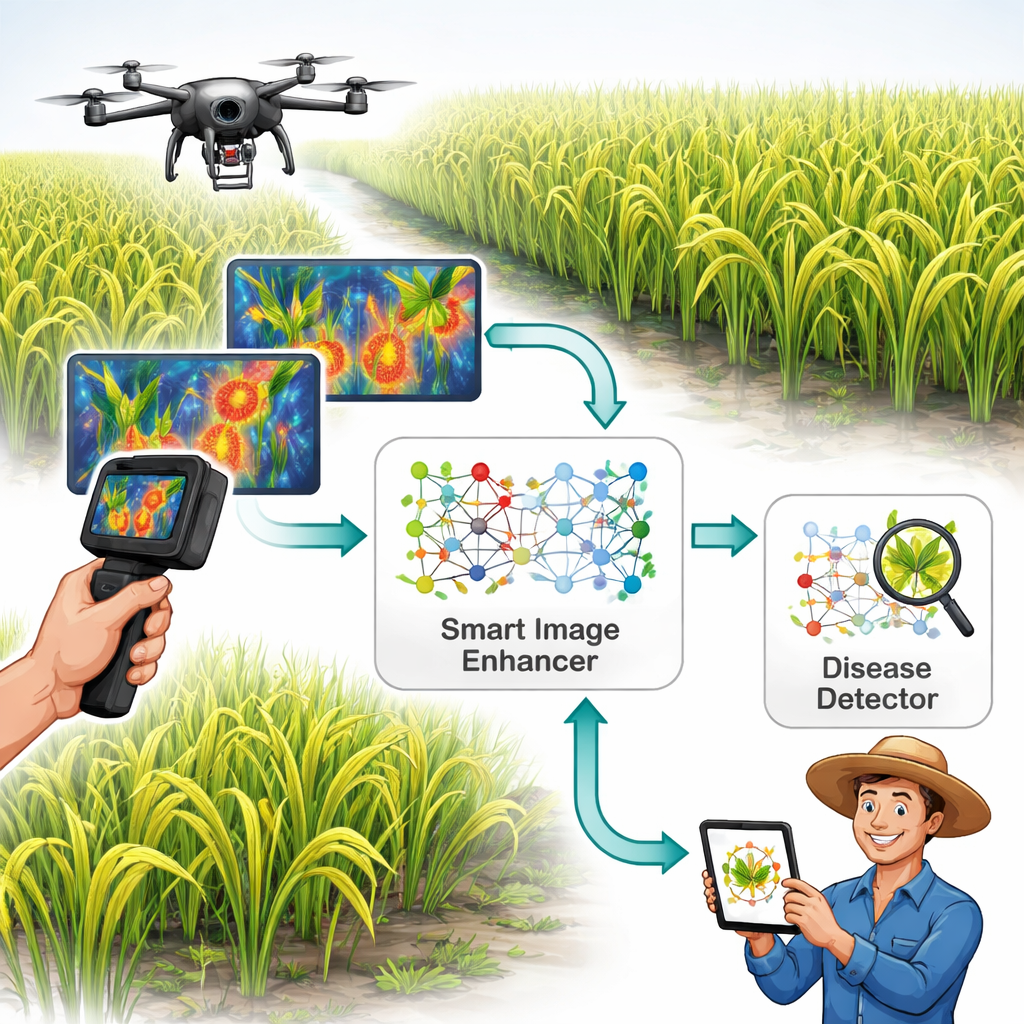
Rice feeds more than half of humanity, so even small improvements in protecting crops can have enormous impacts on food security. Many rice diseases start quietly inside the plant before brown spots or yellow streaks appear on the leaves. This study shows how combining thermal cameras—which see tiny temperature changes—with an advanced kind of artificial intelligence can spot paddy leaf diseases earlier and more reliably, helping farmers save yields while using fewer chemicals.
Seeing Invisible Illness with Heat
When a rice plant becomes sick, its temperature patterns change in subtle ways. Some areas of a leaf may warm up by just one or two degrees as infections or insect damage disrupt water flow and metabolism. The researchers built on this idea by using a handheld thermal camera to photograph 636 rice leaves in India, covering five major diseases plus healthy plants. Each image records temperature across the leaf surface, turning invisible heat differences into colorful maps that can reveal trouble before the human eye notices anything wrong.
Why More and Better Data Are Essential
Modern disease detectors are powered by deep learning—computer models that learn patterns from thousands of examples. But in real farms it is hard and costly to collect large, diverse thermal image datasets for every disease, at every stage, under every weather condition. Simple tricks like flipping or rotating images can only stretch the data so far, and often blur or distort the very temperature patterns that matter most. The authors set out to create synthetic thermal images that are both plentiful and trustworthy, so that classification models trained on them perform better in real fields, not just in the lab.
Nature-Inspired AI that Respects the Signal
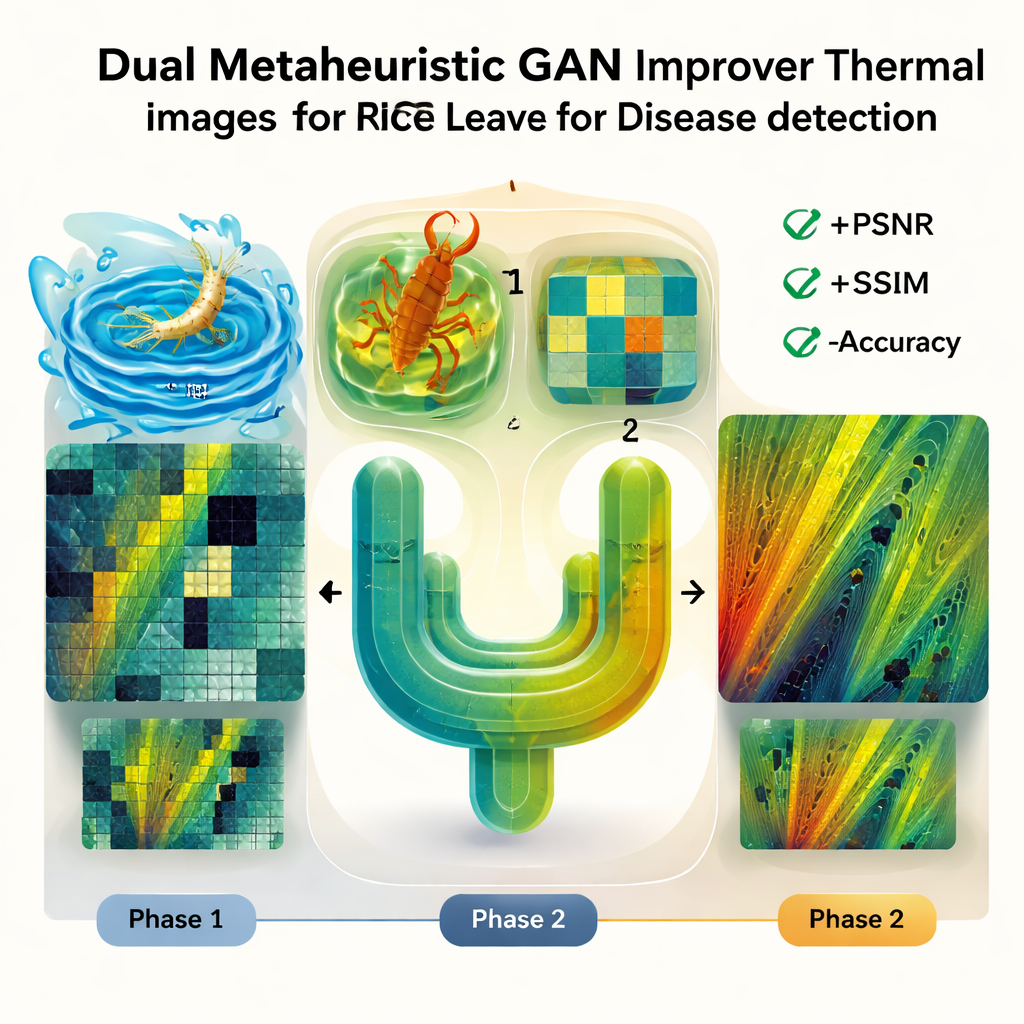
At the heart of the work is a generative adversarial network (GAN), a type of AI that learns to create new images that look real. Instead of using standard training rules, the team replaced the usual loss functions with two bio-inspired optimization routines. One, modeled on the hunting behavior of phantom midge larvae (Chaoborus), focuses on “filling in” missing or noisy pixels and preserving smooth but realistic temperature gradients across the leaf. The other, inspired by Australian crayfish defending and foraging in their territory, concentrates on the relationships between neighboring pixels so that hot and cool regions line up in a physically plausible way. Identity “shortcut” blocks are woven through the network so that essential disease signatures are carried forward unchanged even as the images are enhanced.
Sharper Synthetic Images, Stronger Diagnoses
Using this dual strategy, the GAN produced thermal leaf images that were markedly closer to real camera data than those from well-known generators such as StyleGAN2 and BigGAN. Quality scores like Peak Signal-to-Noise Ratio and Structural Similarity rose noticeably, and specialized measures confirmed that the crucial temperature gradients and disease patterns were better preserved. When these synthetic images were added to the training pool for several disease-detection models, accuracy climbed dramatically: a leading Vision Transformer model jumped from about 83% on the original data to nearly 98% with the new augmentation, with similarly strong gains for ResNet, EfficientNet, and DenseNet architectures.
From Computer Bench to Rice Paddy
The authors went beyond benchmarks and tested their system on more than 44,000 field images collected across four Indian states. The complete pipeline—thermal imaging, enhancement with the dual metaheuristic GAN, and automated classification—achieved about 95% accuracy in real-world conditions, with both false alarms and missed detections kept low. The method held up under different temperatures, humidity levels, times of day, and across several rice varieties and external datasets. In simple terms, the study shows that carefully designed, nature-inspired AI can generate “extra” thermal images that are not only realistic, but actually make disease detectors more dependable in the field, giving farmers an earlier and more accurate warning system against threats to one of the world’s most important crops.
Citation: Khalil, H.M., Elrefaiy, A., Elbaz, M. et al. Enhanced paddy leaf disease detection using novel dual metaheuristic loss functions in generative adversarial networks with identity block preservation for thermal image augmentation. Sci Rep 16, 6544 (2026). https://doi.org/10.1038/s41598-026-36477-3
Keywords: rice disease detection, thermal imaging, generative adversarial networks, agricultural AI, data augmentation