Clear Sky Science · en
Association between thyroid hormone sensitivity indices and renal function in community-dwelling euthyroid older adults: a cross-sectional study
Why your thyroid and kidneys matter as you age
As people grow older, keeping an eye on kidney health becomes increasingly important, because damaged kidneys can quietly raise the risk of heart disease and early death. At the same time, the tiny thyroid gland in the neck helps control how every cell in the body uses energy. This study asked a simple but important question: even when standard thyroid blood tests look “normal,” can more sensitive measures of thyroid action reveal hidden risks for poorer kidney function in older adults?
Taking a closer look at thyroid signals
Traditional thyroid tests usually stop at measuring two hormones in the blood: thyroid-stimulating hormone (TSH), released from the brain’s pituitary gland, and free thyroxine (FT4), produced by the thyroid itself. But the communication loop between brain and thyroid is more complex. New composite indices combine TSH and FT4 into single numbers that reflect how strongly the pituitary senses and responds to thyroid hormone. In this study, the researchers focused on three such indices—TFQI, TSHI, and TT4RI—which are thought to capture how “sensitive” the central control system is to thyroid hormone, even when hormone levels stay in the normal lab range.
Who was studied and how
The team analyzed 2,027 residents aged 65 and older from a community in Shanghai, all of whom had normal thyroid blood tests and no known thyroid disease. Participants answered questions about their health and lifestyle, underwent physical examinations, and had fasting blood samples taken. From these samples, the researchers calculated each person’s thyroid sensitivity indices and estimated kidney filtering capacity using a standard formula called the estimated glomerular filtration rate, or eGFR. An eGFR below 60 milliliters per minute per 1.73 square meters was considered reduced kidney function. Overall, nearly one in six participants fell into this lower-function group. 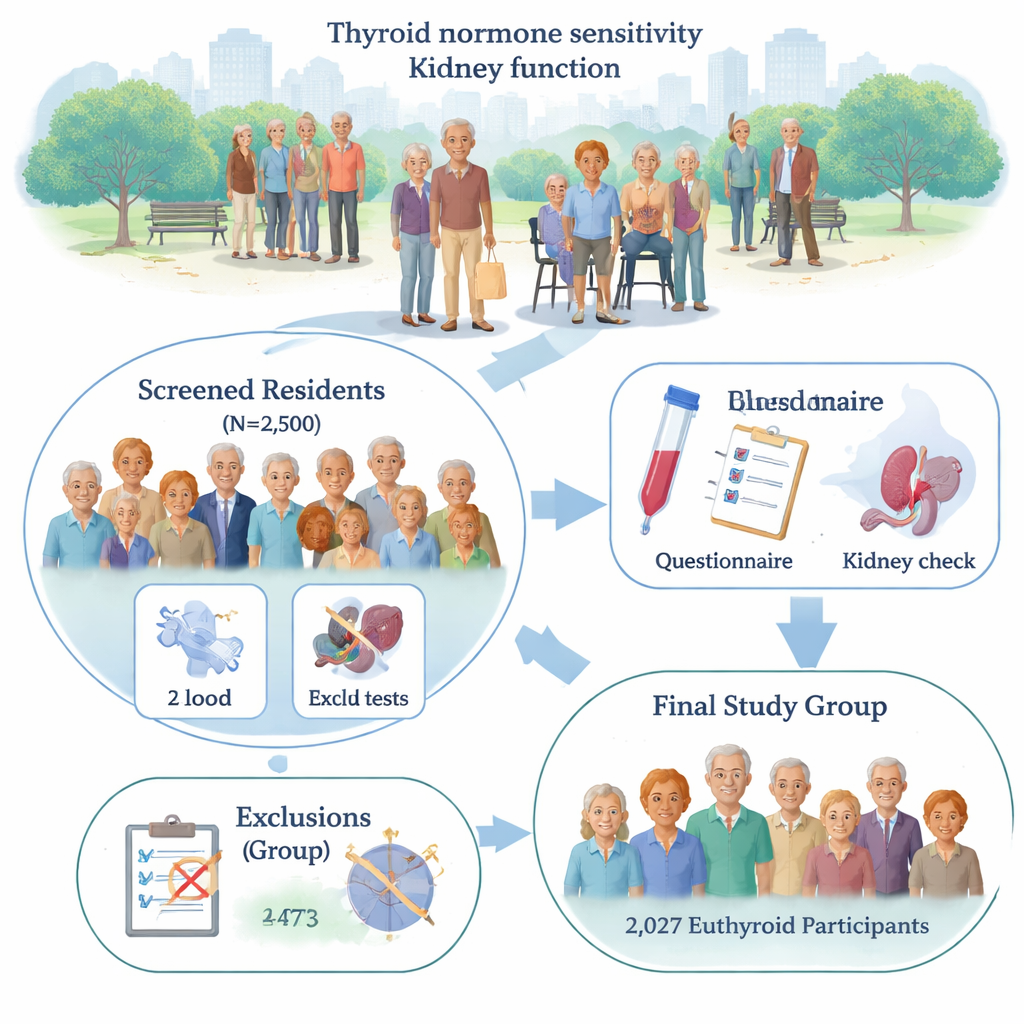
What the numbers revealed
Older adults with reduced kidney function tended to be older, more likely to have diabetes, and showed less healthy patterns in several blood markers. Importantly, they also had higher TSH levels and higher values for all three thyroid sensitivity indices, suggesting that their brains needed a stronger signal to maintain normal thyroid hormone levels. When the researchers used statistical models that accounted for age, sex, blood pressure, diabetes, body weight, smoking, alcohol use, exercise, and several blood fats and kidney-related chemicals, they consistently found that higher values of TFQI, TSHI, and TT4RI were linked to lower eGFR. In simpler terms, worse thyroid “sensitivity” went hand in hand with weaker kidney filtering, even after many other risk factors were taken into account.
Risk of poorer kidney function
The investigators also looked specifically at the odds of having clearly reduced kidney function. Two of the indices—TSHI and TT4RI—stood out. For each step up in these measures, the chance of having an eGFR below 60 rose noticeably, even after full adjustment for other health and lifestyle factors. TFQI showed a similar pattern in simpler analyses, but its link with reduced kidney function weakened once age and metabolic factors were included in the models. When the team drew smooth curves of the data, all three indices showed a roughly straight, downward relationship with eGFR: as central thyroid sensitivity worsened, kidney filtering steadily declined. These trends were broadly similar in men and women and across groups defined by weight, smoking, alcohol use, and the presence of high blood pressure or diabetes. 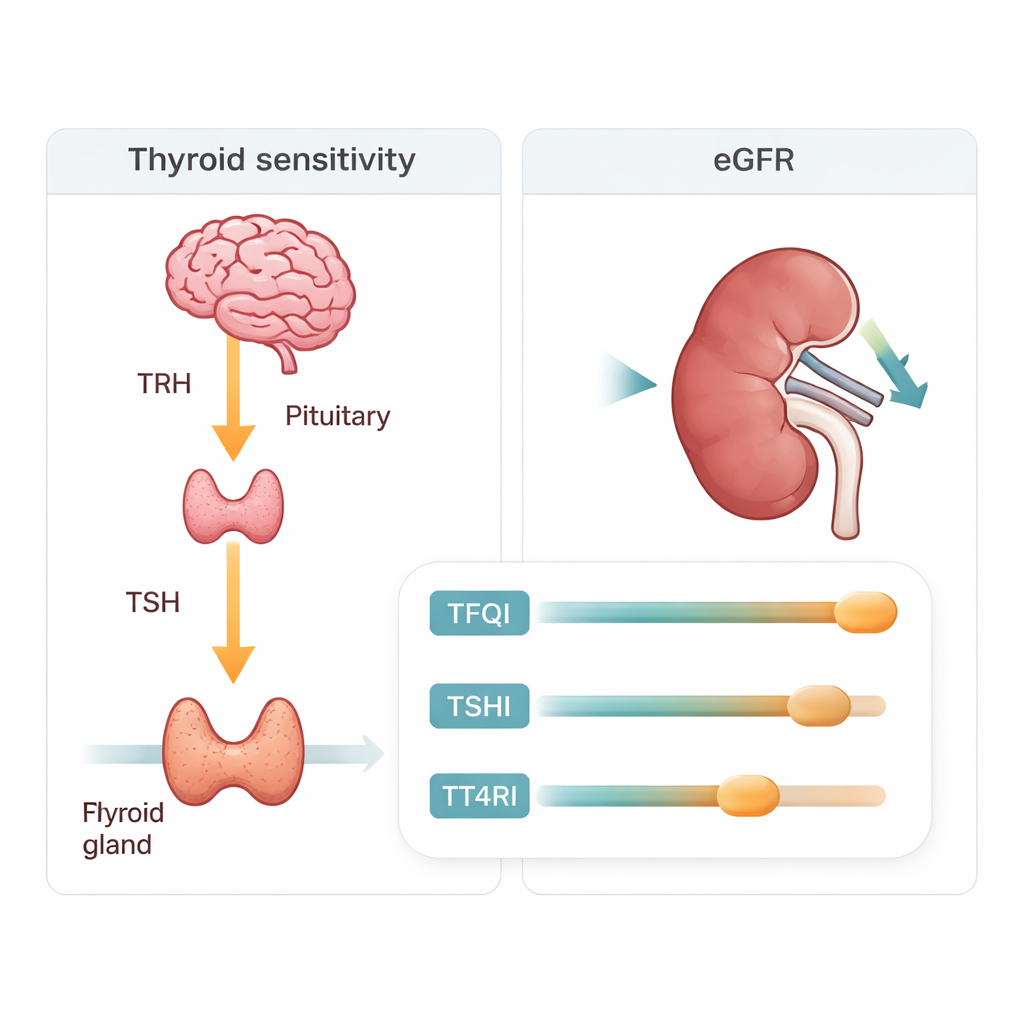
What it might mean for healthy aging
Because this was a snapshot in time, the study cannot prove that subtle thyroid changes cause kidney damage, or vice versa. However, it adds to a growing body of evidence that the communication between brain and thyroid may reflect deeper shifts in metabolism that also affect the kidneys. For older adults whose standard thyroid tests look normal, these newer indices may one day help doctors identify those whose kidneys are more vulnerable, long before symptoms appear. More long-term studies are needed, but this work suggests that fine-tuning our view of thyroid function could become a useful piece of the puzzle in protecting kidney health in later life.
Citation: Xie, J., Zhang, C., Fan, J. et al. Association between thyroid hormone sensitivity indices and renal function in community-dwelling euthyroid older adults: a cross-sectional study. Sci Rep 16, 5700 (2026). https://doi.org/10.1038/s41598-026-36476-4
Keywords: thyroid hormone sensitivity, kidney function, older adults, euthyroid, chronic kidney disease