Clear Sky Science · en
Water use and physiological ecological adaptation strategies of Caragana microphylla of different forest ages in hunshandake sandy
Why a desert shrub matters to everyday life
Across northern China, growing belts of hardy shrubs are one of the main defenses against dust storms and advancing deserts. This study looks closely at one such shrub, Caragana microphylla, which has been widely planted in the Hunshandake Sandy Land to hold sand in place and protect nearby towns and farms. By comparing young and older Caragana stands, the researchers reveal how these plants find and use scarce water and nutrients as they age—insights that help determine how long these green barriers can last and how they should be managed.
Life in a land of too little water
The Hunshandake region in Inner Mongolia is cold, dry, and windy, with far more water evaporating than falling as rain. In this harsh setting, Caragana microphylla has become a cornerstone species for controlling sand movement. It survives thanks to a package of special traits: it can cope with burial by shifting dunes, form partnerships with soil bacteria that help it capture nitrogen, and slowly improve the poor sandy soil around it. But as plantations age, questions arise: do older shrubs start drawing so much deep water that the soil dries out? And do their leaves and roots change in ways that affect how well they protect the land?
Tracing where shrubs drink
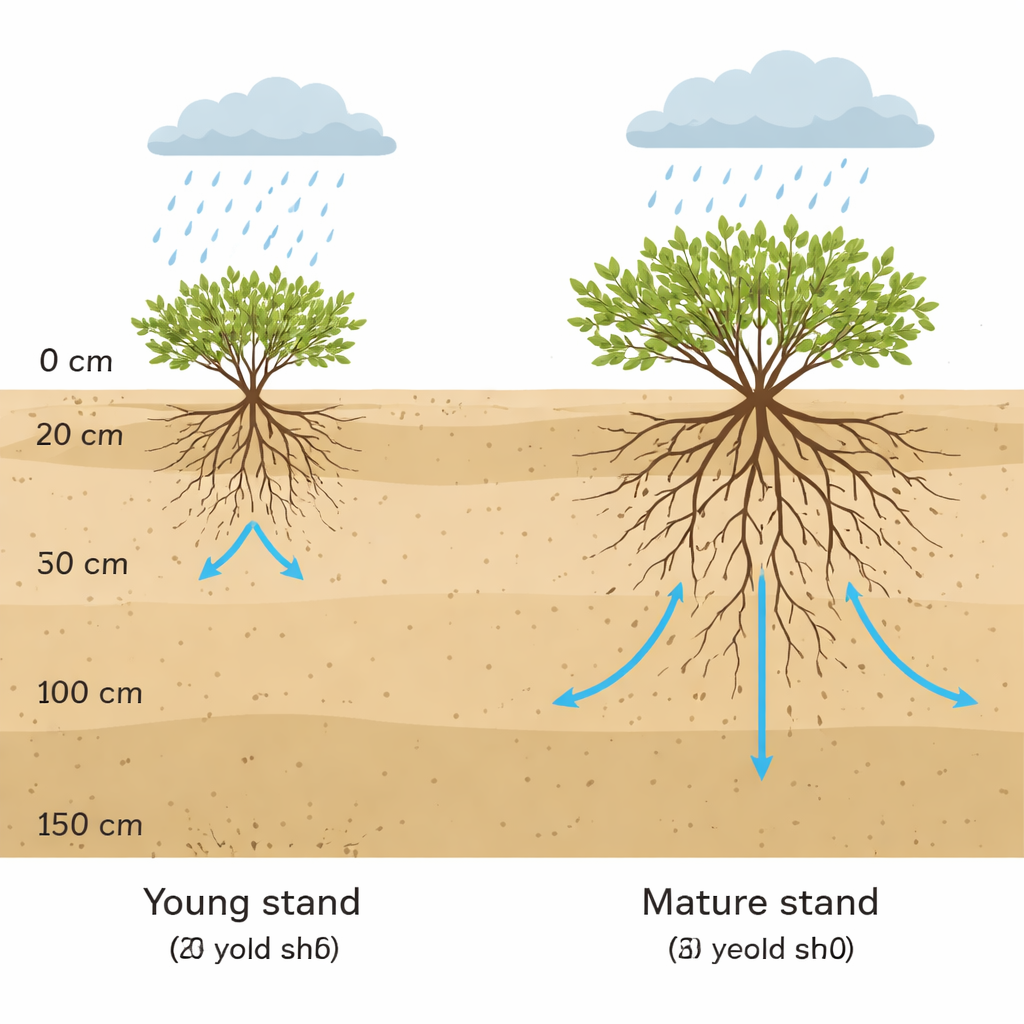
To see where the shrubs get their water, the team compared three‑year‑old and eight‑year‑old Caragana plants. They sampled water from different soil depths and from inside the stems, and then used natural "fingerprints" in the water—tiny differences in hydrogen and oxygen atoms—to match each plant’s water back to its source. The analysis showed that both young and older shrubs mainly relied on the top 20 centimeters of soil, where brief summer showers soak in. However, older shrubs also tapped significantly more water from 50 to 100 centimeters below the surface, thanks to deeper, more extensive roots. Young plants behaved more like fast opportunists, quickly using surface water pulses, while older plants drew from a mixed shallow‑and‑deep "portfolio" that could buffer them against dry spells.
How leaves balance growth and thrift
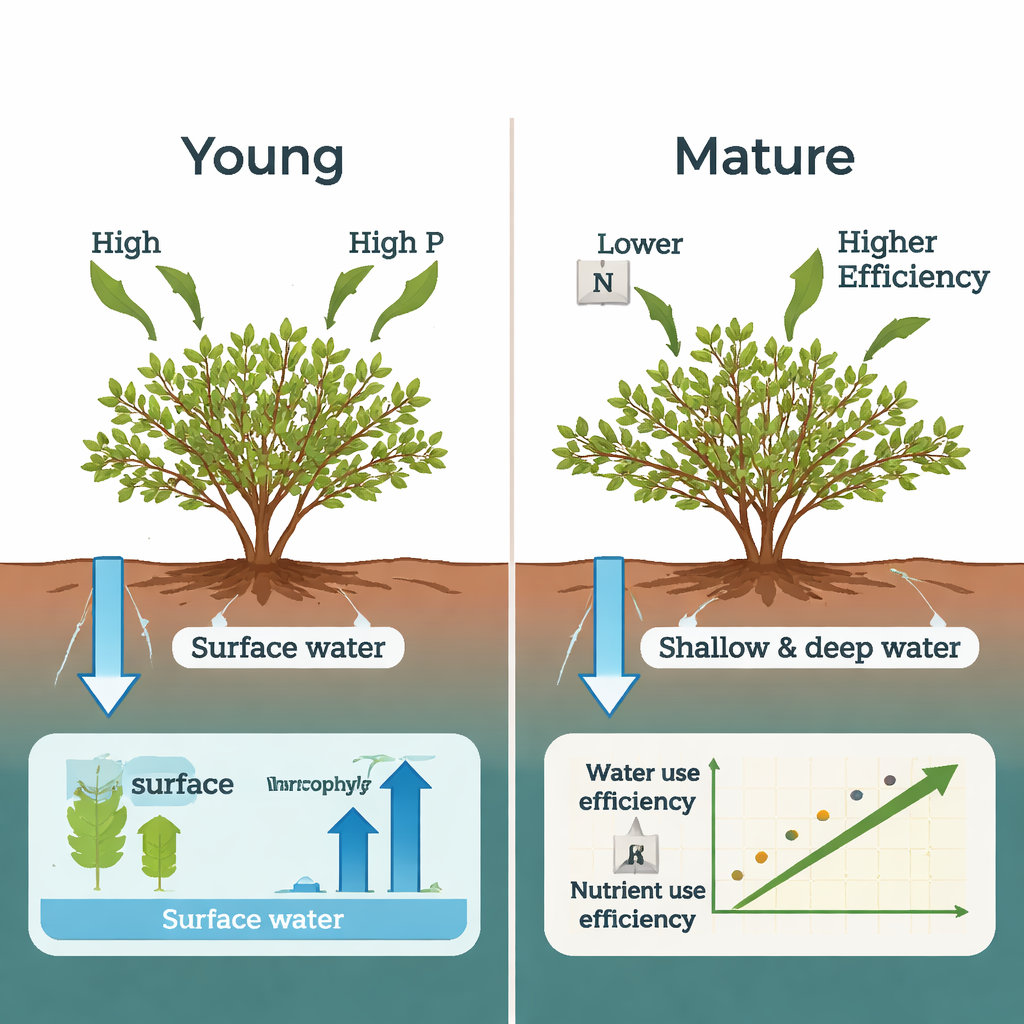
The scientists also examined leaves to understand how efficiently Caragana turns water and nutrients into growth. By measuring a carbon isotope in dried leaves, they estimated long‑term water‑use efficiency—how much carbon the plant gains for a given amount of water lost. Surprisingly, young and older shrubs showed similar long‑term efficiency, suggesting that both age groups had found workable solutions to the desert’s dryness. But their nutrient strategies differed: older shrubs had lower nitrogen and phosphorus levels in their leaves, while the ratios of carbon to these nutrients were higher. In other words, mature plants "stretch" each bit of nutrient further, fixing more carbon per unit of nitrogen or phosphorus. Leaf size per unit mass did not change much, but statistical tests showed that plants with denser leaves tended to use water more efficiently.
Water and nutrients working in sync
By relating leaf chemistry to water‑use efficiency, the study uncovered a tight link between how Caragana handles water and how it handles nutrients. Plants that showed higher water‑use efficiency also tended to have leaves richer in carbon relative to nitrogen and phosphorus, and lower specific leaf area, meaning thicker or tougher leaves. This pattern fits a broader ecological idea: young plants follow a "spend freely" strategy, with nutrient‑rich leaves and heavy reliance on surface water to grow quickly and establish themselves. As stands mature, they shift toward a "save and invest" strategy, with deeper roots, thriftier use of nitrogen and phosphorus, and leaves built to last longer while losing less water. Together, these changes help older shrubs survive in a chronically dry, nutrient‑poor environment.
What this means for managing desert forests
For land managers and policymakers, the message is that age matters. Caragana microphylla does not behave the same way throughout its life. Young stands are especially good at rapid sand fixation and early soil improvement, while older stands specialize in long‑term survival using deeper water and more efficient nutrient use. If plantations become too old and dense over large areas, they may gradually draw down deep soil moisture, raising concerns about long‑term water reserves. The authors argue that restoration plans should mix stands of different ages and keep track of how soil water changes over time. By matching planting and thinning schedules to the shrub’s changing strategies, it may be possible to maintain green, stable barriers against desertification without exhausting the hidden water that keeps them alive.
Citation: Gu, R., Zhang, L., Wan, Z. et al. Water use and physiological ecological adaptation strategies of Caragana microphylla of different forest ages in hunshandake sandy. Sci Rep 16, 5336 (2026). https://doi.org/10.1038/s41598-026-36472-8
Keywords: desertification control, Caragana microphylla, water use efficiency, stable isotopes, arid land restoration