Clear Sky Science · en
Reconstruction of temperature, precipitation, and identification of extreme climate events in high mountain Asia over 500 years using multi-method EnKF
Why the "Third Pole" Matters to All of Us
High Mountain Asia, the vast highland that includes the Himalayas and the Tibetan Plateau, is sometimes called the "Third Pole" because of its enormous stores of snow and ice. Rivers fed by this frozen water support more than a billion people downstream. Yet the region has been warming about twice as fast as the global average, with shrinking glaciers and more frequent floods and landslides. To know whether today’s changes are truly unprecedented—or part of natural ups and downs—scientists need to look far beyond the short span of thermometer records. This study reaches back 500 years to rebuild the region’s temperature and rainfall history and to pinpoint past episodes of intense cold, heat, drought, and wet spells.
Looking Back Half a Millennium
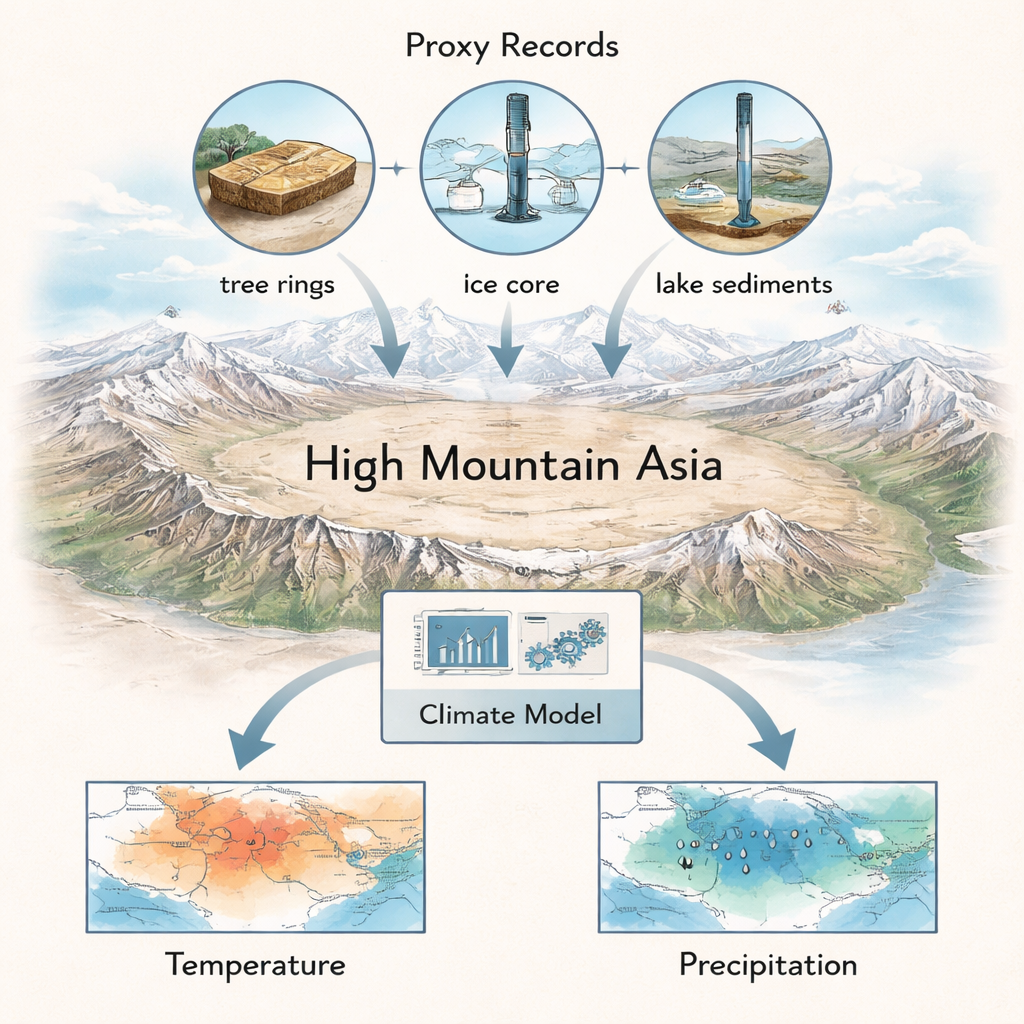
Weather stations in High Mountain Asia only go back about 150 years, and even those records are patchy. To extend the timeline, the researchers turned to natural archives that quietly record the climate year after year: tree rings, ice cores, cave deposits, and lake sediments. They assembled two large collections of these "proxy" records, one based on an existing international database and another expanded set that added nearly 100 more series scattered across the region. These data were combined with long computer simulations of Earth’s climate, using approaches borrowed from modern weather forecasting to produce complete maps of temperature and precipitation for each year from 1501 to 2000.
Blending Clues with Smart Algorithms
The team used three related data-assimilation methods, all based on the Ensemble Kalman Filter, a workhorse technique in weather prediction. In simple terms, the climate model offers many possible versions of past conditions, while the proxy data nudge those versions toward what actually happened. The three methods differ in how they choose and weight model states that best match the proxy evidence. By running all three methods with both proxy datasets, the scientists created six reconstructions. They then checked these against modern instrumental records and against withheld proxy records. The reconstructions tracked regional temperature swings well and captured the main rainfall changes, though precipitation proved harder to pin down than temperature.
From Little Ice Age Chill to Modern Warmth
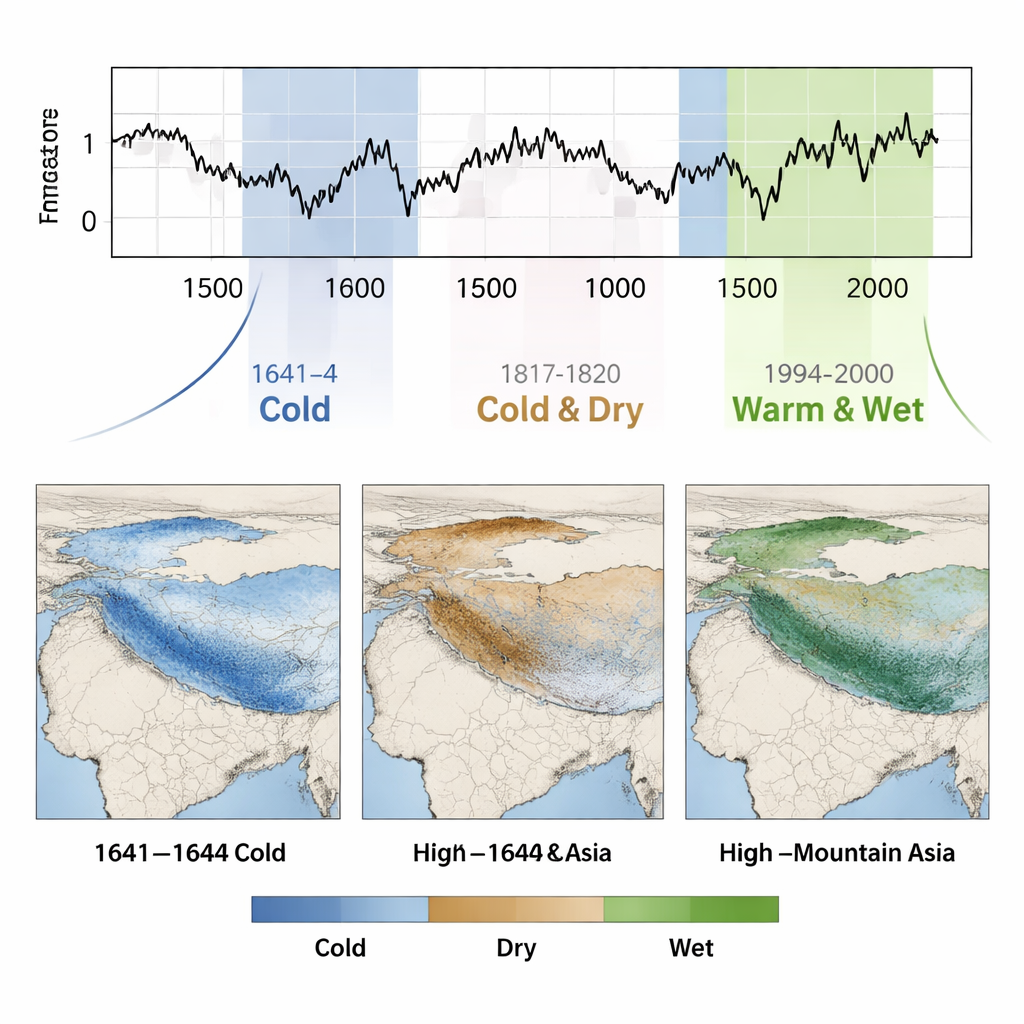
The 500-year record reveals a clear shift from the cooler conditions of the so‑called Little Ice Age to the pronounced warming of the 20th century. High Mountain Asia experienced several distinct cold phases, including a long cool spell from about 1620 to 1680 and a particularly harsh period in the early 1800s. Rainfall, in contrast, showed no simple long-term trend; instead it oscillated over decades between wetter and drier conditions. What stands out is the late 20th century, when warming accelerated and the region entered a sustained wet phase from the late 1980s through 2000. Across all six reconstructions, the timing of major swings in temperature and rainfall was remarkably consistent, underscoring the robustness of the results.
Discovering Past Climate Extremes
With annual maps in hand, the authors systematically searched for years and multi-year stretches that were far outside the usual range—both for cold and heat, and for drought and wetness. They found that strongly cold years made up about 11% of the record, while very warm years accounted for nearly 9%. Three standout events emerged. First, from 1641 to 1644, the region endured an intense, widespread cold spell, likely linked to a major volcanic eruption that dimmed sunlight and weakened summer monsoon rains in the southeast. Second, from 1817 to 1820, High Mountain Asia suffered a compound cold and dry event, again probably tied to volcanic activity (including the famous Tambora eruption), with severe cooling over much of the region and drought in key mountain ranges. Finally, from 1994 to 2000, the area experienced the longest sustained warm period in the 500-year record, coupled with unusual wetness, especially in the northwest.
What This Means for Today and Tomorrow
For non-specialists, the take-home message is that High Mountain Asia’s climate has always varied, sometimes sharply, but the recent decades stand out. The late‑20th‑century warm and wet episode is both unusually long and intense compared with the previous five centuries, even when judged against major natural disruptions such as volcanic eruptions. By providing detailed, map-based reconstructions of temperature and rainfall over 500 years, this work offers a powerful baseline for testing climate models and for judging how much recent change is driven by human activity rather than natural swings. That, in turn, can help planners and communities prepare for future shifts in water supply and climate-related hazards in one of the world’s most vital—and vulnerable—mountain regions.
Citation: Zhou, J., Chen, F., Zhu, Y. et al. Reconstruction of temperature, precipitation, and identification of extreme climate events in high mountain Asia over 500 years using multi-method EnKF. Sci Rep 16, 5610 (2026). https://doi.org/10.1038/s41598-026-36469-3
Keywords: High Mountain Asia, paleoclimate reconstruction, climate extremes, temperature and precipitation, Tibetan Plateau