Clear Sky Science · en
Stability analysis and numerical simulation of nonlocal extended epidemic models using positivity-preserving scheme
Why long-distance jumps matter in epidemics
When we think of disease spread, we often picture infections moving gradually from town to town. In reality, people travel by car, train, and plane, allowing pathogens to leap across regions in a single day. This paper develops a new computational method to capture that kind of long-distance, or "nonlocal," spread inside epidemic models. By blending advanced mathematics with efficient algorithms, the authors show how to simulate outbreaks that reflect real-world mobility patterns while keeping key quantities, such as population numbers, physically meaningful.
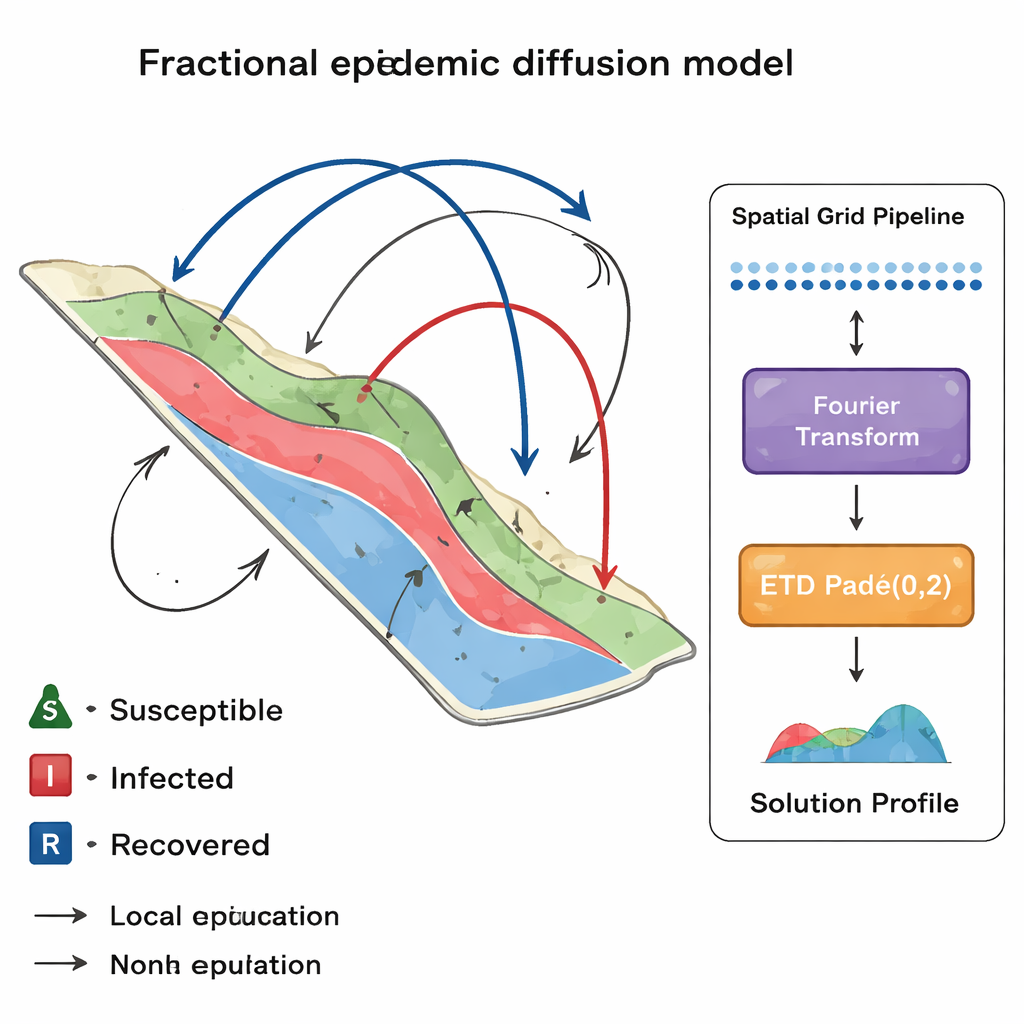
From local mixing to long leaps
Traditional epidemic models usually assume that individuals mix only with their close neighbors, mathematically described by standard diffusion. That picture breaks down in sparse or highly connected settings, such as rural regions linked by highways or air routes. Here, the authors replace classical diffusion with "fractional diffusion," a tool that allows infections to jump over long distances with a probability that follows a power law. In practical terms, the model can represent rare but important long trips that quickly seed new hotspots far from the original outbreak, changing when and where epidemic peaks occur.
Two familiar models, upgraded
The study focuses on two well-known epidemic frameworks: the SIR model, which divides the population into susceptible, infected, and recovered groups, and the SEIR model, which adds an exposed (infected but not yet infectious) class. Both are extended to include fractional diffusion in space, so that each group can move in a nonlocal way. The authors analyze the stability of these models—showing when a disease will die out or persist—and compute the basic reproduction number, the average number of new infections caused by a single case. These theoretical results connect directly to numerical experiments: when the reproduction number is below one, the disease-free state is stable; when it exceeds one, the models settle into an endemic state with ongoing transmission.
Keeping simulations realistic and well-behaved
Simulating fractional diffusion is mathematically demanding: the nonlocal operators are costly to compute, and naive methods can produce negative population values or unstable results. To address this, the authors design a numerical scheme that combines a Fourier spectral method in space with a special time-stepping strategy known as exponential time differencing. A key ingredient is a rational approximation, called Padé(0,2), chosen because it is both strongly damping (L-stable) and positivity-preserving. In everyday terms, the method smooths out stiff, rapidly changing components without introducing spurious oscillations and guarantees that compartment sizes—numbers of susceptible, infected, or recovered individuals—remain non-negative and conserve total population where appropriate.
Testing accuracy and exploring disease spread
The framework is validated on a reaction–diffusion problem with a known exact solution, showing third-order accuracy in space and second-order accuracy in time across different degrees of fractional diffusion. The authors then apply their method to fractional SIR and SEIR models with "hat-shaped" initial distributions, where most infections start around the center of a region. By varying the fractional order, they demonstrate how stronger nonlocal effects lead to faster spatial spread and earlier peaks. Sensitivity studies on parameters like the infection rate and mobility coefficients reveal how changing travel intensity or contact behavior shifts the system from disease-free to endemic regimes and alters the shape of infection waves across space and time.
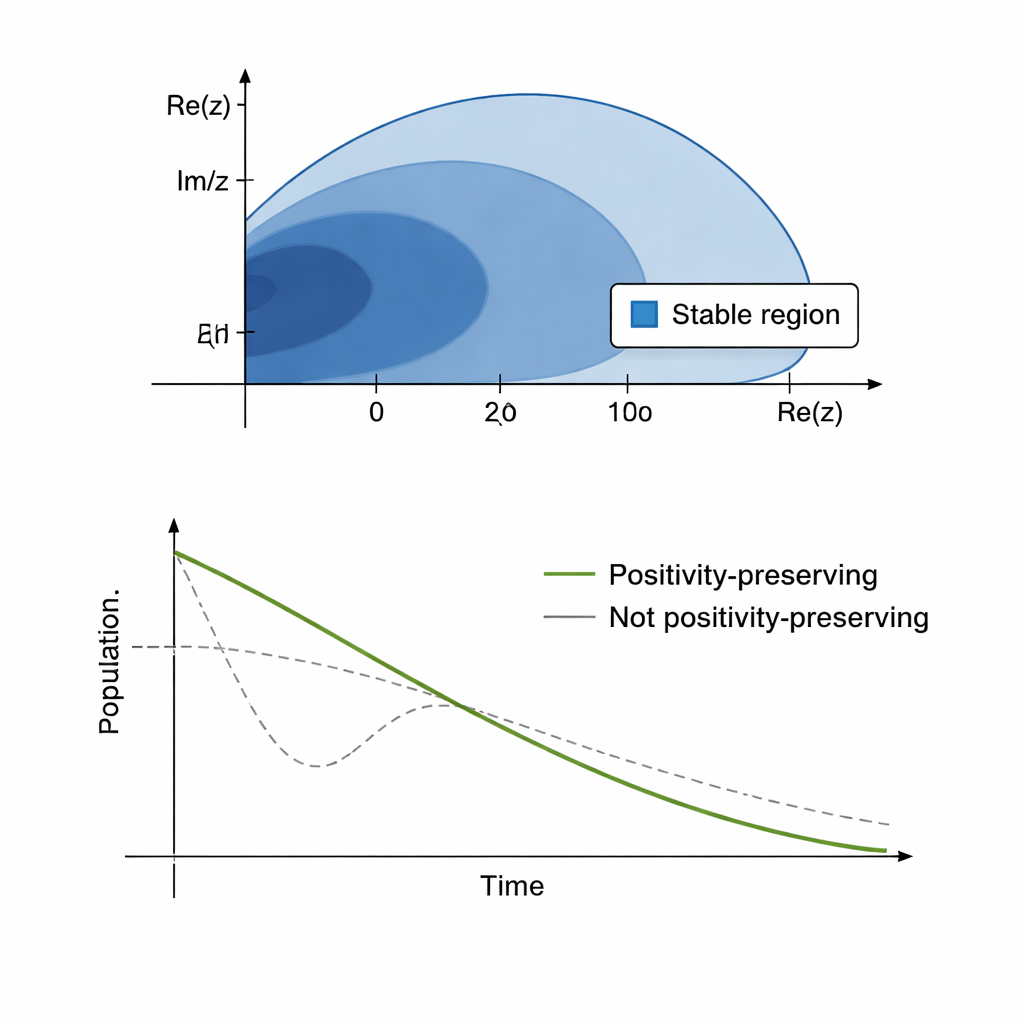
What the findings mean for outbreak modeling
Overall, the paper provides a stable, accurate, and efficient numerical toolkit for simulating epidemics in settings where long-distance movement cannot be ignored. Although the work is methodological rather than data-driven, it lays the groundwork for future studies that combine real mobility data with fractional diffusion models. For public health planners, this approach promises more realistic maps of how infections move through networks of communities, and a safer numerical backbone that avoids unphysical artifacts such as negative population counts. As such, it offers a powerful step toward better understanding—and ultimately controlling—the geographic spread of infectious diseases.
Citation: Yousuf, M., Alshakhoury, N. Stability analysis and numerical simulation of nonlocal extended epidemic models using positivity-preserving scheme. Sci Rep 16, 5964 (2026). https://doi.org/10.1038/s41598-026-36463-9
Keywords: fractional diffusion, epidemic modeling, numerical simulation, spatial spread, stability analysis